Bat symbolism has fascinated humanity for thousands of years. Few animals inspire such a wide range of emotions from fear and mystery to wisdom, protection, renewal, and transformation.
Depending on where you look in the world, a bat may represent good fortune, spiritual awakening, death, longevity, hidden knowledge, or even happiness.
These contrasting meanings make bats one of the most complex and misunderstood symbolic animals in history.
Their nocturnal lifestyle, ability to navigate in complete darkness, and unique appearance have inspired myths, religious beliefs, folklore, artistic expression, and modern storytelling across civilizations.
Understanding bat symbolism goes far beyond superstition. It reveals how different societies interpret nature, communicate values, and assign meaning to the world around them.
Whether encountered in dreams, literature, branding, architecture, or spiritual traditions, the bat continues to serve as a powerful symbol of change, intuition, resilience, and adaptation.
Featured Snippet: What Does Bat Symbolism Mean?
Bat symbolism generally represents transformation, intuition, rebirth, mystery, adaptability, and hidden wisdom.
While some cultures associate bats with darkness or death, many others view them as symbols of protection, happiness, prosperity, longevity, and spiritual growth.
Their symbolic meaning varies according to cultural traditions, historical context, and personal beliefs.
What Does Bat Symbolism Represent?
Quick Answer
At its core, bat symbolism reflects the ability to navigate uncertainty, embrace transformation, and trust instincts. Because bats thrive in darkness using echolocation instead of sight, they often symbolize finding direction even when the path ahead is unclear.
Common symbolic meanings include:
- Personal transformation
- Rebirth and renewal
- Intuition
- Hidden knowledge
- Adaptability
- Protection
- Spiritual awareness
- Courage during uncertainty
- Emotional resilience
- Balance between light and darkness
Unlike many animals, bats symbolize both endings and beginnings, making them powerful icons of life’s continuous cycles.
The Historical Origins of Bat Symbolism
Human fascination with bats dates back thousands of years.
Ancient civilizations observed their unusual characteristics:
- They fly like birds but are mammals.
- They emerge at sunset.
- They disappear into caves.
- They navigate without relying on eyesight.
- Many species sleep upside down.
These behaviors inspired symbolic interpretations connected with mystery, unseen worlds, and life’s hidden dimensions.
As civilizations developed, bat symbolism evolved differently depending on local beliefs, ecosystems, religions, and folklore.
Bat Symbolism Across Different Cultures
| Culture | Primary Symbolism | Overall Meaning |
| Chinese | Prosperity, happiness, blessings | Very positive |
| Japanese | Good fortune, protection | Positive |
| Native American | Intuition, transition | Positive |
| Ancient Maya | Underworld, transformation | Mixed |
| European Medieval | Darkness, fear, witchcraft | Mostly negative |
| African Traditions | Adaptability, wisdom | Mixed |
| Modern Western | Mystery, resilience | Increasingly positive |
This diversity shows that symbolism is shaped by culture rather than biology alone.
Bat Symbolism in Chinese Culture
Perhaps nowhere is bat symbolism more positive than in China.
The Chinese word for bat (“fu”) sounds similar to the word for good fortune.
Because of this linguistic connection, bats became symbols of:
- Wealth
- Prosperity
- Good luck
- Happiness
- Long life
- Family blessings
Traditional Chinese art frequently depicts Five Bats, representing the Five Blessings:
- Health
- Wealth
- Longevity
- Virtue
- Peaceful death
These images remain popular in architecture, ceramics, embroidery, and decorative arts.
Bat Symbolism in Native American Traditions
Many Native American traditions view bats with respect rather than fear.
Depending on the tribe, bats symbolize:
- Rebirth
- Communication
- Transition
- Dreams
- Inner awareness
- Community
Because bats spend time in caves—often viewed as symbolic entrances to the Earth—they are sometimes connected with spiritual journeys and personal transformation.
These interpretations differ among nations, highlighting the importance of cultural diversity rather than assuming a single universal meaning.
Bat Symbolism in Ancient Maya Civilization
For the Maya, bats occupied an important place within mythology.
Bat imagery often represented:
- The underworld
- Death as transition
- Sacrifice
- Cosmic balance
- Spiritual transformation
Rather than viewing death purely as an ending, Maya cosmology frequently understood it as part of an ongoing cycle of renewal.
This perspective gave bats symbolic importance within religious narratives and ceremonial art.
Bat Symbolism in European Folklore
Medieval Europe developed a much darker view of bats.
They became associated with:
- Witchcraft
- Haunted places
- Vampires
- Evil spirits
- Darkness
- Fear
Many of these beliefs emerged from limited scientific understanding and the bat’s nocturnal habits.
Later Gothic literature and horror fiction reinforced these associations, especially after vampire stories became popular.
Today, many historians recognize these portrayals as cultural myths rather than reflections of the animals themselves.
Psychological Meaning of Bat Symbolism
Direct Answer
Psychologically, bats symbolize the unconscious mind, intuition, adaptability, and personal transformation.
From a symbolic psychology perspective, bats represent navigating emotional uncertainty.
Their ability to move confidently through darkness mirrors human experiences such as:
- Major life transitions
- Career changes
- Personal healing
- Emotional growth
- Self-discovery
- Facing fears
Rather than fearing darkness, bat symbolism encourages trusting inner guidance.
Spiritual Meaning of Bat Symbolism
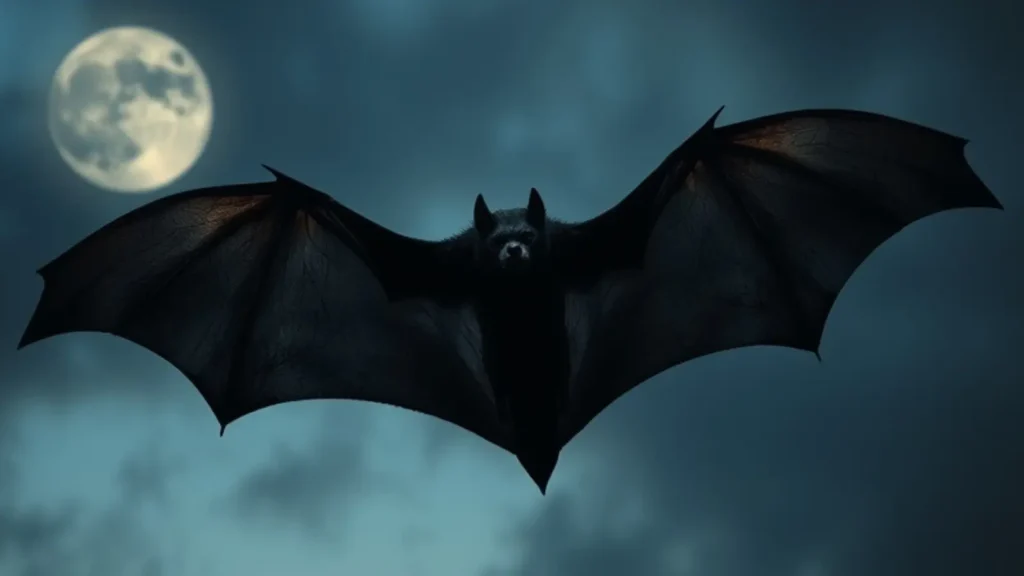
Many spiritual traditions interpret bats as symbols of transformation rather than fear.
Common spiritual meanings include:
Spiritual awakening
Old beliefs give way to greater understanding.
Rebirth
Personal growth often follows emotional endings.
Letting go
Bat symbolism encourages releasing outdated habits and limiting beliefs.
Intuition
Trusting inner wisdom becomes essential.
Shadow work
Many modern spiritual practices use bat symbolism to represent confronting hidden emotions with honesty and compassion.
These interpretations belong to symbolic and spiritual traditions rather than scientific research.
Bat Symbolism in Religion
Religious interpretations vary significantly.
Christianity
Biblical references often classify bats among unclean animals according to ancient dietary laws. Symbolically, some Christian traditions connected darkness with moral caution rather than the animal itself.
Buddhism
While bats play a smaller symbolic role, compassion toward all living beings remains central.
Taoism
Chinese Taoist traditions often celebrate bats as fortunate creatures connected with harmony and longevity.
Indigenous Spiritual Traditions
Many Indigenous belief systems interpret bats through relationships with nature, transformation, and seasonal cycles.
Bat Symbolism in Dreams
Dream interpretation is highly personal.
Common symbolic themes include:
| Dream Situation | Possible Symbolic Interpretation |
| Flying bat | Freedom during transition |
| Many bats | Overwhelming change |
| Peaceful bat | Trusting intuition |
| Bat leaving darkness | Personal growth |
| Injured bat | Emotional vulnerability |
| Baby bat | New beginnings |
Dream symbolism should not be viewed as prediction. Personal experiences and cultural background greatly influence dream meaning.
Bat Symbolism in Literature and Storytelling
Writers often use bats to create atmosphere and emotional depth.
Common literary themes include:
- Hidden identity
- Inner conflict
- Transformation
- Secrets
- Survival
- Wisdom
- Mystery
Modern authors increasingly portray bats as misunderstood rather than frightening, reflecting changing public attitudes.
Bat Symbolism in Art and Visual Culture
Artists use bats to communicate complex emotional ideas.
Examples include:
- Gothic paintings
- Traditional Chinese artwork
- Contemporary illustration
- Tattoo design
- Fantasy art
- Graphic novels
Because bats combine elegance, mystery, and motion, they remain visually compelling symbols.
Bat Symbolism in Branding and Design
Designers often choose bat imagery to communicate:
- Innovation
- Intelligence
- Mystery
- Protection
- Night vision
- Precision
- Stealth
Entertainment, gaming, technology, and sports brands sometimes use bat-inspired imagery to evoke agility and confidence.
The symbolic meaning depends heavily on visual style, color palette, and audience perception.
Bat Symbolism in Modern Media
Popular culture has reshaped public perceptions.
Today bats may represent:
- Superheroes
- Environmental conservation
- Wildlife education
- Scientific curiosity
- Ecological balance
As public awareness of biodiversity grows, bats are increasingly appreciated for their ecological importance rather than feared.
Did You Know?
🦇 Over 1,400 bat species exist worldwide, making bats one of the largest groups of mammals.
🦇 Many bats help pollinate flowers.
🦇 Fruit bats disperse seeds that support forest regeneration.
🦇 Insect-eating bats naturally reduce agricultural pests.
Their ecological roles have inspired symbolic associations with balance, renewal, and interconnected ecosystems.
Expert Tip
When interpreting bat symbolism, always consider cultural context.
The same bat may symbolize:
- Good fortune in one society
- Transformation in another
- Mystery elsewhere
- Fear in Gothic traditions
Avoid assuming that one symbolic meaning applies universally.
Common Mistakes About Bat Symbolism
Mistake 1: Assuming bats always symbolize evil
Many cultures celebrate bats as fortunate animals.
Mistake 2: Confusing folklore with biology
Symbolic beliefs differ from scientific understanding of bat behavior.
Mistake 3: Ignoring cultural diversity
Interpretations vary widely across history and geography.
Mistake 4: Treating symbolism as universal truth
Symbolism reflects shared cultural meanings rather than objective facts.
Myth vs. Fact
| Myth | Fact |
| Bats always symbolize death | Many cultures associate bats with happiness and prosperity. |
| Bat symbolism is negative everywhere | Interpretations vary widely across civilizations. |
| Spiritual symbolism is scientific evidence | Symbolism reflects beliefs and traditions, not scientific proof. |
| All bat imagery has identical meaning | Meaning depends on context, culture, and artistic intention. |
Practical Applications of Bat Symbolism
Understanding bat symbolism can benefit many fields.
Education
Teachers can compare cultural interpretations to explore diversity.
Branding
Designers can use bat imagery strategically depending on audience expectations.
Literature
Authors can build richer symbolic narratives.
Art
Artists communicate transformation, mystery, and resilience visually.
Psychology
Symbolic reflection may help individuals explore personal growth, though it is not a substitute for clinical practice.
Cultural Studies
Anthropologists examine how symbolic meanings evolve alongside social change.
Why Bat Symbolism Still Matters Today
Modern society increasingly recognizes bats as valuable ecological contributors.
This shift influences symbolic meaning.
Instead of representing fear alone, bats now symbolize:
- Environmental awareness
- Adaptation
- Biodiversity
- Sustainability
- Scientific discovery
- Resilience
Their symbolism continues evolving alongside human understanding.
Key Insights
- Bat symbolism varies dramatically across cultures.
- Transformation remains the most widespread symbolic meaning.
- Chinese traditions strongly associate bats with prosperity.
- Psychological interpretations often emphasize intuition and resilience.
- Modern symbolism increasingly reflects conservation and ecological awareness.
- Historical context is essential when interpreting symbolic meanings.
Conclusion
Bat symbolism is far richer and more nuanced than its popular reputation suggests. Across history, bats have represented transformation, intuition, prosperity, mystery, protection, renewal, and resilience.
While some traditions associate them with darkness or the unknown, many others celebrate them as powerful symbols of happiness, longevity, and good fortune.
Understanding these diverse interpretations helps us appreciate how symbolism reflects human culture rather than fixed truths.
Whether encountered in mythology, religion, psychology, literature, branding, or everyday art, the bat reminds us that meaning is shaped by history, belief, and perspective.
As our understanding of bats and their ecological importance continues to grow, their symbolic significance evolves as well, encouraging us to see beyond appearances and recognize the value of adaptation, balance, and transformation.

Lucas Whitmore reveals the hidden messages behind symbols, signs, and traditions through detailed symbolism guides.
