Flowers have always been more than beautiful objects. Across civilizations, people have used plants to communicate ideas that words sometimes struggle to express love, grief, hope, faith, courage, remembrance, renewal, and transformation.
Iris symbolism is particularly rich because the iris connects botanical beauty with Greek mythology, medieval art, religious imagery, heraldry, literature, gardens, and the Victorian language of flowers.
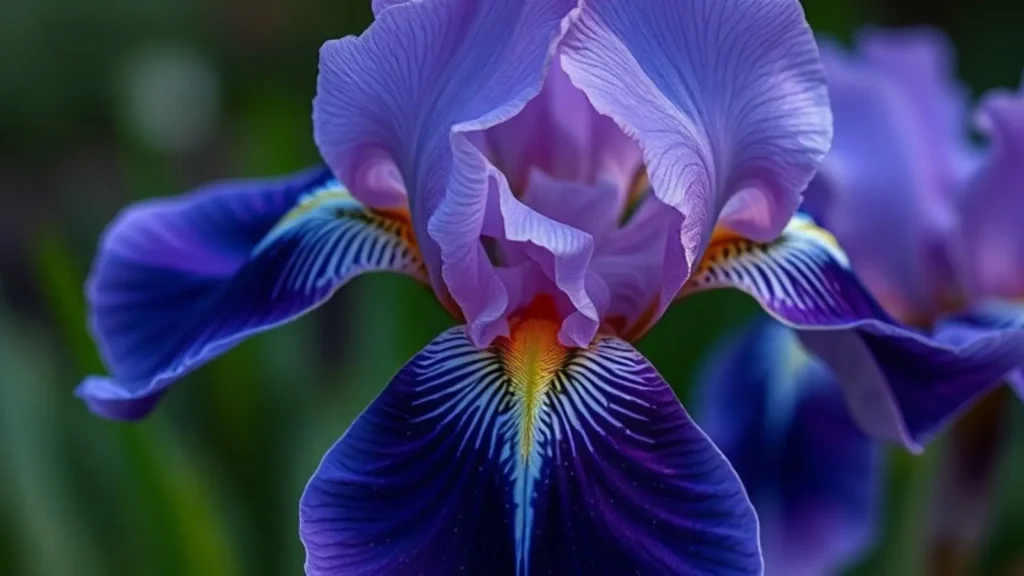
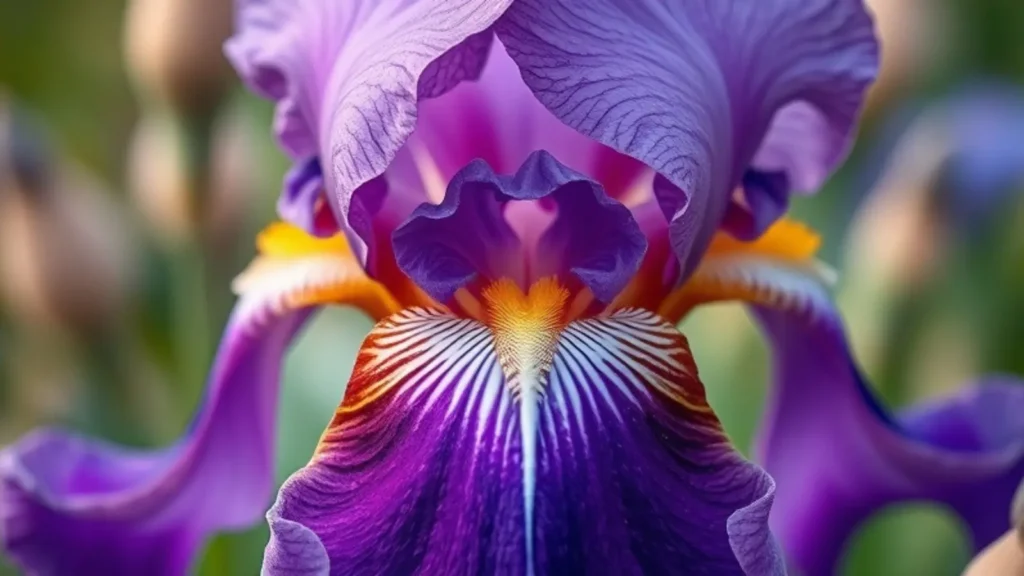
The iris is visually distinctive: three upright petals, three spreading or drooping falls, sword-like leaves, and an extraordinary range of colors.
Its name itself comes from Iris, the Greek goddess associated with the rainbow and divine messages, reflecting the flower’s long association with color, communication, and transition.
The Metropolitan Museum of Art notes that the genus was named for the Greek goddess because of the remarkable range of colors found among irises.
Featured-Snippet Answer: What Does the Iris Symbolize?
The iris commonly symbolizes hope, faith, wisdom, communication, remembrance, courage, and renewal. Its meanings vary by culture and historical period. Greek mythology connects it with divine messages and the rainbow, while Christian traditions associated its three-part flower structure with the Trinity. In art and design, its distinctive form can suggest dignity, spirituality, beauty, and transformation.
What Does Iris Symbolism Mean?
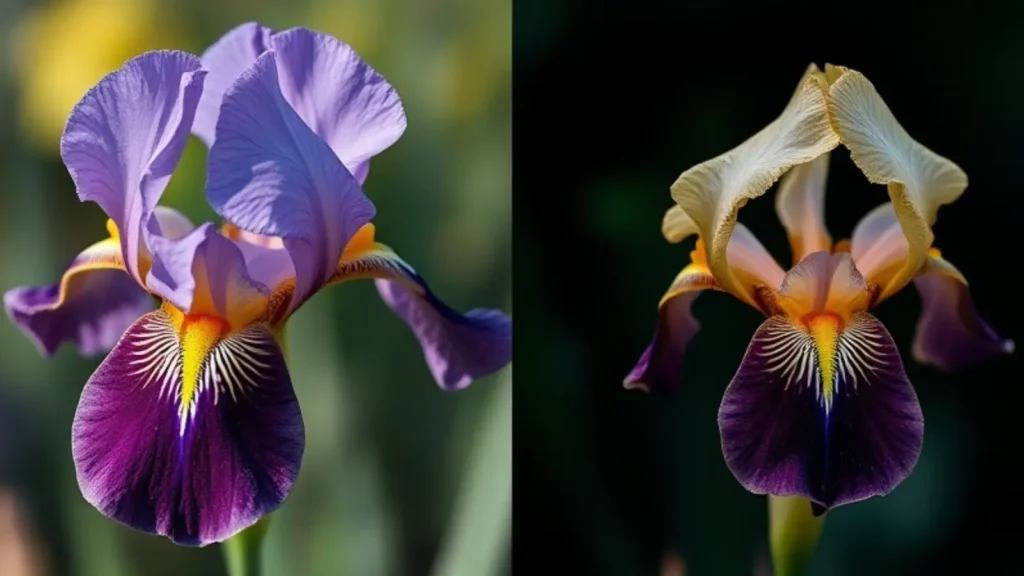
At its broadest, iris symbolism represents communication between worlds, hope after difficulty, wisdom, faith, remembrance, and transformation.
There is no single universal definition. Symbolism develops through stories, religious traditions, artistic conventions, language, color associations, and social customs. Consequently, an iris in a Greek myth does not necessarily communicate exactly the same idea as an iris in a medieval manuscript, Victorian bouquet, modern tattoo, or contemporary brand identity.
Several symbolic themes repeatedly appear around the flower:
- Communication — connected to Iris, the divine messenger of Greek mythology.
- Hope and renewal — reinforced by its emergence as a seasonal garden flower.
- Faith and spirituality — especially through Christian artistic interpretations.
- Wisdom — a modern symbolic association often linked with purple and blue irises.
- Remembrance — particularly appropriate in memorial and cemetery contexts.
- Courage and strength — visually reinforced by the flower’s upright form and sword-like foliage.
- Royalty and dignity — especially through the historical association of iris-like forms with heraldry and the fleur-de-lis.
- Transformation — suggested by the rainbow connection and the flower’s wide range of colors.
These meanings overlap rather than existing as isolated definitions.
The Historical Origins of Iris Symbolism
Iris in Ancient Greek Culture
The oldest major symbolic association comes from Greek mythology.
Iris was a divine messenger associated with the rainbow. The rainbow itself was understood as a bridge or pathway between the realm of the gods and humanity. Because the botanical genus Iris was named after this goddess, the flower inherited a powerful conceptual relationship with messages, transition, color, and connection.
This gives iris symbolism an unusual depth. The flower is not simply associated with beauty; its name carries a mythological idea of movement between different realms.
The rainbow also explains why the iris became particularly suitable as a symbol of diversity and visual richness. Irises occur naturally and through cultivation in many colors, including blue, purple, white, yellow, pink, and combinations of these shades.
Did You Know?
The genus name Iris is directly connected to the Greek goddess of the rainbow. The enormous variety of iris colors makes that mythological name especially fitting.
Iris Symbolism in Mythology and the Idea of Divine Messages
Mythological symbolism often turns ordinary natural objects into bridges between human experience and the supernatural.
Iris, as a messenger figure, makes the flower especially relevant to ideas such as:
message → connection → transition → guidance → hope
This symbolic chain explains why the iris can work so effectively in storytelling.
For example, an artist portraying an iris beside a letter, doorway, road, rainbow, or dawn can subtly reinforce the idea that something is being communicated or transformed.
The symbolism does not require the viewer to know the mythology consciously. Cultural symbols can operate through visual familiarity as well as explicit knowledge.
From a semiotic perspective, the iris therefore functions as more than an ornamental flower. It can become a sign representing an idea beyond the physical object.
Iris Symbolism in Christianity and Religious Art
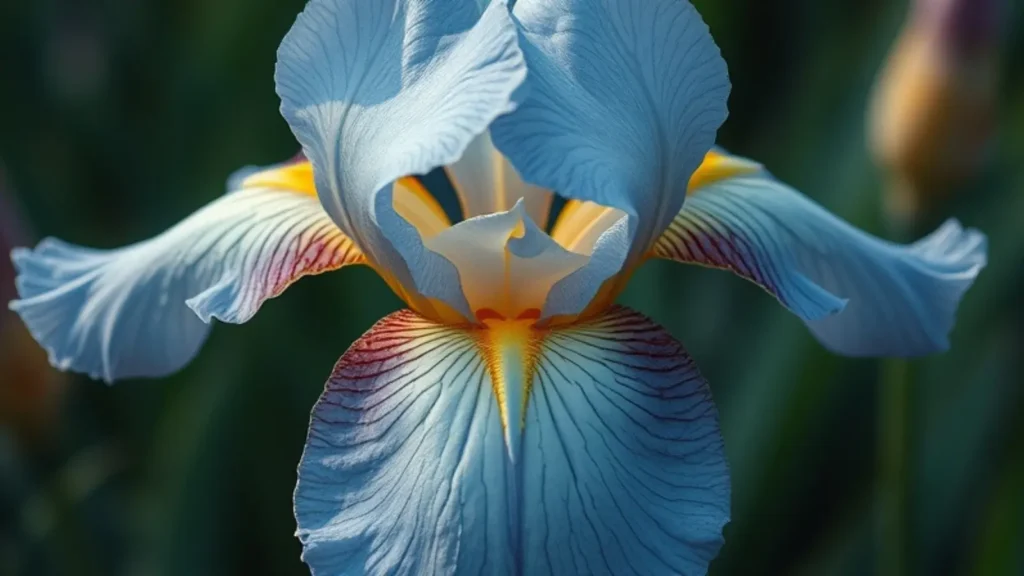
The iris also developed religious associations in Christian visual culture.
The Royal Horticultural Society records a longstanding interpretation of the iris’s three-part flower structure as a symbol of the Holy Trinity. It also notes traditions involving irises and burial places in both Greek and Muslim contexts.
This is important because religious symbolism should not be treated as one fixed universal code. Different Christian artists, regions, and periods could use flowers differently.
Nevertheless, the iris’s tripartite structure naturally encouraged symbolic interpretation:
- three petals or standards,
- three falls,
- one unified flower.
That visual relationship can evoke the theological concept of three-in-one.
Iris and Spiritual Reflection
Because flowers appear, bloom, fade, and return seasonally, they have long provided visual metaphors for mortality and renewal.
An iris can therefore appear appropriate in:
- memorial gardens,
- religious artwork,
- cemetery plantings,
- devotional imagery,
- contemplative spaces,
- spiritual writing.
Its symbolism becomes especially powerful when paired with ideas of resurrection, remembrance, passage, or eternal hope.
Iris Symbolism in the Middle Ages
The medieval period gave the iris additional practical and artistic significance.
The Metropolitan Museum of Art’s Cloisters Gardens documents several irises associated with medieval gardens, including Iris germanica, Iris pallida, and orris. Their colors ranged from blue-white through deep violet.
The plant was not merely decorative.
Iris rhizomes, particularly orris, had uses connected with fragrance, while iris pigments were also used in medieval artistic production. The Met notes that crushed blue or purple iris petals could be combined with alum to create a green pigment used in manuscript illumination.
This creates an interesting intersection of symbolism and material culture:
flower → fragrance → pigment → manuscript → religious/artistic communication
The iris therefore existed simultaneously as a living plant, useful material, artistic motif, and symbolic object.
Iris Symbolism and the Fleur-de-Lis
One of the most famous symbolic associations connected with the iris is the fleur-de-lis.
The relationship between the fleur-de-lis and the botanical iris is complicated, and it should not be reduced to the statement that every fleur-de-lis is literally an iris flower. The stylized emblem has a long heraldic history and has been interpreted in different ways.
The Royal Horticultural Society notes that the stylized fleur-de-lis became an emblem of the French monarchy from the 12th century and also appears in the arms of Florence.
The Metropolitan Museum of Art likewise records the association of an iris with Florence, including the city’s historic emblematic use of a white iris against red and its later reversal of colors.
What Does This Add to Iris Symbolism?
Heraldic associations introduce ideas of:
- authority,
- nobility,
- dignity,
- heritage,
- identity,
- sovereignty,
- prestige.
This is one reason stylized iris-like imagery can still feel formal or regal in contemporary visual communication.
Iris Symbolism by Color
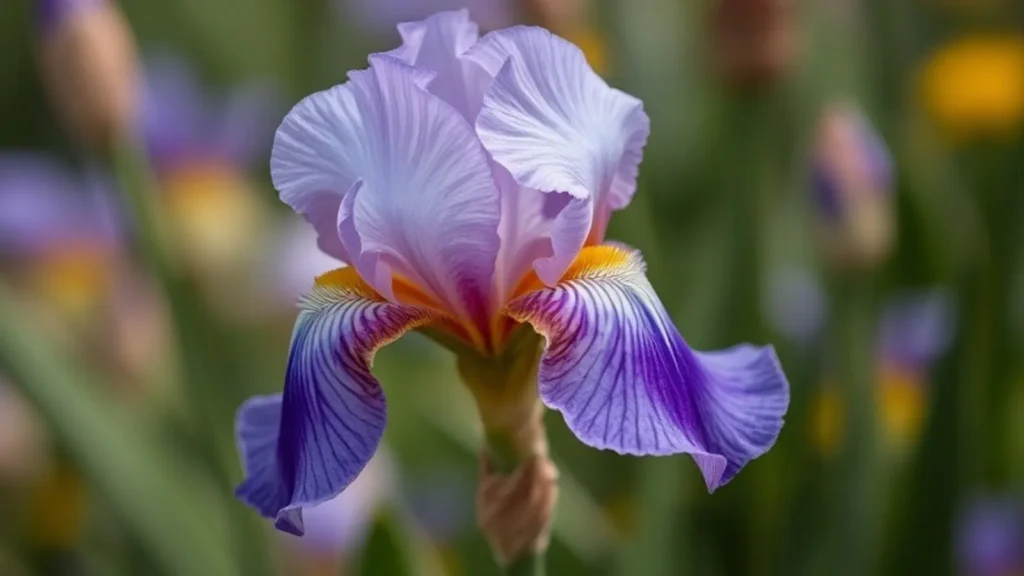
Color dramatically changes how an iris may be interpreted.
However, color meanings are context-dependent rather than universal psychological laws. A purple iris in a garden does not automatically communicate one fixed emotion.
| Iris Color | Common Symbolic Associations | Useful Contexts |
| Purple | Wisdom, dignity, spirituality, admiration | Art, gifts, gardens |
| Blue | Faith, tranquility, hope, communication | Spiritual or reflective settings |
| White | Purity, remembrance, peace | Memorials, weddings, religious settings |
| Yellow | Energy, affection, warmth | Celebrations and expressive arrangements |
| Pink | Affection, tenderness, appreciation | Personal gifts and decorative design |
| Mixed colors | Diversity, complexity, transformation | Art, branding, storytelling |
The safest approach is to treat these meanings as symbolic conventions, not scientific facts.
The RHS’s educational material, for example, specifically records yellow iris as associated with the “flame of love” in the Victorian-style language of flowers.
Purple Iris Symbolism
Purple is arguably the color most strongly associated with the visual identity of the classic iris.
Because purple has historically been associated in many cultures with prestige, spirituality, mystery, and nobility, a purple iris can naturally acquire similar connotations.
A purple iris may therefore suggest:
wisdom + dignity + mystery + spiritual depth + admiration
This makes it especially effective in paintings, gardens, memorial arrangements, and symbolic photography.
Yet context remains crucial. A florist may use purple simply because the recipient likes the color, while an artist may intentionally use it to create an atmosphere of mystery.
Blue Iris Symbolism
Blue irises often evoke:
- calm,
- faith,
- serenity,
- reflection,
- trust,
- hope.
Blue also has strong associations with sky and water, making it useful for symbolic compositions involving openness, transcendence, or emotional depth.
In visual storytelling, a blue iris against a dark background can produce a very different emotional effect from the same flower against bright yellow surroundings.
This illustrates an important principle of visual semiotics: meaning emerges from relationships, not isolated objects.
White Iris Symbolism
White commonly communicates purity, simplicity, peace, innocence, and remembrance in many modern Western contexts.
When an iris is used in memorial settings, its elegant shape can support themes of dignity and quiet reflection.
Historical traditions involving white irises in burial contexts have also been documented. The RHS notes the decoration of graves with white irises in some Muslim communities.
This should be understood as a cultural tradition rather than a universal religious rule.
Iris Symbolism in the Victorian Language of Flowers
The Victorian language of flowers, or floriography, is one of the most frequently cited sources for flower symbolism today.
During the 19th century, flowers were used to communicate coded sentiments through bouquets and floral arrangements. The RHS explains that the fashion grew from French sources and became particularly popular in Britain and America during the 19th century.
But there is an important scholarly caution here.
There was never one completely standardized dictionary of flower meanings.
Different books assigned different meanings to the same plants, and later authors sometimes modified earlier interpretations. The RHS’s historical research demonstrates how complicated and inconsistent this system could become.
Therefore, statements such as “the iris always means X in Victorian symbolism” should be treated carefully.
Iris Symbolism in Art
The iris has extraordinary artistic potential because of its combination of geometry and organic movement.
Artists can exploit:
- the three-part flower structure,
- vertical leaves,
- curved petals,
- strong color contrasts,
- repeated forms,
- dramatic silhouettes,
- botanical detail.
Vincent van Gogh and the Iris
One of the most famous modern artistic treatments of the iris is associated with Vincent van Gogh.
His iris paintings demonstrate how botanical imagery can become emotionally expressive rather than merely descriptive.
The flower’s repeated vertical forms and saturated colors create rhythm and movement. In this setting, the iris becomes part of a larger artistic language involving color, brushwork, nature, and emotion.
This is a useful lesson in symbolism: an object’s meaning can be transformed by composition and artistic context.
Iris Symbolism in Literature
Flowers frequently serve as literary metaphors because they can represent abstract ideas without explicitly naming them.
An iris can symbolize:
- a message,
- memory,
- transition,
- beauty,
- fragility,
- spiritual awakening,
- seasonal change,
- hidden knowledge,
- emotional complexity.
Writers can use the iris as a recurring motif. For example, an iris appearing at the beginning and end of a story could subtly frame a character’s transformation.
Unlike a dictionary definition, literary symbolism is intentionally open-ended. The author may establish a personal meaning that differs from traditional flower symbolism.
Iris Symbolism in Psychology and Human Perception
It is useful to distinguish symbolic psychology from scientific psychology.
There is no established psychological rule stating that seeing an iris automatically produces one universal emotional response.
However, human perception is highly sensitive to:
- color,
- symmetry,
- contrast,
- familiarity,
- natural forms,
- cultural associations,
- personal memories.
The iris has a particularly recognizable structure, and its vivid colors make it visually salient.
From a design perspective, that makes the flower useful as an emotional and symbolic cue.
A person who associates irises with a deceased relative may experience remembrance when seeing one. Another person may simply associate them with spring gardening.
Personal experience can therefore modify cultural symbolism.
Iris Symbolism Across Cultures and Traditions
Symbolism changes as flowers move across geographic and cultural boundaries.
| Context | Iris-Related Symbolism or Role |
| Ancient Greece | Rainbow, divine messenger, transition |
| Christian traditions | Trinity-related visual interpretation |
| Medieval Europe | Gardens, fragrance, manuscripts, religious/artistic culture |
| French heraldry | Fleur-de-lis and royal identity |
| Florence | Historic heraldic association with the iris |
| Some Muslim traditions | White irises associated with graves |
| Victorian floriography | Flower-based coded communication |
| Modern design | Elegance, wisdom, beauty, identity, remembrance |
This comparison reveals why “the meaning of iris” cannot be answered with one word.
Symbols are historical systems. Their meanings develop through mythology, religion, geography, art, language, politics, commerce, and personal experience.
Iris Symbolism in Branding and Visual Identity
The iris can be a powerful branding element because it combines natural beauty with cultural depth.
A brand using an iris might communicate:
- sophistication,
- creativity,
- heritage,
- intelligence,
- beauty,
- spirituality,
- individuality,
- refinement.
Expert Tip
If using an iris in branding, decide what the flower should communicate before selecting its color.
For example:
Purple iris + refined typography can suggest sophistication.
Blue iris + spacious layout can suggest calm and trust.
White iris + minimalist design can suggest purity and simplicity.
Multicolored iris + energetic typography can suggest diversity and creativity.
The symbol should support the brand’s actual identity rather than replace it.
Iris Symbolism in Gardens and Architecture
Garden design has always been capable of communicating ideas through plants.
Iris works particularly well in symbolic landscape design because its upright leaves provide architectural structure while the flowers introduce color.
The RHS describes irises as hardy garden plants capable of providing color year after year, with different types flowering in different seasons.
An iris garden can therefore communicate more than ornamental beauty.
It can create an atmosphere of:
- remembrance,
- tranquility,
- renewal,
- seasonal transition,
- natural elegance.
In memorial landscaping, the flower’s established cultural connections with remembrance and burial traditions can add another layer of meaning.
Iris Symbolism in Weddings and Relationships
Flowers used in weddings often carry symbolic associations even when couples do not consciously follow traditional floriography.
An iris can contribute themes of:
- admiration,
- faith,
- hope,
- beauty,
- new beginnings,
- emotional connection.
Because the Victorian language of flowers was historically used to encode personal messages, floral arrangements can still function as a form of nonverbal communication today—even if modern couples interpret the flowers more freely.
The best approach is to choose flowers according to both personal meaning and visual harmony.
Practical Applications of Iris Symbolism
Understanding iris symbolism can be useful beyond historical research.
1. Art and Illustration
Artists can use iris imagery to communicate transformation, memory, spirituality, or beauty.
2. Tattoo Design
An iris tattoo may represent personal growth, remembrance, wisdom, or a meaningful relationship.
3. Floral Gifts
The flower can convey admiration, affection, hope, or remembrance depending on color and occasion.
4. Memorial Design
White or purple irises can create an atmosphere of dignity and reflection.
5. Branding
Stylized iris imagery can communicate sophistication, creativity, heritage, or individuality.
6. Education
The iris provides an accessible way to teach mythology, botany, art history, symbolism, and cultural studies together.
7. Literature
Writers can use an iris as a recurring motif representing communication, memory, or transformation.
8. Photography
Iris flowers provide strong opportunities for color psychology, macro photography, portrait composition, and visual storytelling.
Common Mistakes When Interpreting Iris Symbolism
Mistake 1: Treating One Meaning as Universal
Symbolism varies across cultures and periods.
Mistake 2: Assuming Color Has One Fixed Meaning
Color symbolism depends heavily on cultural context.
Mistake 3: Confusing Tradition With Science
A symbolic belief is not automatically a scientifically established psychological effect.
Mistake 4: Treating the Fleur-de-Lis as Simply “the Iris”
The historical relationship is more complicated than a straightforward botanical identification.
Mistake 5: Ignoring Personal Meaning
Someone may associate an iris with a family member, childhood garden, funeral, wedding, or personal memory.
Myth vs. Fact: Iris Symbolism
| Myth | Fact |
| The iris has one universal meaning | Its meaning changes across cultures and periods |
| Every purple iris means wisdom | Purple carries different associations depending on context |
| Victorian flower meanings were standardized | Historical flower dictionaries often disagreed |
| Every fleur-de-lis is literally an iris | The heraldic emblem has a complex history |
| Flower symbolism is scientifically proven psychology | Much flower symbolism is cultural and interpretive |
Did You Know? Iris Symbolism Has a Material History
Iris symbolism is not limited to myths and paintings.
Medieval irises had practical applications as well. Orris rhizomes were valued for fragrance, and iris-related materials entered artistic practices. The Metropolitan Museum of Art records their role in medieval gardens and manuscript illumination.
This reminds us that historical symbols are often connected to everyday life. A plant could simultaneously be:
beautiful + useful + sacred + artistic + commercial
That combination helps explain why certain flowers become culturally powerful.
Iris Symbolism and Semiotics
From a semiotic perspective, an iris can operate at several levels.
Literal Level
It is simply a flowering plant belonging to the genus Iris.
Cultural Level
It carries associations inherited from mythology, religion, art, and tradition.
Personal Level
An individual attaches memories or emotions to it.
Communicative Level
A person deliberately uses it to send a message.
This layered structure explains why symbols remain useful even when people no longer know their historical origins.
A modern viewer may not know the story of the Greek goddess Iris, yet still perceive an iris as elegant, mysterious, spiritual, or emotionally significant.
Philosophical Meaning of the Iris
The iris can also support philosophical reflection because its symbolism repeatedly circles around boundaries and transitions.
The rainbow represents a connection between different realms.
A flower moves from bud to bloom and eventually fades.
A perennial plant returns across seasons.
A memorial flower connects the living with memories of the dead.
A message connects one person with another.
Seen this way, iris symbolism is fundamentally concerned with relationship and transition.
It asks us to consider how meaning moves between:
- nature and culture,
- life and memory,
- beauty and mortality,
- individual and community,
- human and divine,
- past and present.
Why Is Iris Symbolism Still Relevant Today?
Iris symbolism survives because modern communication is still highly visual.
People use flowers in:
- social media imagery,
- tattoos,
- logos,
- weddings,
- memorials,
- interior design,
- photography,
- fashion,
- gardens,
- illustrations,
- digital artwork.
The medium has changed, but the underlying human behavior has not.
People continue to use visual objects to communicate feelings and identities without stating them directly.
The iris is particularly adaptable because it carries multiple symbolic layers rather than one narrow message.
Key Insights About Iris Symbolism
- Iris symbolism has deep mythological roots. Its name connects it with Iris, the Greek rainbow goddess and divine messenger.
- Communication is one of its most meaningful symbolic themes.
- The flower has strong associations with transition and connection.
- Christian visual traditions connected its three-part structure with the Trinity.
- Medieval culture valued iris for both beauty and practical uses.
- Iris-related heraldry contributed associations with royalty and identity.
- Victorian floriography expanded flower symbolism but was never perfectly standardized.
- Color changes the emotional interpretation of the iris.
- Personal experience can be as influential as historical symbolism.
- Modern uses include art, branding, memorials, tattoos, gardens, literature, and digital communication.
Frequently Asked Questions About Iris Symbolism
What is the main symbolism of the iris?
The iris commonly symbolizes hope, faith, wisdom, communication, remembrance, courage, and transformation. Its mythological connection to Iris, the Greek rainbow goddess and messenger, makes communication and transition especially important themes. However, the exact meaning depends on culture, historical period, color, artistic context, and personal experience.
What does an iris symbolize spiritually?
Spiritually, an iris can represent faith, divine communication, transition, renewal, remembrance, and connection between earthly and spiritual realms. Some Christian traditions associated the flower’s three-part structure with the Holy Trinity. Such interpretations are religious and cultural traditions rather than universal scientific meanings.
What does a purple iris symbolize?
A purple iris is commonly associated with wisdom, dignity, admiration, spirituality, and mystery in modern symbolic interpretations. These associations are not universal rules, however. The meaning of purple can change according to culture, occasion, artwork, and personal interpretation.
What does a blue iris symbolize?
A blue iris can suggest faith, calmness, hope, trust, reflection, and emotional depth. Blue’s broader cultural associations with sky, water, tranquility, and openness can reinforce these interpretations.
What does a white iris symbolize?
A white iris can symbolize purity, peace, remembrance, innocence, and dignity. White irises have also appeared in burial traditions in some Muslim communities, demonstrating that their symbolism can become connected with remembrance and memorial practices.
Why is the iris associated with the rainbow?
The genus Iris was named after Iris, the Greek goddess associated with the rainbow, partly reflecting the remarkable range of colors found among iris flowers. This connection gives the flower symbolic associations with communication, divine messages, transition, and connection between realms.
Final Thoughts: The Enduring Meaning of Iris Symbolism
Iris symbolism is ultimately a story about connection.
From the rainbow messenger of Greek mythology to medieval gardens, religious imagery, heraldry, Victorian flower language, famous paintings, memorial gardens, branding, tattoos, and modern digital art, the iris has repeatedly been used to express ideas that go beyond the flower itself.
Its meanings are not fixed. They change with culture, color, historical period, artistic intention, and personal experience.
That flexibility is precisely what makes the iris such a powerful symbol.
It can represent a message arriving from somewhere distant, hope appearing after difficulty, a memory preserved through beauty, spiritual reflection, personal transformation, or simply the elegance of nature.
Understanding iris symbolism therefore means understanding more than a flower. It means examining how human beings turn color, shape, mythology, memory, and nature into language.

Nathaniel Brooks analyzes symbols, their origins, cultural importance, and psychological impact across history and modern society.
