William Golding’s Lord of the Flies is far more than a story about schoolboys stranded on an island. First published in 1954, the novel uses objects, characters, animals, natural elements, and recurring images to explore civilization, fear, power, violence, morality, and the darker possibilities of human behavior.
Symbolism in Lord of the Flies is therefore central to understanding what Golding is actually saying beneath the surface of the adventure story.
The boys do not simply find a shell; they create a political system around it. They do not merely fear a mysterious creature; their fear gradually becomes a mechanism of control.
Fire can represent rescue and civilization in one scene, yet destruction and death in another. The pig’s head becomes something more disturbing than a hunting trophy: it becomes an embodiment of the evil the boys imagine exists outside themselves.
Golding’s symbols work together rather than independently. The conch, glasses, fire, beast, Lord of the Flies, masks, island, and characters form a symbolic network that traces the boys’ movement from organized society toward violence and disorder.
Featured-Snippet Answer: What does symbolism mean in Lord of the Flies?
Symbolism in Lord of the Flies uses objects, characters, settings, and images to represent larger ideas about civilization, savagery, fear, power, morality, and human nature. The conch represents order and democratic authority, Piggy’s glasses represent reason and science, the signal fire represents rescue and civilization, while the Lord of the Flies represents humanity’s capacity for evil.
What Is the Main Symbolism in Lord of the Flies?
The main symbolism in Lord of the Flies centers on the conflict between civilization and savagery.
Golding turns the island into a kind of social experiment. Once the boys are separated from adult authority, familiar institutions become fragile. Rules exist only if people believe in them. Leadership works only when others recognize its legitimacy. Knowledge has influence only when people respect it. Fear can become politically powerful when people are desperate for protection.
The novel is commonly interpreted as an allegorical work in which characters and objects represent larger psychological and social forces. Ralph represents the impulse toward organization, Piggy represents intellect and rational thought, Jack represents domination and savagery, while Roger represents increasingly unrestricted violence.
This does not mean every symbol has one rigid definition.
A strong literary interpretation asks:
- What does the object represent?
- How does its meaning change?
- Who controls it?
- How do the boys respond to it?
- What happens when its symbolic authority disappears?
That last question is particularly important because Golding repeatedly shows that symbols are powerful only when people collectively believe in what they represent.
The Conch Shell: Symbol of Civilization, Democracy, and Order
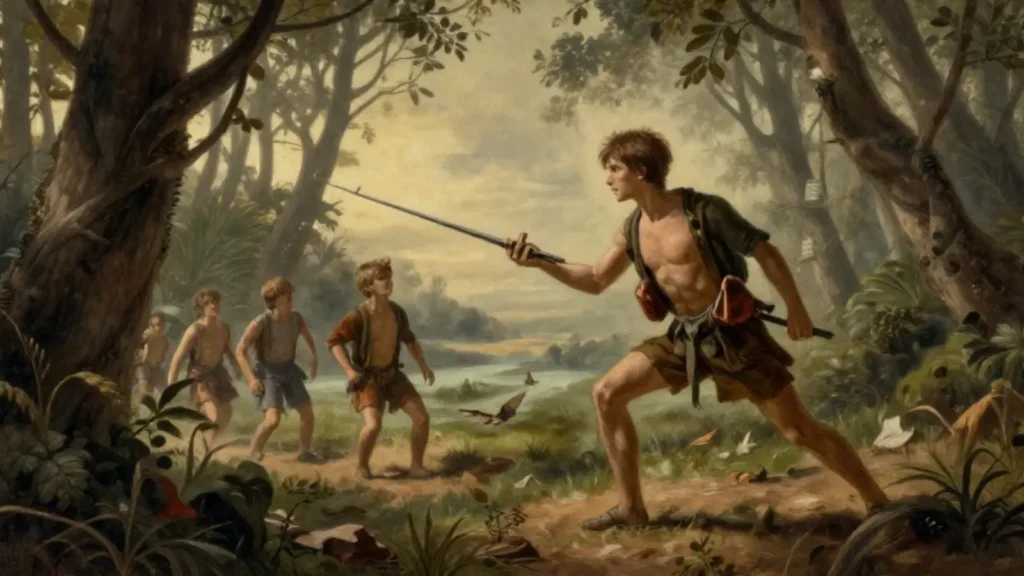
The conch is arguably the most recognizable symbol in the novel.
When Ralph and Piggy discover the shell, it becomes a practical communication device. Ralph blows it to summon the scattered boys, and it subsequently becomes associated with meetings, speaking rights, and collective decision-making.
What does the conch symbolize?
The conch symbolizes:
- Civilization
- Democracy
- Political legitimacy
- Order
- Communication
- Equal participation
- Rules and social authority
Its meaning develops throughout the novel.
At first, the conch seems almost magical. The boys respond to its call because they understand the social function behind it. Whoever holds it receives the right to speak, creating a miniature democratic procedure.
But Golding gradually exposes the weakness behind this system.
The conch has symbolic authority, not physical power.
It cannot force Jack to obey. It cannot stop Roger from becoming violent. It cannot protect Piggy. It cannot defeat fear.
Eventually, the conch is destroyed during Piggy’s death, symbolizing the collapse of the social order it represented.
Why is the conch important?
The conch demonstrates that civilization depends not merely on objects or laws but on collective consent.
A democratic system can create rules, but those rules require people willing to respect them.
That makes the conch more than a symbol of democracy. It becomes a symbol of democracy’s fragility.
Piggy’s Glasses: Intelligence, Science, and Civilization
Piggy’s glasses are another major symbol in Lord of the Flies.
At a literal level, the glasses help Piggy see. More importantly for the plot, they can concentrate sunlight and produce fire. This makes them essential to the boys’ attempts to maintain a signal fire.
Symbolically, they represent:
- Intelligence
- Scientific knowledge
- Rational thinking
- Technology
- Practical problem-solving
- Civilization
SparkNotes similarly identifies Piggy’s glasses with scientific reasoning and civilization, while also emphasizing their connection to fire.
The changing meaning of the glasses
The glasses become increasingly important as Jack’s group gains power.
When Piggy’s glasses are damaged, stolen, or controlled by others, the events represent more than an attack on one boy. They show the weakening of reason and the transfer of useful knowledge into the hands of people willing to use it for different purposes.
This creates one of Golding’s most interesting symbolic contrasts:
Knowledge itself is morally neutral; the people controlling it determine how it is used.
Fire created through scientific knowledge can help rescue the boys—or help Jack’s group cook meat and sustain its new social order.
The glasses therefore symbolize both human ingenuity and the vulnerability of knowledge when power becomes more important than reason.
The Signal Fire: Hope, Rescue, Civilization, and Destruction
Fire has deliberately contradictory symbolism.
Initially, the boys want fire because they believe a passing ship might see the smoke and rescue them. The signal fire therefore represents:
- Hope
- Rescue
- Connection to civilization
- Communication
- Future-oriented thinking
- Responsibility
But the boys’ first attempt to create it becomes uncontrolled, and a young boy disappears during the resulting blaze. Later, the signal fire goes out while Jack and the hunters are pursuing a pig, preventing a possible rescue opportunity.
Fire therefore develops into a double-edged symbol.
| Symbolic meaning | Positive side | Destructive side |
| Fire | Hope | Violence |
| Smoke | Rescue signal | Chaos |
| Technology | Human achievement | Weaponized power |
| Energy | Survival | Destruction |
| Civilization | Connection to society | Ability to destroy |
The irony becomes especially powerful at the end of the novel, when the fire associated with destruction also contributes to Ralph’s eventual rescue.
Golding refuses to make fire simply “good” or “bad.” Like knowledge, authority, and power, its meaning depends on how humans use it.
The Beast: Fear, the Unknown, and Inner Evil

The beast begins as a frightening possibility in the minds of the younger boys.
They imagine something dangerous living on the island. As fear spreads, the beast becomes increasingly important to the group’s psychology.
What does the beast symbolize?
The beast can represent:
- Fear of the unknown
- Psychological anxiety
- The primitive imagination
- Collective paranoia
- Human evil
- The tendency to externalize internal fears
The crucial revelation is that the boys’ greatest danger is not an external monster.
The supposed beast is connected to the dead parachutist, while Simon gradually understands the deeper truth: the terrifying force the boys fear is connected to themselves.
This makes the beast one of the novel’s most important psychological symbols.
The boys want evil to exist somewhere outside themselves because that explanation is easier to accept than recognizing their own capacity for violence.
The Lord of the Flies: Evil, Savagery, and the Dark Side of Humanity
The pig’s head mounted on a stick is the novel’s most disturbing symbol.
The title itself refers to this image.
The expression “Lord of the Flies” is connected to Beelzebub, traditionally associated with the devil in Judeo-Christian tradition; the phrase’s literal association with flies also evokes decay and dead matter.
What does the Lord of the Flies symbolize?
It represents:
- Evil
- Violence
- Savagery
- Moral corruption
- The instinct toward domination
- The darker side of human nature
The Lord of the Flies is especially important because Simon encounters it during a moment of profound psychological and symbolic significance.
The head seems to communicate the idea that the source of the boys’ problem is not merely the island.
It is within them.
That is why the symbol is more frightening than a conventional monster. A monster outside the human being can theoretically be defeated.
But if the “monster” represents an aspect of humanity itself, there is nowhere external to escape.
Simon and the Symbolism of Moral Insight
Simon is one of the novel’s most complex symbolic characters.
While Ralph is associated with organized civilization and Piggy with rational intelligence, Simon represents something different: moral and spiritual insight.
He is unusually sensitive to the natural world and capable of recognizing truths that the other boys struggle to accept.
Simon understands that the beast is not simply a physical creature.
His insight makes him symbolically important because Golding separates intellectual knowledge from moral knowledge.
Piggy can reason logically.
Simon can perceive psychologically and morally.
Both forms of understanding matter, but neither is powerful enough to stop violence once the group has abandoned its ethical boundaries.
Ralph: Civilization and Responsible Leadership

Ralph is not a perfect symbol of goodness.
Instead, he primarily represents the effort to preserve:
- Social organization
- Rules
- Rescue
- Cooperation
- Democratic leadership
- Responsibility
His authority initially comes from the conch and from the boys’ collective decision to make him chief.
But Ralph’s leadership becomes increasingly fragile.
Golding uses Ralph to demonstrate that civilization is not simply a natural condition. It requires continual effort.
Ralph must repeatedly remind the boys about shelters, meetings, fire, and rescue because the immediate excitement of hunting is more emotionally satisfying.
This creates a conflict between long-term responsibility and immediate gratification.
Jack: Power, Savagery, and Authoritarianism
Jack begins the novel as the leader of the choirboys, but he becomes increasingly obsessed with hunting and authority.
His symbolic role develops from disappointed leader to embodiment of domination.
Jack represents:
- Hunger for power
- Tribalism
- Violence
- Authoritarian leadership
- Fear-based control
- Rejection of democratic restraint
One of the most important contrasts is between Ralph’s authority and Jack’s power.
Ralph depends on agreement.
Jack increasingly depends on fear, rewards, punishment, and group identity.
This makes the novel relevant to political philosophy because Golding is exploring a basic question:
What happens when people prefer security and power over freedom and responsibility?
Roger: Violence Without Moral Restraint
If Jack represents the desire for power, Roger represents something even darker: violence released from social restraint.
Early in the story, Roger throws stones near a younger boy but deliberately avoids hitting him.
Why?
Because the rules of the world he came from still exist psychologically inside him.
As civilization weakens, that restraint weakens too.
Roger’s development therefore illustrates an important idea:
Civilization does not necessarily eliminate violent impulses; it can restrain them.
When the consequences disappear, behavior can change.
Roger eventually becomes one of the clearest representations of violence operating without meaningful moral limits.
Face Paint: Identity, Anonymity, and Transformation
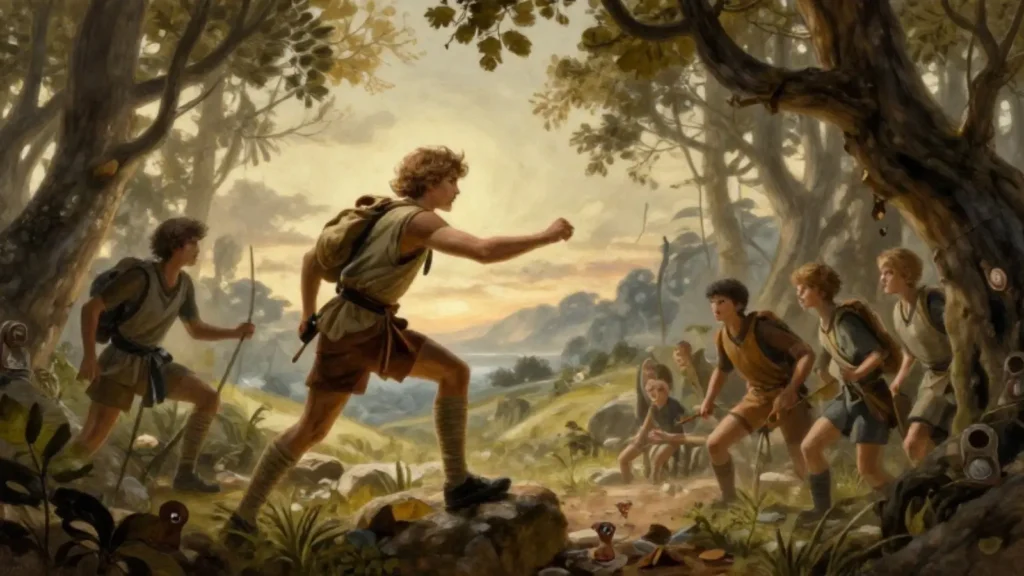
Jack’s hunters use face paint, which becomes another important symbol.
The paint allows the boys to hide their familiar identities.
This matters psychologically.
A boy who thinks of himself as a student, son, choir member, or English schoolboy carries social expectations.
A masked hunter can imagine himself differently.
Face paint symbolizes:
- Anonymity
- Transformation
- Group identity
- Loss of individual responsibility
- Liberation from social expectations
- Psychological distance from civilized behavior
This connects with a broader anthropological phenomenon: masks and costumes can change how people perceive social roles. But Golding uses the idea dramatically rather than claiming that masks automatically cause violence.
The boys use the paint as part of a new identity—and that identity makes behavior that once seemed unacceptable increasingly possible.
The Island: Paradise That Becomes a Social Experiment
The island initially appears beautiful.
It contains beaches, vegetation, water, food, and the possibility of freedom.
At first, the boys may interpret it as an adventure.
But the island gradually becomes a testing ground for human behavior.
Its symbolism can therefore be understood in two ways.
The island as paradise
It represents:
- Freedom
- Childhood adventure
- Natural beauty
- Escape from adult restrictions
The island as isolation
It represents:
- Separation from social institutions
- Lack of accountability
- Psychological pressure
- The breakdown of external authority
The island itself does not create the boys’ violence.
Instead, it removes many of the structures that previously restrained them.
The Pig: Hunting, Violence, and Dehumanization
Pigs are initially a source of food.
But hunting quickly becomes more than survival.
Jack and his hunters experience excitement, pride, and social status through killing.
The pig therefore becomes a symbol of the transformation of violence from necessity into entertainment and identity.
This distinction matters.
Hunting could theoretically be justified as a survival activity.
Golding instead shows how killing can become psychologically rewarding and socially prestigious.
The pig’s head then takes that process to its most disturbing symbolic level: the animal killed for food becomes an object representing the boys’ own violent impulses.
The Ocean: Separation and Isolation
The ocean surrounding the island is easy to overlook as a symbol.
It separates the boys from the adult world.
It represents:
- Isolation
- Uncertainty
- Distance from civilization
- The boundary between childhood and adult society
- The impossibility of simply walking home
The ocean also creates psychological confinement.
The boys may have freedom within the island, but they remain physically trapped by the surrounding water.
Symbolism of Clothing and the Loss of Civilization

Clothing in the novel also contributes to Golding’s symbolic design.
At the beginning, the boys are associated with recognizable social identities. As their society deteriorates, physical appearance changes.
The movement toward less formal clothing, hunting gear, body paint, and weapons visually communicates a movement away from their former identities.
This is an example of visual symbolism: readers can see the social transformation before every character fully understands it.
The external body becomes a reflection of internal change.
Major Symbols in Lord of the Flies at a Glance
| Symbol | Primary meaning | Deeper significance |
| Conch | Democracy and order | Fragility of legitimate authority |
| Piggy’s glasses | Reason and science | Knowledge can be controlled by power |
| Signal fire | Rescue and hope | Civilization can also create destruction |
| Beast | Fear | Evil is partly internal |
| Lord of the Flies | Savagery and evil | Humanity’s capacity for violence |
| Face paint | Anonymity | Loss of individual responsibility |
| Island | Isolation | Society without normal institutions |
| Pig | Hunting | Violence becoming pleasurable |
| Ocean | Separation | Physical and psychological isolation |
| Ralph | Civilization | Responsible but fragile leadership |
| Piggy | Reason | Vulnerability of intellect |
| Jack | Power and savagery | Authoritarian domination |
| Roger | Brutality | Violence without restraint |
| Simon | Moral insight | Recognition of inner evil |
How the Symbols Work Together
The real brilliance of Golding’s symbolism lies in the relationships between symbols.
Consider this progression:
Conch → rules → disagreement → fear → hunting → face paint → violence → destruction of conch
At the same time:
Glasses → fire → rescue → conflict → theft → control of fire
And:
Beast → fear → superstition → Jack’s authority → sacrifice → violence
These chains demonstrate that Golding is not simply attaching one meaning to each object.
Instead, symbols interact.
The conch loses power when people stop respecting it.
The glasses become politically valuable because they provide access to fire.
The beast becomes powerful because the boys believe in it.
The Lord of the Flies becomes meaningful because it gives physical form to the evil the boys are unwilling to recognize within themselves.
Historical and Cultural Context of the Symbolism
Golding wrote Lord of the Flies in the aftermath of World War II, a period deeply marked by mass violence, authoritarianism, genocide, and competing political ideologies.
The novel’s setting therefore carries historical weight.
The boys come from a supposedly civilized society, yet their behavior deteriorates rapidly after isolation.
Golding’s central question is uncomfortable:
If civilization is so powerful, why can it disappear so quickly?
The novel does not offer a simplistic answer.
It does not say that human beings are always violent.
Nor does it suggest that civilization is meaningless.
Instead, it explores the tension between social cooperation and destructive impulses.
The war mentioned in the opening chapters reinforces this irony: the adult world from which the boys have been separated is itself engaged in enormous violence.
The island is therefore not a completely different world.
It is a smaller reflection of the larger human world.
Psychological Meaning of the Symbols
From a psychological perspective, the novel’s symbolism repeatedly explores externalization.
The boys experience fear and uncertainty.
Instead of recognizing those emotions as internal psychological experiences, they project them onto the imagined beast.
This creates a feedback loop:
Fear → imagined threat → group anxiety → belief → social control → violence
Jack benefits from this cycle because fear increases his perceived importance.
If he can position himself as the protector against the beast, he gains authority.
This is one reason the symbolism remains relevant beyond literature classrooms.
Groups throughout history have sometimes used perceived threats to justify stronger leadership, exclusion, punishment, or violence. Golding’s novel dramatizes this dynamic without reducing every real-world political situation to the same pattern.
Religious and Biblical Connections
Religious symbolism is also important in Lord of the Flies.
The name “Lord of the Flies” has Judeo-Christian associations through Beelzebub, traditionally connected with Satan or demonic evil.
Simon also has characteristics that encourage readers to consider religious parallels, particularly his recognition of the truth about the beast and his sacrificial death.
However, readers should be careful about treating the novel as a simple Christian allegory.
Golding’s symbolism is richer than a one-to-one equation such as:
Simon = Jesus
or
Jack = Satan
Such comparisons can illuminate certain elements of the story, but they should remain interpretations rather than absolute meanings.
A stronger approach is to ask how Golding uses religious imagery to deepen questions about:
- Evil
- Sacrifice
- Temptation
- Fear
- Moral truth
- Human responsibility
Literary Symbolism and Allegory
Lord of the Flies is often described as an allegorical novel because characters and objects correspond to broader ideas.
But the novel is not merely a puzzle in which every character equals one concept.
The best interpretations recognize symbolic complexity.
For example:
Ralph
Primarily civilization and responsible leadership, but he is not morally perfect.
Piggy
Reason and science, but his intelligence does not automatically give him social power.
Jack
Savagery and authoritarian power, but his attraction to hunting also exposes the emotional appeal of immediate gratification.
Simon
Moral insight and compassion, but his goodness does not protect him from collective violence.
This complexity makes the symbolism more convincing.
Myth vs. Fact
Myth: Every symbol has exactly one meaning.
Fact: Golding’s symbols can carry several related meanings that evolve with the plot.
Myth: The conch simply represents “good.”
Fact: The conch represents order, democratic procedure, and legitimate authority—but Golding also shows how fragile these systems can be.
Myth: The beast is a literal monster.
Fact: The boys initially perceive it as a physical threat, but its deeper significance concerns fear and humanity’s capacity for evil.
Myth: Fire is always positive.
Fact: Fire represents rescue and civilization but can also cause destruction and death.
Myth: Jack is simply evil from the beginning.
Fact: Jack’s development is important. His behavior changes as hunting, power, fear, and group identity become increasingly dominant.
Common Mistakes When Analyzing Symbolism in Lord of the Flies
1. Listing symbols without explaining them
Saying “the conch represents democracy” is only the beginning.
A stronger analysis explains how the conch gains authority and why that authority eventually fails.
2. Ignoring changes in meaning
Symbols develop.
Fire is a particularly good example because its meaning changes according to context.
3. Treating characters as simple labels
Jack is not merely “evil,” and Ralph is not simply “good.”
Their behavior creates the symbolism.
4. Forgetting historical context
The novel’s concerns about civilization, violence, authority, and war become more meaningful when placed within its twentieth-century historical context.
5. Confusing interpretation with fact
Literary symbolism often allows multiple defensible interpretations.
A good essay should distinguish between what the text clearly establishes and what a critic reasonably infers.
Expert Tip: How to Write About Symbolism in an Essay
When analyzing a symbol, use this five-step method:
Symbol → Scene → Change → Meaning → Theme
For example:
Conch → meetings → declining authority → fragile democracy → civilization versus savagery
This produces much stronger literary analysis than simply naming the symbol.
A useful thesis might argue that Golding uses the conch not merely as a symbol of democracy but to demonstrate that democratic institutions depend on collective respect and cannot survive through symbolism alone when people abandon the values behind them.
Practical Applications of Symbolism Beyond Literature
Although Lord of the Flies is a novel, its symbolism can be useful for understanding modern communication.
Education
Teachers can use the conch to discuss:
- Democracy
- Classroom rules
- Leadership
- Group decision-making
- Social responsibility
Psychology
The beast can stimulate discussions about:
- Fear
- Projection
- Group psychology
- Moral responsibility
- Perceived threats
Political communication
Jack’s rise can be examined in terms of:
- Leadership
- Fear-based persuasion
- Group loyalty
- Authority
- Tribal identity
Branding and visual communication
The novel also demonstrates how objects acquire meaning through collective agreement.
A logo, flag, uniform, badge, or emblem can function similarly: the physical object is relatively simple, while its social meaning can be enormous.
Literature and storytelling
Golding demonstrates how recurring objects can carry narrative information without lengthy explanation.
The changing condition of the conch or glasses can communicate social deterioration visually.
Did You Know?
One of the most effective features of Golding’s symbolism is that many symbols begin as ordinary practical objects.
The conch is simply a shell.
The glasses are simply spectacles.
The fire is simply fire.
The pig’s head is initially a hunting trophy.
Their symbolic power emerges through human behavior.
That is a useful lesson about symbolism generally: symbols are often ordinary things that acquire extraordinary meaning through cultural, psychological, or narrative context.
Key Insights About Symbolism in Lord of the Flies
- The conch represents civilized authority, especially democratic participation and the right to speak.
- Piggy’s glasses symbolize reason, science, and technological knowledge.
- The signal fire represents rescue and connection with civilization, but it also becomes destructive.
- The beast represents fear and the human tendency to externalize evil.
- The Lord of the Flies represents inner savagery and evil.
- Jack represents the attraction of power and authoritarian control.
- Roger represents violence increasingly freed from social restraint.
- Simon represents moral and spiritual insight.
- Face paint symbolizes anonymity and transformation.
- The island represents both freedom and isolation.
- The destruction of the conch marks the collapse of civilized political order.
- The novel’s symbols work together rather than existing as isolated definitions.
Conclusion: Why Symbolism in Lord of the Flies Still Matters
The enduring power of Lord of the Flies comes partly from its ability to turn simple objects into complicated ideas.
A shell becomes democracy.
Glasses become knowledge.
Fire becomes both hope and destruction.
A pig’s head becomes a representation of evil.
A supposed beast becomes a reflection of human fear.
A painted face becomes a sign of psychological transformation.
Most importantly, Golding’s symbols show that civilization is not simply a collection of buildings, laws, uniforms, and institutions. It depends on people continuing to value cooperation, restraint, reason, empathy, and legitimate authority.
The destruction of the conch is therefore more than the breaking of a shell. It represents the destruction of an idea.
Likewise, Piggy’s death is more than the death of an individual. It dramatizes the collapse of reason and intellectual authority within the boys’ society. The novel’s final movement confirms the devastating consequences of that collapse.
Understanding symbolism in Lord of the Flies ultimately means understanding how Golding connects individual psychology with social organization. The symbols remain powerful because their questions are not confined to a fictional island: Who gets to speak? What makes authority legitimate? How does fear influence groups? What happens when rules lose their meaning? Can knowledge survive without social respect? And how easily can people surrender moral responsibility to a group?
Those questions explain why the novel continues to invite literary, psychological, philosophical, educational, and cultural interpretation.

Olivia Hartwell explores the hidden meanings behind symbols, animals, colors, dreams, and cultural traditions through insightful symbolism research.
