Fish symbolism is remarkably widespread because fish inhabit a world humans can see but cannot easily enter: water. They move beneath the surface, appear and disappear, travel in schools, survive in changing environments, and have provided food for human communities for thousands of years.
These qualities have made fish powerful symbols of life, abundance, transformation, fertility, spirituality, adaptability, mystery, prosperity, faith, and renewal.
Yet there is no single universal meaning of a fish. A koi may represent perseverance in Japan, paired fish may convey auspiciousness in Buddhist traditions, a fish may symbolize Christ in Christianity, while particular fish in ancient Egypt could carry associations with regeneration, sacredness, or taboo. Meaning depends on species, culture, historical period, visual context, and the beliefs of the person interpreting the symbol.
Fish symbolism in one sentence
Fish symbolism generally represents life, abundance, fertility, transformation, adaptability, spirituality, prosperity, and hidden knowledge, although its meaning changes across cultures. Because fish live in water and move beneath the surface, they are also frequently associated with mystery, intuition, emotional depth, renewal, and the unseen dimensions of existence.
What Does Fish Symbolism Mean?

At its broadest level, fish symbolism connects the natural behavior of fish with human ideas about existence.
A fish lives in water, an environment traditionally associated with birth, emotion, purification, mystery, and the unconscious. Fish therefore lend themselves naturally to symbolic interpretations involving hidden worlds and inner life.
Their ability to reproduce in large numbers has also contributed to associations with fertility and abundance. Their importance as food has connected them with nourishment, survival, prosperity, and community.
Meanwhile, a fish’s movement through water makes it a useful metaphor for adaptability. Unlike an animal walking across land, a fish appears to move through an entirely different element with effortless fluidity.
This produces several recurring symbolic themes:
| Fish symbolism | What it can represent |
| Water | Emotion, mystery, intuition, spiritual depth |
| Swimming | Adaptability, movement, freedom |
| Schools of fish | Community, cooperation, collective identity |
| Many fish | Abundance, fertility, prosperity |
| Koi/carp | Perseverance, courage, achievement |
| Goldfish | Beauty, tranquility, prosperity, paradise |
| Paired fish | Balance, auspiciousness, liberation |
| Christian fish | Christ, faith, salvation |
| Fish beneath the surface | Hidden knowledge or unconscious thought |
| Fish emerging from water | Renewal, transformation, rebirth |
The important point is that these meanings are symbolic associations rather than scientific properties. A fish does not inherently possess a universal spiritual meaning. Human societies create meaning around observable natural characteristics.
The Historical Evolution of Fish Symbolism
Fish symbolism developed partly because waterways were fundamental to early civilizations.
Rivers, lakes, seas, and wetlands provided drinking water, transportation, agriculture, and food. Fishing therefore occupied both practical and cultural roles. A creature that fed communities and lived in a mysterious environment naturally acquired symbolic significance.
Fish symbolism in ancient Egypt
Ancient Egyptian culture provides an especially interesting example because fish symbolism was not uniform.
The Nile was central to Egyptian civilization, and fish were both an important food source and a subject of religious representation. Some fish became associated with particular sacred traditions, while other fish could be regarded negatively in specific religious contexts.
The Nile tilapia, for example, was associated in some Egyptian representations with regeneration because of its mouth-brooding behavior. Archaeological evidence also demonstrates the ritual importance of fish, including fish amulets and mummified fish.
This reveals an important principle of symbolism: the same animal can simultaneously represent nourishment, sacred power, danger, fertility, or taboo depending on context.
Fish in Asian traditions
Across South and East Asian cultures, fish acquired numerous associations involving prosperity, spiritual awareness, perseverance, fertility, and good fortune.
In Buddhist visual culture, the pair of golden fish became one of the Eight Auspicious Symbols. The motif appears in Buddhist art across regions and later entered decorative traditions beyond strictly religious settings.
In China, fish imagery also became associated with abundance and good fortune. Whole fish served as an auspicious food during Lunar New Year celebrations, where the symbolism connects fish with abundance and prosperity.
Fish Symbolism Across Different Cultures
One of the most fascinating aspects of fish symbolism is how similar themes sometimes appear independently while the specific meanings remain culturally distinct.
Japan: Koi, Courage, Perseverance and Transformation
Few fish carry a stronger symbolic identity than the koi.
Japanese cultural traditions associate carp with qualities such as strength, resilience, courage, and advancement. The famous Dragon Gate story describes carp overcoming powerful currents and, in legend, transforming into dragons after successfully passing the waterfall. This narrative makes the fish a metaphor for overcoming obstacles and achieving transformation.
Koi therefore frequently symbolize:
- Perseverance
- Courage
- Personal growth
- Ambition
- Transformation
- Success after struggle
- Determination
This symbolism explains why koi imagery is common in gardens, paintings, decorative objects, tattoos, and contemporary visual culture.
Expert Tip
When interpreting koi symbolism, focus on movement and direction. A koi swimming upstream can emphasize struggle and perseverance, while a peacefully swimming koi may communicate harmony, patience, or emotional balance.
China: Fish, Prosperity and Auspiciousness

Fish have long held positive associations in Chinese visual culture.
Their symbolic connection with abundance is reinforced by linguistic and cultural associations surrounding prosperity. Fish also appear in decorative art alongside other auspicious motifs.
Paired fish are particularly important in Buddhist-derived Chinese decorative traditions. Museum collections show double-fish imagery incorporated into objects designed to communicate auspicious wishes, happiness, abundance, and spiritual symbolism.
Fish imagery may therefore communicate:
abundance → prosperity → good fortune → harmonious living
The exact meaning still depends on the species, composition, color, accompanying symbols, and historical context.
Buddhism: The Two Golden Fish
The two golden fish are among the Eight Auspicious Symbols associated with Buddhist traditions.
They are frequently interpreted in relation to freedom, auspiciousness, spiritual flourishing, and movement through existence. Their presence in Buddhist art demonstrates how an ordinary natural creature can become part of a sophisticated religious visual language.
The motif later spread into decorative arts across parts of Asia. Museum collections document paired fish among the Eight Auspicious Symbols in Chinese, Tibetan, and Central Asian objects.
Another Buddhist association comes from the perceived wakefulness of fish. Because fish have no visible eyelids, Buddhist and East Asian traditions have used fish imagery to symbolize alertness, vigilance, and wakeful attention. Fish-shaped Buddhist instruments such as the mokugyo embody this idea.
Fish Symbolism in Christianity
Perhaps the most recognizable religious fish symbol in Western culture is the Ichthys, often called the Christian fish.
The Greek word ichthys means “fish.” Early Christians associated the letters of the Greek word with the phrase commonly translated as Jesus Christ, Son of God, Savior. Fish imagery also connects with New Testament narratives involving Jesus, including the feeding of crowds and the calling of disciples as “fishers of men.”
Fish imagery also became connected with baptism and Christian ideas of spiritual rebirth.
Early Christian art used fish alongside other symbolic imagery, and fish appear in catacomb and funerary contexts. Art historians also identify fish symbolism in scenes involving Jonah, whose survival inside a great fish could be read as a prefiguration of death and resurrection.
Myth vs. Fact: Was the fish simply a secret Christian code?
Myth: Early Christians universally used the fish as a secret sign in the sand to identify one another during persecution.
More nuanced interpretation: The story is popular, but the historical evidence does not justify treating it as a universally established explanation for the symbol’s origin. The fish had multiple theological and scriptural associations, and the Ichthys acronym itself became an important Christian wordplay and symbol.
That distinction matters because historical symbolism is rarely as simple as a single origin story.
Fish Symbolism in Hindu Tradition
Fish also occupy an important place in Hindu religious thought through Matsya, the fish avatar of Vishnu.
Matsya is traditionally understood as Vishnu’s first avatar. In the flood narrative, Matsya helps preserve Manu and protects sacred knowledge through the catastrophe.
The Metropolitan Museum of Art’s collection includes an image of Matsya depicting Vishnu in fish form while rescuing Manu’s family and the Four Vedas from the Great Flood.
Here, the fish becomes associated with:
- Divine protection
- Preservation
- Rescue
- Cosmic renewal
- Survival through catastrophe
- Restoration of sacred knowledge
The symbolism is especially powerful because water is simultaneously the setting of danger and the environment through which salvation arrives.
Fish Symbolism in Psychology
Psychological interpretations of fish often begin with the symbolic meaning of water.
In many psychological and artistic traditions, water can represent emotional depth, uncertainty, unconscious material, or the unknown. A fish moving beneath the surface therefore becomes a compelling image for something that exists outside ordinary conscious awareness.
However, it is important not to present dream symbolism as a scientific diagnostic system.
If someone dreams about a fish, there is no scientifically established rule saying that the dream must mean prosperity, pregnancy, transformation, or spirituality.
Instead, interpretation should consider:
- The person’s emotional response to the fish.
- Whether the water was calm or threatening.
- Whether the fish was alive, dead, trapped, or free.
- Whether the person was observing or catching it.
- The individual’s cultural background.
- Personal memories involving fish or water.
A fish swimming peacefully may evoke freedom for one person and loneliness for another.
Why fish can feel psychologically powerful
Fish are visually fascinating because they belong to a world that humans cannot naturally inhabit.
We can observe them through glass or from the surface, but their environment remains partially inaccessible.
That visual separation makes the fish a natural metaphor for the unknown.
Fish Symbolism in Dreams
Fish dreams are frequently given spiritual or psychological interpretations, but these interpretations should be treated as personal symbolism rather than universal facts.
Common symbolic readings include:
- Swimming fish: emotional movement or adaptability
- Large fish: something psychologically significant or overwhelming
- Many fish: abundance, social connection, or emotional complexity
- Dead fish: loss, stagnation, or the end of a phase
- Fish in clear water: clarity or emotional awareness
- Fish in muddy water: uncertainty or confusion
- Catching a fish: achieving, discovering, or confronting something
- Fish escaping: missed opportunity or something difficult to control
The most useful question is not “What does a fish always mean?”
It is:
“What does this fish mean within the person’s emotional and cultural context?”
Fish Symbolism in Mythology and Folklore
Fish frequently appear in stories involving creation, floods, transformation, supernatural knowledge, and survival.
This is hardly surprising. Water itself has mythological importance in cultures throughout the world.
The sea can represent:
- Chaos
- Creation
- The unknown
- Danger
- Fertility
- Infinite possibility
- The boundary between worlds
A fish living within that environment can therefore function as a guide between ordinary reality and an unseen realm.
The fish’s ability to disappear beneath the water’s surface gives it a narrative quality that land animals often lack. In storytelling, a fish can appear, vanish, transform, carry a message, grant a wish, or reveal hidden truth.
Fish Symbolism in Art

Artists have used fish for both obvious and subtle symbolic purposes.
Fish can serve as religious symbols, decorative motifs, metaphors for nature, or simply visual elements that create rhythm and movement.
Henri Matisse and the Goldfish
Modern art offers an excellent example through Henri Matisse’s fascination with goldfish.
Art-historical interpretations connect Matisse’s goldfish imagery with tranquility and an idealized paradise. The fish became part of a broader visual world involving gardens, water, color, and contemplation.
This demonstrates how symbolism can shift from traditional religion to modern psychological and aesthetic experience.
A goldfish does not have to represent a fixed doctrine. It can represent a state of mind.
Fish Symbolism in Literature
Fish are particularly useful literary symbols because they can operate on several levels simultaneously.
A writer might use a fish to represent:
- Freedom
- Captivity
- Survival
- Isolation
- Transformation
- Desire
- Mystery
- Nature
- Human vulnerability
- The struggle between individual and environment
A fish in a bowl can suggest confinement.
A fish in the open ocean can suggest freedom.
A fish pulled from water can represent displacement.
A school of fish can represent collective identity.
The symbolism depends heavily on narrative context.
Semiotic Perspective
From a semiotic perspective, the fish is both a signifier and a culturally constructed sign.
The physical animal is the signifier. The concept attached to it—faith, prosperity, transformation, abundance, or freedom—is the symbolic meaning.
Change the cultural context and the sign can change.
That is why responsible symbolic analysis avoids saying that “fish always mean X.”
Fish Symbolism and Color Psychology

Color can significantly modify the meaning of fish imagery.
| Fish color | Common symbolic associations |
| Gold | Wealth, prosperity, value, illumination |
| Red | Passion, vitality, courage, celebration |
| Black | Mystery, depth, power, protection |
| White | Purity, peace, spirituality |
| Blue | Calmness, water, trust, contemplation |
| Orange | Energy, warmth, creativity |
| Multicolored | Diversity, vitality, celebration |
These associations are not universal psychological laws. Color meanings are strongly influenced by culture, design conventions, personal experience, and context.
For example, goldfish can visually communicate luxury or prosperity in branding, while the same fish can simply communicate peacefulness in an interior-design setting.
Fish Symbolism in Branding and Visual Communication
Fish are exceptionally useful in branding because they can communicate several ideas without requiring words.
A seafood business might use a fish literally.
A financial company might use a fish metaphorically to suggest abundance or flow.
An environmental organization might use a fish to communicate conservation.
A wellness brand might combine fish and water to suggest calmness.
A religious organization may use the Ichthys to immediately communicate Christian identity.
Practical Applications
Fish imagery can work particularly well for:
- Seafood businesses
- Aquariums
- Fishing organizations
- Environmental campaigns
- Travel brands
- Wellness businesses
- Water-related companies
- Spiritual organizations
- Children’s education
- Japanese-inspired design
- Asian cultural products
- Art and tattoo concepts
Expert Tip
Don’t select a fish symbol simply because it “looks beautiful.” Ask what the image communicates in the audience’s cultural context.
A koi may communicate perseverance to one audience but simply appear decorative to another.
Fish Symbolism in Tattoos
Fish tattoos are popular because the symbol allows for highly personal interpretation.
A koi tattoo may represent overcoming adversity.
A fish skeleton may represent mortality, memory, or transformation.
A pair of fish may represent partnership or balance.
A Christian fish may express religious identity.
A colorful tropical fish may symbolize individuality, freedom, or a love of nature.
The direction of movement can also matter aesthetically. A fish moving upward can visually suggest progress, while one swimming downward can suggest descent, introspection, or exploration.
The most meaningful tattoo symbolism is usually personal rather than dictionary-based.
Common Mistakes When Interpreting Fish Symbolism
1. Assuming one meaning applies everywhere
Fish symbolism varies enormously between cultures.
2. Treating folklore as historical fact
A popular legend may be culturally meaningful without being historically documented.
3. Confusing modern symbolism with ancient symbolism
A contemporary logo may use a fish for completely different reasons than an ancient religious image.
4. Ignoring the species
Koi, salmon, tilapia, goldfish, sharks, and other fish carry different associations.
5. Ignoring composition
Two fish, one fish, a fish in water, a fish in a bowl, and a fish emerging from water can communicate very different ideas.
6. Overinterpreting every fish image
Sometimes a fish is simply a fish.
Art interpretation should allow room for ambiguity.
Did You Know? Fish Symbolism Has a Built-In Paradox

Fish can symbolize freedom and captivity at the same time.
A fish swimming through a vast ocean can represent unrestricted movement. Yet the same creature placed inside a small aquarium becomes a symbol of confinement.
This contradiction makes fish particularly effective in literature and visual art.
The meaning comes not only from the animal but from its relationship with its environment.
Myth vs. Fact: Understanding Symbolic Meanings Responsibly
| Claim | Reality |
| Fish always symbolize prosperity | False; meanings vary by culture |
| The Christian fish has religious significance | Yes |
| Koi traditionally symbolize perseverance | Yes, particularly within Japanese cultural traditions |
| Fish are always positive symbols | No |
| Fish symbolism is universal | No |
| The two golden fish are Buddhist symbols | Yes |
| Fish dreams have one fixed meaning | No established scientific rule |
| Fish can symbolize fertility and abundance | Yes, in several cultural contexts |
| Every ancient fish image had religious meaning | No |
| Color changes symbolic interpretation | Often, but context matters |
The safest approach is to distinguish documented cultural symbolism, traditional belief, artistic interpretation, and modern personal meaning.
The Philosophical Meaning of Fish
Fish encourage a broader philosophical question:
What does it mean to belong to a world we cannot fully see?
Humans live primarily on land, yet much of the planet is covered by water. Fish inhabit a parallel environment that surrounds us but remains physically inaccessible without technology.
This makes the fish a powerful metaphor for perspective.
A fish knows its environment differently from a human observer.
In philosophical and literary terms, this can represent the limits of perception: we understand reality from within our own environment and experience.
The fish therefore becomes more than a symbol of water.
It can represent another way of being.
Fish Symbolism and Human Connection With Nature
Fish symbolism also reflects humanity’s dependence on aquatic ecosystems.
Historically, fish have been food, economic resources, religious objects, artistic subjects, and ecological indicators.
Modern environmental communication has therefore given fish another symbolic dimension: the health of water itself.
A fish struggling in polluted water can communicate environmental damage instantly.
A school of healthy fish can symbolize ecological balance.
In this sense, contemporary fish imagery can connect ancient symbolism with modern environmental awareness.
How Fish Symbolism Changes With Context
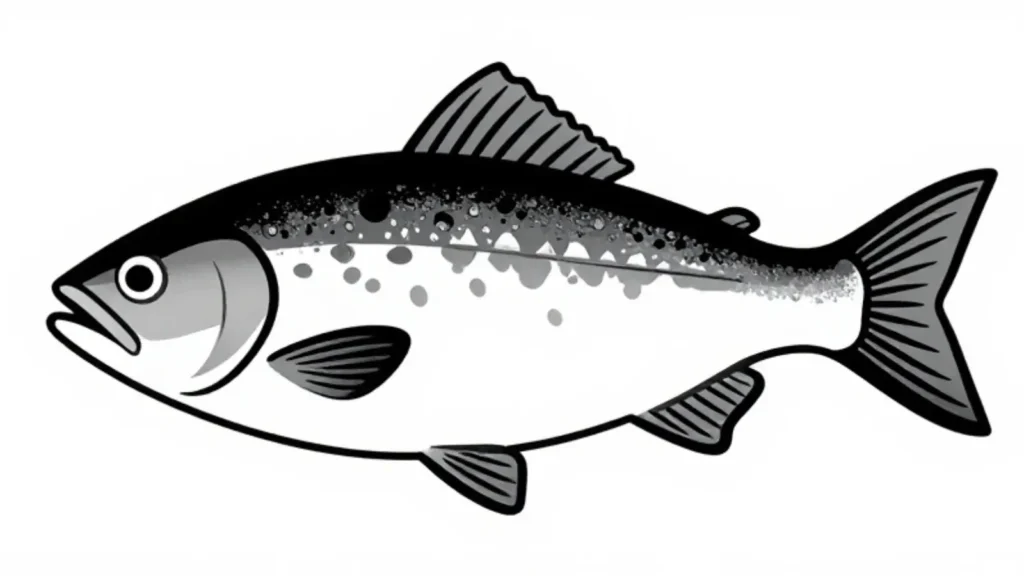
The same fish can communicate completely different meanings depending on where it appears.
Consider a koi:
In a Japanese garden:
It may suggest perseverance, beauty, and cultural tradition.
In a tattoo:
It may represent a personal struggle or achievement.
In a luxury hotel:
It may function primarily as an aesthetic symbol of calm and refinement.
In an environmental campaign:
It may represent aquatic ecosystems.
In a children’s book:
It may represent curiosity and adventure.
In a religious artwork:
Its meaning may be theological.
This is why symbolic interpretation requires contextual reading rather than keyword matching.
Practical Guide: How to Interpret Fish Symbolism
When you encounter fish imagery, ask seven questions:
- What species of fish is shown?
- What culture produced the image?
- What historical period does it belong to?
- What is the fish doing?
- What surrounds it?
- What colors are being used?
- What is the purpose of the image?
A religious icon, advertising logo, tattoo, children’s illustration, archaeological object, and contemporary painting should never automatically be interpreted using the same symbolic framework.
Key Insights About Fish Symbolism
The deepest lesson of fish symbolism is that meaning develops through relationships.
Fish relate to water.
Water relates to life and mystery.
Fish relate to food.
Food relates to survival and abundance.
Fish move in schools.
Schools relate to community.
Koi overcome currents.
Struggle becomes perseverance.
Fish disappear beneath the surface.
The unseen becomes mystery.
Christian fish imagery connects fish with scripture.
The symbol becomes faith.
This chain of associations explains why fish have remained culturally powerful for so long.
Frequently Asked Questions About Fish Symbolism

What is the main symbolism of fish?
Fish commonly symbolize abundance, fertility, prosperity, transformation, adaptability, spirituality, mystery, and renewal. However, there is no single universal interpretation. Meaning depends on the species, culture, religion, historical period, artistic context, and personal experience.
What does a fish symbolize spiritually?
Spiritually, fish may represent life, rebirth, spiritual transformation, hidden knowledge, faith, abundance, or movement through emotional and metaphysical depths. In Buddhism, paired fish form part of the Eight Auspicious Symbols, while Christianity uses the fish as an important symbol of Christ and faith.
What does a koi fish symbolize?
Koi commonly symbolize perseverance, courage, strength, achievement, and transformation. Their symbolism is closely associated with the traditional story of carp overcoming powerful currents and becoming dragons, making the koi a strong metaphor for overcoming adversity.
What does the fish symbolize in Christianity?
The Christian fish, or Ichthys, is associated with Jesus Christ and Christian faith. The Greek word ichthys means fish and was interpreted as an acronym for “Jesus Christ, Son of God, Savior.” Fish symbolism also connects with biblical stories involving Jesus, disciples, food, baptism, and salvation.
What do two fish symbolize?
Two fish can represent different ideas depending on the tradition. In Buddhist iconography, the paired golden fish are among the Eight Auspicious Symbols. In Chinese decorative art, paired fish can also communicate auspiciousness, happiness, abundance, and good fortune.
What does a fish symbolize in dreams?
There is no scientifically established universal meaning for dreaming about fish. Symbolic interpretations may associate fish with emotions, intuition, hidden thoughts, transformation, abundance, or freedom, but personal experience and cultural background are more useful than a fixed dream dictionary.
Key Takeaways
- Fish symbolism is culturally diverse, not universal.
- Fish frequently represent life, abundance, fertility, transformation, adaptability, and mystery.
- Water gives fish an especially strong connection with emotion, spirituality, the unknown, and renewal.
- Koi are strongly associated with perseverance and transformation in Japanese cultural traditions.
- Paired golden fish are important in Buddhist symbolism and later Asian decorative traditions.
- The Christian Ichthys connects fish imagery with Christ, faith, salvation, baptism, and biblical narratives.
- Matsya, Vishnu’s fish avatar, connects fish with divine protection, preservation, and survival through the flood.
- Fish imagery remains powerful in art, literature, tattoos, branding, religion, environmental communication, education, and digital media.
- Symbolic interpretation should distinguish historical evidence, cultural tradition, artistic interpretation, and personal belief.
Semantic Entities, NLP Concepts, LSI Keywords & Topical Relationships

Major Semantic Entities
Fish, koi, carp, goldfish, tilapia, Ichthys, Matsya, Vishnu, Christianity, Buddhism, Hinduism, Japan, China, ancient Egypt, Nile River, Asian art, Buddhist Eight Auspicious Symbols, Christian iconography, mythology, folklore, psychology, semiotics, literature, visual communication, branding, environmental symbolism.
LSI and Contextual Keywords
- fish symbolism meaning
- fish spiritual meaning
- fish symbol meaning
- fish symbolism in Christianity
- koi fish symbolism
- koi fish meaning
- fish symbolism in Buddhism
- fish symbolism in Hinduism
- fish symbolism in ancient Egypt
- fish symbolism in Chinese culture
- fish symbolism in Japanese culture
- two fish symbolism
- golden fish meaning
- fish symbolism in art
- fish symbolism in literature
- fish symbolism in dreams
- fish as a symbol of abundance
- fish as a symbol of transformation
- fish as a symbol of fertility
- fish as a symbol of prosperity
- fish spiritual symbolism
- Christian fish symbol
- Ichthys meaning
- Matsya avatar
- Buddhist fish symbol
- Eight Auspicious Symbols
- koi perseverance symbolism
- fish mythology
- fish folklore
- fish psychology
- fish semiotics
- aquatic symbolism
- water symbolism
- symbolic animals
- animal symbolism
- cultural symbolism
- religious symbolism
- visual symbolism
- color symbolism
Topical Relationships
Fish → water → life → fertility → abundance → renewal
Fish → movement → adaptability → resilience → transformation
Fish → hidden underwater world → mystery → intuition → unconscious
Koi → carp → perseverance → courage → Dragon Gate → transformation
Ichthys → Greek word for fish → Christ → faith → salvation → baptism
Two golden fish → Buddhism → Eight Auspicious Symbols → freedom → auspiciousness
Matsya → Vishnu → flood → preservation → sacred knowledge → renewal
Fish → visual culture → art → literature → branding → tattoos → digital communication
Final Perspective
Fish symbolism has survived because the fish itself sits at the intersection of several fundamental human experiences: water, food, survival, mystery, movement, reproduction, community, and transformation.
That combination makes fish unusually flexible symbols. They can represent prosperity in one cultural setting, spiritual vigilance in another, Christian faith in another, or personal perseverance in contemporary art and tattoo culture.
The most responsible way to understand fish symbolism is therefore not to search for one permanent definition. Instead, examine the fish within its culture, history, species, visual environment, religious tradition, and human purpose.
A fish swimming beneath the surface can be an animal, a source of food, a religious emblem, a metaphor for the unconscious, a symbol of prosperity, or an artistic device—all at once.
That layered quality is precisely why fish continue to fascinate human beings and why fish symbolism remains relevant across culture, religion, psychology, art, literature, branding, education, and everyday visual communication.

Amelia Rosewood writes about symbolic meanings, ancient traditions, and the emotional connections between humans and symbols.
