A bunny may look like a simple symbol of cuteness, but bunny symbolism reaches far beyond soft fur, long ears, and springtime decorations. Across different cultures and historical periods, rabbits and hares have been associated with fertility, abundance, vulnerability, agility, cleverness, renewal, the moon, innocence, and even mystery.
The meanings are not universal. A rabbit can represent good fortune in one tradition, a clever trickster in another, and vulnerability or fear in a different psychological or literary context. Understanding bunny symbolism therefore requires more than memorizing a list of meanings.
It means looking at history, folklore, religion, visual culture, psychology, literature, mythology, and the circumstances in which the rabbit appears.
Today, bunny imagery continues to influence everything from Easter celebrations and children’s books to fashion, branding, tattoos, emojis, advertising, home décor, and digital communication.
What Does Bunny Symbolism Mean?
Bunny symbolism generally represents fertility, new beginnings, abundance, innocence, agility, vulnerability, cleverness, and renewal. Because rabbits reproduce quickly and are highly alert animals, they have historically attracted associations with growth, life, sensitivity, and survival. Their meanings can also change according to cultural traditions, religious contexts, stories, colors, and individual experiences.
In other words, the bunny is a multivalent symbol: one image can communicate several ideas at once.
Why Are Bunnies Such Powerful Symbols?
The symbolic power of rabbits comes partly from their observable characteristics.
Rabbits are small prey animals with strong reproductive capacity, remarkable alertness, quick movement, and distinctive behavior. Humans have transformed these visible characteristics into cultural metaphors.
A rabbit can therefore become a visual shorthand for:
- Fertility because of its reproductive capacity
- Abundance because populations can increase rapidly
- Vulnerability because rabbits occupy a prey position in many ecosystems
- Agility because of their speed and evasive movement
- Cleverness because folklore frequently portrays small rabbits outsmarting stronger opponents
- Innocence because of their gentle appearance
- Renewal because rabbits became associated with spring and Easter traditions
- Mystery through lunar and supernatural folklore
- Curiosity through famous literary rabbit characters
- Transformation through stories in which following a rabbit leads into an unfamiliar world
This is an important principle in semiotics, the study of signs and meaning: the physical characteristics of an object can become cultural signs when communities repeatedly associate those characteristics with abstract ideas.
The Historical Evolution of Bunny Symbolism
Rabbit symbolism did not emerge from one single civilization. Instead, meanings developed through overlapping traditions, stories, artistic representations, religious imagery, and observations of the natural world.
One particularly important symbolic connection is between the rabbit or hare and the moon.
The famous “Moon Rabbit” tradition appears in several Asian cultures. In Chinese mythology, the Jade Rabbit is associated with the Moon and is traditionally depicted preparing an elixir of immortality. Related lunar-rabbit traditions appear elsewhere in East Asia.
The symbolism is especially interesting because the Moon itself is associated with cycles, disappearance and return, time, and renewal. A rabbit therefore becomes part of a larger symbolic system involving cycles of life, death, rebirth, and transformation.
The Three Hares Symbol
Another fascinating example is the Three Hares or Three Rabbits motif. Three animals appear in a circular arrangement, with their ears forming an unusual shared structure.
The motif has appeared in locations ranging from medieval European churches to Buddhist caves in China and objects associated with Islamic and Jewish contexts. Its exact original meaning remains uncertain, which is an important reminder that historical symbols should not automatically be assigned one universal interpretation.
Possible interpretations include:
- Continuity
- Cycles
- Interconnection
- Life and renewal
- Eternity
- Community
- The relationship between three entities
However, scholars and historians should distinguish documented usage from modern speculation about what the symbol “must” have meant.
Bunny Symbolism Across Different Cultures
There is no single global definition of the rabbit. Its meaning changes according to cultural history.
| Culture or tradition | Common rabbit-related association | Important context |
| China | Moon, longevity, immortality | Jade Rabbit lunar mythology |
| Japan | Moon, good fortune, seasonal imagery | Rabbit traditions include lunar folklore |
| Korea | Moon and lunar storytelling | Rabbit appears in traditional moon-related narratives |
| European folklore | Fertility, cleverness, spring | Meanings vary considerably by region |
| German tradition | Easter hare | Connected with the Osterhase tradition |
| African-American folklore | Cleverness and survival | Br’er Rabbit traditions |
| Christian visual culture | Purity or devotional symbolism in some contexts | Not a universal Christian doctrine |
| Modern Western culture | Cuteness, Easter, childhood, renewal | Strongly influenced by popular culture |
These differences demonstrate why cultural symbolism should be interpreted contextually rather than treated as a universal dictionary.
Bunny Symbolism in Chinese Culture
The rabbit has a particularly prominent place in Chinese lunar mythology.
The Jade Rabbit, or Yùtù, is traditionally associated with the Moon. In one familiar version of the legend, the rabbit prepares an elixir connected with immortality.
This creates a symbolic chain:
Rabbit → Moon → cycles → longevity → immortality
The image is therefore much more complex than the modern Western idea of a “cute bunny.”
The rabbit can represent endurance, lunar mystery, longevity, and transformation.
Bunny Symbolism in Japan
Japanese culture also contains important rabbit and Moon associations.
The Moon Rabbit is widely recognized in Japanese visual and folkloric traditions, where people may interpret markings on the lunar surface as the shape of a rabbit.
This is a good example of pareidolia: the human tendency to perceive familiar shapes in ambiguous visual patterns.
Interestingly, scientific and cognitive research has also explored why humans and even artificial vision systems may identify rabbit-like forms in the Moon’s surface patterns.
Symbolically, the Moon Rabbit connects the animal with:
- Lunar cycles
- Imagination
- Time
- Mystery
- Transcendence
- Seasonal change
Bunny Symbolism and Fertility
Perhaps the most familiar meaning of bunny symbolism is fertility.
Rabbits became associated with fertility partly because of their reproductive biology. This observable characteristic made them a natural metaphor for multiplication, growth, and abundance. Historical and modern discussions of rabbit symbolism repeatedly identify fertility and new life as major themes.
However, it is useful to avoid turning this into an oversimplified claim that “rabbits always meant fertility.”
The same animal can represent very different ideas depending on the story surrounding it.
For example:
- A rabbit in a spring festival may suggest renewal.
- A rabbit escaping a predator may symbolize survival.
- A rabbit in a children’s story may represent curiosity.
- A rabbit in a lunar myth may suggest immortality.
- A rabbit in a trickster tale may symbolize intelligence.
Expert Tip: When interpreting an animal symbol, start with the surrounding narrative rather than the animal alone.
Bunny Symbolism and Innocence
The modern bunny is strongly associated with innocence.
Its rounded body, soft appearance, large eyes, small nose, and gentle movements can trigger associations with vulnerability and childhood.
This connects with a psychological concept often discussed in visual design: baby-schema features. Features such as relatively large eyes and rounded forms can increase perceptions of cuteness and care-related responses.
This helps explain why bunny imagery is common in:
- Children’s products
- Nursery décor
- Storybooks
- Plush toys
- Greeting cards
- Baby clothing
- Easter decorations
- Cute digital stickers
- Character design
The symbolic meaning is therefore partly cultural and partly connected to how humans respond to certain visual characteristics.
Bunny Symbolism and Cleverness
The rabbit is not always portrayed as innocent.
In folklore, rabbits frequently become tricksters.
A famous example is Br’er Rabbit, a figure in African-American storytelling traditions. The character survives not because he is physically powerful, but because he uses intelligence, improvisation, and strategy.
This creates an important symbolic contrast:
The rabbit can be physically vulnerable but intellectually powerful.
That contrast is one reason rabbit characters work so effectively in storytelling.
The small animal can represent the underdog who survives by thinking rather than overpowering.
Bunny Symbolism in Literature
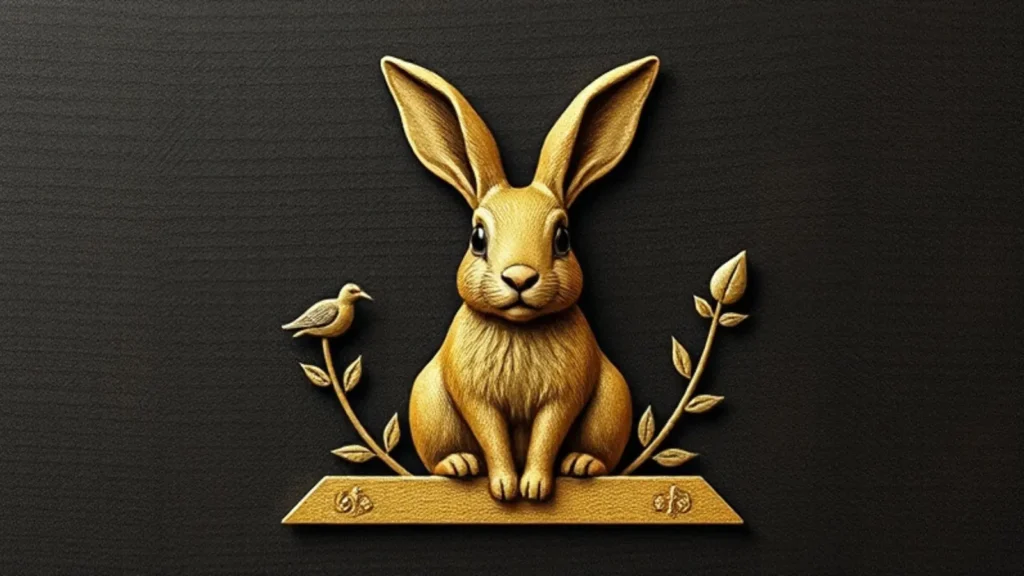
Literature has transformed the rabbit into one of the most recognizable animal archetypes.
Alice’s Adventures in Wonderland contains the famous White Rabbit, whose hurried movements and mysterious behavior initiate Alice’s journey into Wonderland.
The White Rabbit can therefore symbolize:
- Curiosity
- Time
- Urgency
- Following the unknown
- Transition
- Adventure
- The beginning of psychological transformation
Similarly, The Tale of Peter Rabbit uses a rabbit character to explore curiosity, disobedience, danger, and consequences.
In this context, the rabbit is not simply “cute.” Peter Rabbit embodies the tension between innocence and independence.
Richard Adams’s Watership Down takes the symbolism in another direction, using rabbits to explore leadership, community, survival, freedom, political organization, fear, and social responsibility.
This demonstrates how flexible rabbit symbolism can become in literature.
Bunny Symbolism in Art and Visual Culture
Artists have repeatedly used rabbits because the animal is visually recognizable and emotionally versatile.
A rabbit can be drawn realistically, anthropomorphically, humorously, spiritually, mysteriously, or abstractly.
Religious and Medieval Art
Rabbits and hares occasionally appear in European religious art. In some medieval and Renaissance contexts, rabbits were associated with purity or vulnerability, while in other contexts they could carry different or even contradictory meanings.
This is an important example of iconographic ambiguity.
A symbol’s presence does not automatically establish a single meaning.
Art historians therefore examine:
- Where the rabbit appears
- What objects surround it
- Who commissioned the artwork
- What period produced it
- Which visual conventions were used
- What textual sources influenced the artist
That method is more reliable than assigning a symbolic meaning from modern assumptions.
Bunny Symbolism in Religion and Spirituality
Rabbit symbolism sometimes appears in religious and spiritual interpretations, but these meanings should not be confused with universal religious doctrine.
In some Christian visual traditions, rabbits or hares have been interpreted in connection with purity, vulnerability, or spiritual themes. However, the Bible does not identify the Easter Bunny as a Christian symbol, and the modern Easter Bunny developed through later folklore and cultural traditions.
Spiritually, modern individuals may interpret a rabbit as a personal symbol of:
- New beginnings
- Gentleness
- Trust
- Sensitivity
- Intuition
- Growth
- Fertility
- Hope
- Adaptability
These are best described as contemporary spiritual interpretations, not universally established religious teachings.
The Easter Bunny: From Hare Folklore to Modern Tradition
The Easter Bunny is perhaps the most recognizable modern expression of bunny symbolism.
The historical story is more accurately described as an Easter hare tradition that became associated with German-speaking communities and later developed into the American Easter Bunny.
German immigrants brought the tradition to Pennsylvania. Historical documentation identifies the Pennsylvania Dutch form as Oschter Haws or Oster Haas, traditionally understood as an Easter hare. Children were encouraged to prepare nests in which the creature would supposedly leave colored eggs.
Over time, the tradition evolved.
The symbolic progression can be summarized as:
Hare → Easter folklore → children → colored eggs → spring → renewal → modern Easter Bunny
The transformation is an excellent example of cultural adaptation.
Myth vs. Fact
| Claim | More accurate interpretation |
| The Bible describes the Easter Bunny | False |
| The Easter Bunny is an ancient universal Christian symbol | Unsupported |
| German traditions influenced the American Easter Bunny | Well documented |
| The original figure was often a hare | Correct |
| Rabbits have long been associated with fertility | Historically widespread |
| Every rabbit symbol means fertility | False |
The Library of Congress documents the Pennsylvania German Easter Hare tradition and notes that the original term referred to a hare even though it was commonly rendered as “rabbit” in English.
Bunny Symbolism in Psychology
Psychological interpretations of rabbits depend heavily on context.
A rabbit may evoke feelings of:
- Safety
- Tenderness
- Vulnerability
- Alertness
- Curiosity
- Playfulness
- Anxiety
- Escape
This apparent contradiction is meaningful.
A rabbit is cute, but it is also a prey animal. It is gentle, but extremely alert. It may freeze, flee, or rapidly change direction when threatened.
Consequently, the rabbit can become a useful psychological metaphor for sensitivity combined with survival instinct.
Bunny Symbolism in Dreams
Dream interpretation should be approached carefully.
There is no scientifically established universal dictionary in which “rabbit in a dream” automatically means one particular thing. Dream imagery is influenced by personal memories, emotions, culture, recent experiences, and the dream’s narrative context.
A rabbit might therefore represent:
- Something vulnerable that needs protection
- A new opportunity
- Curiosity
- Fear or avoidance
- A desire for freedom
- Fertility or family, if personally relevant
- A childhood memory
- A cultural or spiritual association
The best interpretation comes from asking what the rabbit meant to the dreamer.
Bunny Symbolism in Branding and Marketing
Bunny imagery has enormous value in visual communication because it combines several desirable associations.
A brand may use a bunny to communicate:
- Friendliness
- Softness
- Youth
- Playfulness
- Innocence
- Nature
- Approachability
- Whimsy
- Gentleness
This is especially useful for brands targeting children, families, beauty audiences, lifestyle consumers, or customers who respond to nostalgic aesthetics.
But bunny symbolism can also create unintended meanings.
A rabbit may look:
- Too childish
- Too feminine
- Too playful
- Too seasonal
- Too Easter-specific
- Too soft for a serious product
Branding Example
Imagine two logos.
Logo A: A realistic rabbit silhouette with sharp geometric lines.
Possible associations:
- Nature
- Agility
- Speed
- Freedom
- Outdoor identity
Logo B: A rounded pastel bunny with oversized eyes.
Possible associations:
- Childhood
- Cuteness
- Comfort
- Innocence
- Playfulness
The animal has not changed. The visual language has changed.
That is a fundamental principle of semiotics and branding.
Bunny Symbolism in Colors
Color can significantly modify the meaning of bunny imagery.
| Bunny color | Common symbolic associations |
| White | Purity, innocence, peace, new beginnings |
| Black | Mystery, sophistication, night, transformation |
| Brown | Nature, earthiness, warmth, simplicity |
| Pink | Tenderness, affection, sweetness, femininity |
| Gray | Neutrality, subtlety, maturity |
| Gold | Luxury, prosperity, celebration |
| Blue | Calmness, trust, serenity |
| Red | Passion, energy, vitality |
These associations are contextual rather than universal rules.
For example, a black rabbit might represent mystery in a gothic design but simply be an ordinary animal in a natural-history illustration.
Bunny Symbolism in Tattoos
Rabbit tattoos can carry highly personal meanings.
Someone may choose a bunny to represent:
- A loved one
- Childhood
- Family
- Fertility
- New beginnings
- Resilience
- Gentleness
- Luck
- A favorite literary character
- A connection to nature
- A personal spiritual belief
The design can dramatically alter the interpretation.
A realistic rabbit may communicate a connection with nature, while a cartoon bunny may evoke childhood or nostalgia. A lunar rabbit may emphasize mystery, spirituality, and cyclical transformation.
Expert Tip: If a rabbit tattoo has personal significance, adding contextual elements—such as the Moon, flowers, stars, books, or seasonal imagery—can make the symbolism more specific than the animal alone.
Bunny Symbolism in Modern Digital Culture
The bunny has adapted remarkably well to digital communication.
Bunny emojis, stickers, GIFs, avatars, illustrations, and memes often communicate emotions without words.
In digital spaces, bunny imagery may suggest:
- Cuteness
- Affection
- Playfulness
- Shyness
- Softness
- Flirting
- Humor
- Whimsical identity
- Internet culture
The modern “cute” aesthetic demonstrates how visual shorthand works online.
A small bunny icon can communicate an emotional tone that would otherwise require several words.
Why Humans Find Bunny Imagery Appealing
Bunny imagery combines several psychologically powerful visual characteristics.
The rabbit is:
- Small
- Soft-looking
- Familiar
- Non-threatening in many contexts
- Highly recognizable
- Visually expressive
- Easy to stylize
That makes it highly adaptable to character design.
A designer can exaggerate the ears, eyes, cheeks, or body shape and instantly produce a recognizable rabbit-like character.
This is why bunny imagery works across:
illustration → animation → toys → fashion → branding → advertising → emojis → social media
The symbol survives because it can be repeatedly redesigned without losing its basic identity.
Common Mistakes When Interpreting Bunny Symbolism
1. Assuming every rabbit means fertility
Fertility is important, but it is only one symbolic layer.
2. Treating folklore as historical fact
A popular internet explanation may repeat a tradition without reliable historical evidence.
3. Assuming Easter Bunny symbolism is biblical
The Easter Bunny is a later cultural tradition, not a figure described in the Bible.
4. Ignoring cultural differences
A Chinese Moon Rabbit and a Western Easter Bunny belong to different symbolic traditions.
5. Confusing modern spirituality with established religion
Personal spiritual interpretations can be meaningful without being historical religious doctrines.
6. Ignoring visual context
Color, posture, surrounding objects, medium, and narrative can completely change a rabbit’s meaning.
Did You Know?
- The traditional Easter figure was often a hare, not the domesticated rabbit commonly pictured today.
- The Pennsylvania German Easter Hare tradition involved children preparing nests for the creature.
- The Moon Rabbit appears in several Asian cultural traditions.
- The Three Hares motif has appeared across multiple regions and religious contexts, but its original meaning remains uncertain.
- Rabbits have become major literary symbols through characters such as the White Rabbit, Peter Rabbit, Br’er Rabbit, and the rabbits of Watership Down.
Practical Applications of Bunny Symbolism
Understanding bunny symbolism can be useful far beyond folklore.
For Writers
Use rabbits to represent curiosity, vulnerability, cleverness, survival, innocence, or transformation.
For Artists
Change posture, color, scale, and surroundings to alter the symbolic message.
For Designers
Use rounded bunny forms for warmth and friendliness, or sharper silhouettes for speed and independence.
For Marketers
Consider whether the intended audience associates rabbits with childhood, Easter, nature, luxury, or cuteness.
For Educators
Rabbit stories can introduce children to themes such as consequences, courage, empathy, curiosity, and community.
For Researchers
Rabbit imagery provides an excellent case study in comparative mythology, anthropology, semiotics, iconography, and cultural transmission.
Key Insights About Bunny Symbolism
The most important lesson is that symbols do not have one permanent meaning.
Bunny symbolism has developed through the interaction of:
biology + observation + folklore + religion + mythology + literature + art + psychology + commerce + popular culture
The same rabbit can represent life in one context and vulnerability in another.
It can represent cleverness in folklore, curiosity in literature, fertility in seasonal traditions, immortality in lunar mythology, and childhood innocence in modern design.
That flexibility is precisely what makes the bunny such a powerful cultural symbol.
Frequently Asked Questions About Bunny Symbolism
What does a bunny symbolize spiritually?
A bunny may spiritually symbolize new beginnings, fertility, gentleness, intuition, abundance, vulnerability, adaptability, and renewal. However, spiritual interpretations vary considerably between traditions and individuals. There is no single universally accepted spiritual meaning of a rabbit.
What does bunny symbolism mean in love?
In romantic or emotional contexts, a bunny can symbolize affection, tenderness, playfulness, vulnerability, fertility, and emotional closeness. The meaning depends on the surrounding imagery and the relationship between the people using the symbol.
Why is a bunny associated with Easter?
The modern Easter Bunny developed from German-speaking Easter hare traditions. German immigrants brought the custom to Pennsylvania, where children traditionally prepared nests for the Easter hare to fill with colored eggs. The tradition gradually developed into the modern Easter Bunny.
What does a white bunny symbolize?
A white bunny commonly evokes purity, innocence, peace, gentleness, and new beginnings. In some contexts, white can also suggest spirituality or mystery. The meaning depends on cultural and visual context rather than the color alone.
What does a rabbit symbolize in Chinese culture?
One of the best-known Chinese rabbit symbols is the Jade Rabbit associated with the Moon. The figure is connected with lunar mythology and an elixir associated with longevity or immortality. This makes the rabbit a symbol of lunar mystery, endurance, and longevity in that tradition.
What does a rabbit symbolize in literature?
In literature, rabbits can represent curiosity, innocence, danger, cleverness, time, transformation, survival, community, and the underdog. The White Rabbit represents a gateway into Wonderland, while Peter Rabbit embodies curiosity and disobedience; other rabbit characters explore intelligence, survival, and social organization.
Final Takeaways
Bunny symbolism is much richer than the modern image of a cute animal.
The rabbit has accumulated meanings through centuries of storytelling and cultural interpretation. Its major symbolic associations include:
- Fertility and abundance
- New life and renewal
- Innocence and gentleness
- Vulnerability and sensitivity
- Agility and adaptability
- Cleverness and trickster intelligence
- Curiosity and exploration
- The Moon and cyclical transformation
- Longevity and immortality in some Asian traditions
- Spring and Easter
- Childhood and nostalgia
- Survival and resilience
The most accurate way to understand bunny symbolism is not to ask, “What does a rabbit always mean?” Instead, ask: What role is the rabbit playing in this particular culture, story, image, ritual, or design?
That question reveals why the bunny has remained culturally powerful.
From ancient lunar stories and medieval imagery to children’s literature, Easter celebrations, tattoos, branding, digital icons, and contemporary design, the rabbit continues to function as a remarkably adaptable visual and narrative sign.

Nathaniel Brooks analyzes symbols, their origins, cultural importance, and psychological impact across history and modern society.
