
A bright red cardinal appearing against a winter sky is difficult to ignore. Its vivid plumage, distinctive crest, persistent presence, and familiar song have made the Northern Cardinal one of North America’s most recognizable birds.
Over time, those visible qualities have also inspired layers of symbolic meaning. Red cardinal symbolism is commonly associated with love, vitality, hope, remembrance, courage, renewal, and spiritual connection, although these meanings come from folklore and cultural interpretation rather than from a single universal belief system.
The symbolism becomes especially powerful because the bird combines several visually striking characteristics. Male Northern Cardinals are intensely red, they remain colorful throughout the year, and they do not migrate from their established ranges.
The species is also comfortable around human settlements, gardens, parks, and backyards, making encounters relatively personal and memorable.
Understanding the symbolism of a cardinal therefore requires looking beyond one spiritual interpretation. Its meaning has developed through color symbolism, religious associations, folklore, personal memory, visual culture, literature, psychology, and human relationships with nature.
Featured snippet: Red cardinal symbolism commonly represents love, vitality, hope, remembrance, courage, renewal, and spiritual connection.
In some modern spiritual traditions, seeing a cardinal is interpreted as a comforting sign or message from someone who has died. These interpretations are matters of culture, folklore, and personal belief rather than scientifically established facts.
What Does Red Cardinal Symbolism Mean?
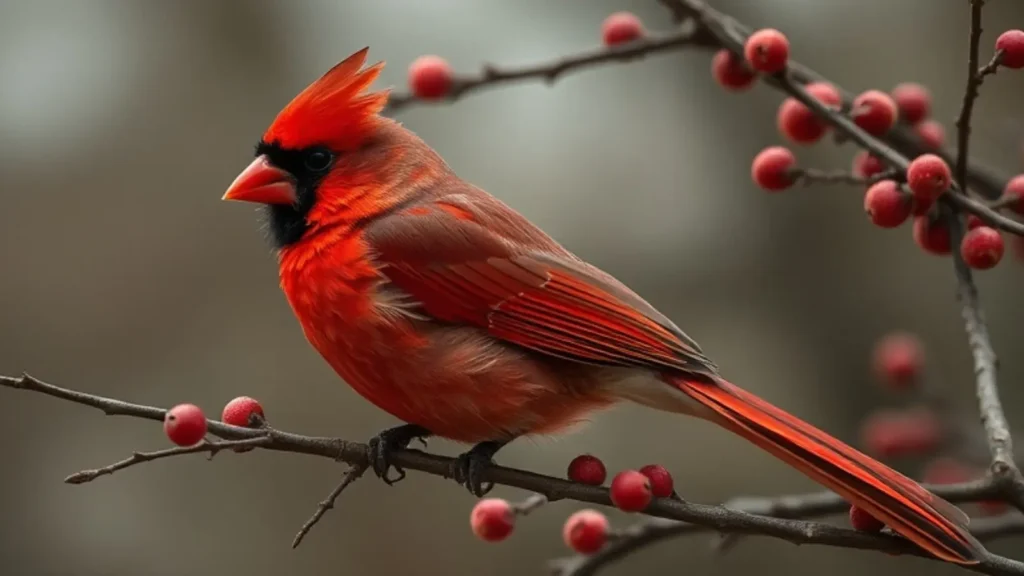
At its simplest, red cardinal symbolism represents emotional strength, life, love, visibility, and remembrance.
The exact interpretation depends heavily on context. Someone grieving may understand a cardinal as a comforting reminder of a deceased loved one. Another person may associate its red feathers with passion and confidence. A Christian viewer might connect its color with religious imagery, while a birdwatcher may simply appreciate a beautiful native songbird.
This distinction matters because symbolism is not a biological property of the bird. A cardinal does not objectively “mean” one particular thing. Rather, people create meaning through cultural associations and personal experience.
| Symbolic association | Why people connect it with cardinals |
| ❤️ Love | Red is strongly associated with affection, passion, and emotional intensity |
| 🌱 Renewal | Cardinals remain conspicuous through winter |
| 🕊️ Remembrance | Folklore connects bird visits with deceased loved ones |
| 🔥 Vitality | Bright red plumage visually suggests energy and life |
| 💪 Courage | The bird’s conspicuous color creates an impression of boldness |
| 🌟 Hope | A vivid bird appearing during difficult seasons can become a personal symbol of encouragement |
| 🙏 Spiritual connection | Religious and spiritual traditions have associated birds with heavenly or transcendent messages |
| 🏠 Home and family | Cardinals commonly visit residential gardens and occur in pairs |
These meanings overlap, which is why the cardinal can simultaneously symbolize love, loss, hope, family, and spiritual reflection.
The Natural History Behind the Symbol
Before examining symbolism, it helps to understand the actual bird.
The Northern Cardinal (Cardinalis cardinalis) is a medium-sized songbird found across much of eastern and central North America, with populations extending into parts of the southwestern United States. The species is a permanent resident throughout much of its range rather than a seasonal migrant.
According to Cornell Lab of Ornithology, adult males have brilliant red plumage, a prominent crest, and a black mask around the bill. Females are primarily brownish but have warm reddish accents and the same distinctive crest.
That difference is symbolically interesting. Popular discussions frequently focus on the male’s intense red appearance, but both sexes participate in the species’ social and visual identity.
Why Is the Cardinal Red?
The bird’s coloration is connected partly to pigments obtained through its diet. Cardinals consume seeds as well as fruits and other foods, and carotenoid-containing foods contribute to red, orange, yellow, and related feather coloration.
The scientific explanation is different from the symbolic one. Biology explains how the feathers become red; culture explains why humans attach meanings to that red color.
That distinction is essential for responsible symbolism writing.
How the Cardinal Became a Symbol of Importance
The name “cardinal” itself helped establish one of the bird’s most recognizable cultural associations.
The Northern Cardinal’s vivid red appearance reminded European observers of the red clothing associated with Roman Catholic cardinals. The resemblance between the bird’s red plumage and ecclesiastical garments contributed to its English common name.
This is an example of visual semiotics: people encounter an unfamiliar object and understand it through something already present in their cultural vocabulary.
The bird’s red color therefore became more than a biological characteristic. It became a visual bridge connecting:
red feathers → ecclesiastical red → authority → religious imagery → spiritual interpretation.
However, it would be inaccurate to claim that every modern belief about cardinals originated in Christianity. Different communities and individuals have developed their own interpretations.
Red Cardinal Symbolism in Christianity

Christian associations with cardinals are among the most frequently discussed aspects of their symbolism, but they need to be presented carefully.
The bird itself is not a biblical symbol explicitly named in Scripture. The Bible does not establish a doctrine saying that seeing a red cardinal means a deceased person is visiting or that God has sent a particular message through the bird.
Instead, Christian interpretations often arise from broader symbolic traditions involving:
- red as a religious color,
- birds as representations of spiritual themes,
- resurrection and renewal,
- sacrifice and devotion,
- creation and divine providence.
The bird’s connection with Catholic cardinals is primarily historical and visual: its name reflects the resemblance between its red coloration and the red vestments associated with church cardinals.
Is a Red Cardinal Mentioned in the Bible?
No. The Northern Cardinal is not specifically mentioned in the Bible.
Claims that the Bible assigns a prophetic meaning to seeing a cardinal should therefore be treated as modern interpretation or devotional folklore rather than direct biblical teaching.
This distinction is especially important for readers searching for the biblical meaning of a red cardinal.
Red Cardinal Spiritual Meaning
In contemporary spirituality, the red cardinal is often interpreted as a symbol of presence, encouragement, remembrance, protection, and emotional connection.
One particularly widespread modern belief says that a cardinal appearing after the death of someone close may represent that person’s presence or a message from beyond.
There is no scientific evidence establishing that cardinals transmit messages from deceased people. Nevertheless, the experience can still carry genuine emotional significance.
A person grieving a parent might see a cardinal repeatedly near a familiar window and interpret the experience as a comforting reminder. Another person might understand exactly the same event simply as an encounter with wildlife.
Neither interpretation can be scientifically proven as a universal meaning.
Why Does the Belief Feel So Powerful?
Grief changes attention and memory. When someone is emotionally connected to a particular object, place, animal, song, or season, encountering it can activate memories associated with the person who has died.
The resulting experience can feel profound without requiring a supernatural explanation.
This is an important example of the difference between psychological meaning and empirical proof.
Red Cardinal Meaning After the Death of a Loved One
The association between cardinals and deceased loved ones is one of the strongest modern interpretations of cardinal symbolism.
A common piece of folklore suggests that when a cardinal appears after someone has died, the bird represents a visit or message from that person.
This belief does not have one universally documented origin, and it should not be presented as a proven religious or scientific fact. Instead, it is best understood as a contemporary folk belief shaped by older human associations between birds, the sky, spirits, and messengers.
Birds have long occupied an interesting place in human imagination because they move between earth and sky. That physical movement naturally lends itself to metaphors involving transcendence, freedom, heaven, and communication.
For a grieving person, therefore, a cardinal can become a powerful symbol of:
- ❤️ enduring love,
- 🕯️ remembrance,
- 🌅 continuity after loss,
- 🕊️ emotional comfort,
- 🌿 the persistence of memory.
Red Cardinal Symbolism and Love
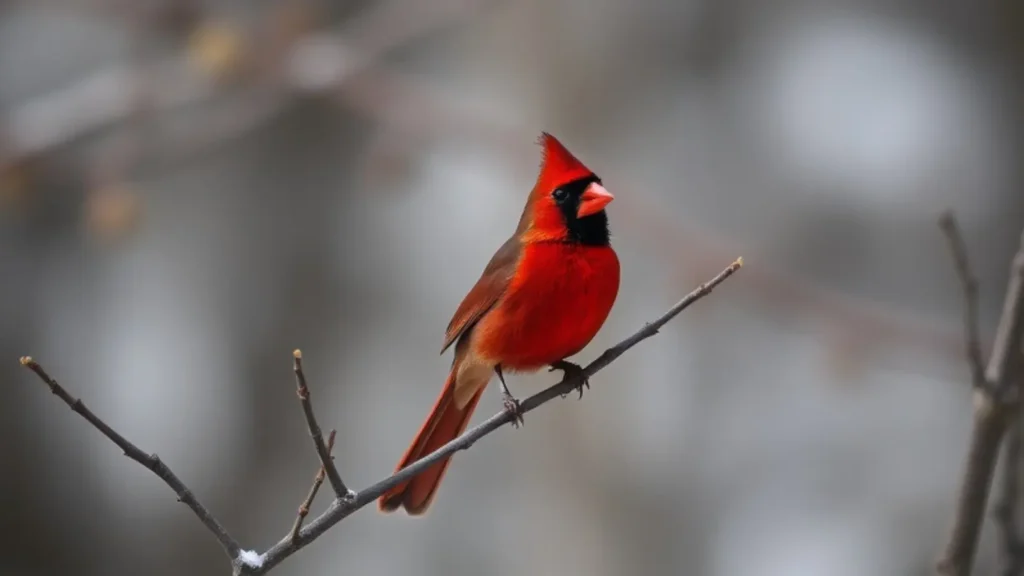
Red has one of the strongest emotional associations in visual culture.
Across many contexts, red can suggest passion, attraction, warmth, urgency, energy, and emotional intensity. When combined with a living creature, those associations can produce a particularly vivid symbolic image.
This is why the cardinal frequently appears in discussions of love symbolism.
A pair of cardinals can also be interpreted by observers as representing companionship or partnership. Yet this should not be confused with a universal cultural rule. The symbolic interpretation comes from human observation and storytelling rather than an objective message encoded in the birds’ behavior.
In art, greeting cards, memorial designs, jewelry, tattoos, and home décor, a red cardinal may therefore communicate:
“Love remains visible even after circumstances change.”
Red Cardinal Meaning in Winter and Renewal
One reason cardinals have become such powerful seasonal symbols is their visibility during winter.
Unlike many migratory songbirds, Northern Cardinals remain year-round residents across their range. Their brilliant red coloration can stand out dramatically against snow and leafless landscapes.
That creates a powerful visual metaphor:
winter → difficulty → persistence → color → hope → renewal.
The bird’s presence does not literally signify that spring is coming. But humans naturally use visual contrasts to construct narratives.
A red cardinal against snow can therefore become an artistic shorthand for warmth during hardship.
This is one reason cardinal imagery works so effectively in winter cards, memorial artwork, Christmas decorations, poetry, and inspirational design.
Red Cardinal Symbolism Across Cultures
There is no single worldwide meaning of the red cardinal.
The Northern Cardinal is native to North America, so interpretations developed in regions where people actually encountered the bird are particularly relevant. Other cultures may have symbolic traditions involving red birds in general, but those should not automatically be attributed to the Northern Cardinal.
This distinction prevents a common research error: taking symbolism associated with another red bird or another culture and presenting it as a universal cardinal tradition.
Cultural Interpretation Table
| Context | Common interpretation | Important qualification |
| Contemporary North American folklore | Remembrance, love, hope | Often personal or family-based |
| Christian-influenced symbolism | Red, devotion, spiritual reflection | The bird is not explicitly given a biblical meaning |
| Memorial culture | Connection with deceased loved ones | A folk belief rather than established fact |
| Nature appreciation | Beauty, resilience, seasonal continuity | Based on observable characteristics |
| Modern spirituality | Signs, guidance, presence | Depends on individual belief |
| Art and design | Passion, warmth, memory | Created through visual symbolism |
| Branding | Energy, visibility, confidence | Context-dependent and strategically constructed |
Symbolism should therefore be interpreted contextually rather than universally.
Psychology of Red Cardinal Symbolism

Why does the cardinal feel so emotionally powerful?
Part of the answer lies in salience.
Human perception is highly responsive to visual contrast. A saturated red bird standing against green foliage, gray branches, or white snow is visually conspicuous. That makes the encounter memorable.
The psychological process can be thought of as:
visual salience → attention → emotional response → memory formation → personal interpretation.
Color psychology also helps explain why red frequently communicates intensity. Red can be associated with love, danger, energy, warmth, celebration, and urgency depending on context.
The cardinal therefore combines two powerful symbolic systems:
- The psychology of red
- The cultural symbolism of birds
Together, they create an unusually flexible visual metaphor.
Red Cardinal Symbolism in Art and Literature
Artists often use cardinals because the bird communicates meaning quickly.
A red cardinal painted against a winter landscape can suggest hope without requiring explanatory text. A cardinal beside a photograph of a deceased person can communicate remembrance. A pair of cardinals can evoke companionship.
This is an example of visual shorthand.
Common Artistic Themes
- A cardinal in snow — resilience and hope
- A cardinal beside a memorial — remembrance
- Two cardinals together — companionship
- A cardinal near flowers — renewal and life
- A flying cardinal — freedom and transition
- A cardinal against darkness — light and perseverance
Literature can use the same principles more subtly. The bird may appear at a moment of emotional transition, allowing its physical presence to mirror a character’s internal experience.
The cardinal does not need to “mean” one thing. Its power comes from the relationship between the bird, the scene, and the reader’s interpretation.
Red Cardinal Symbolism in Branding and Design
The cardinal’s visual identity also makes it useful in branding.
A red bird can communicate:
- energy,
- confidence,
- movement,
- competitiveness,
- visibility,
- courage,
- warmth,
- community.
That helps explain why cardinal imagery appears in sports identities, educational institutions, community organizations, merchandise, and decorative design. Audubon notes that the Northern Cardinal serves as a state bird for seven U.S. states and appears as a mascot for numerous sports teams.
From a branding perspective, the bird has several advantages:
High recognition + strong color contrast + memorable silhouette + emotional associations.
The crest is particularly valuable in visual identity because it creates a recognizable outline even when detailed feather patterns are removed.
Did You Know? Fascinating Cardinal Facts

- 🔴 Both male and female Northern Cardinals have distinctive crests.
- 🐦 Male cardinals are brilliant red, while females are primarily brown with reddish accents.
- 🌲 Cardinals commonly occupy backyards, parks, woodland edges, and shrub-filled environments.
- ❄️ Their year-round presence helps explain why people associate them with winter and seasonal resilience.
- 🌎 The Northern Cardinal is native to North America rather than being a globally distributed bird.
- 🍒 Their red coloration is influenced by carotenoids obtained through their diet.
Myth vs. Fact: Red Cardinal Symbolism
| Myth or claim | Fact-based interpretation |
| “A cardinal is definitely a message from a dead relative.” | This is a widespread belief, not a scientifically established fact. |
| “The Bible says cardinals are heavenly messengers.” | The Northern Cardinal is not specifically mentioned in the Bible. |
| “Every culture believes cardinals mean the same thing.” | Symbolism varies by culture, region, religion, and individual experience. |
| “Cardinals are red because they symbolize love.” | Their red feathers have a biological basis; love is a human symbolic interpretation. |
| “Seeing a cardinal always predicts something.” | There is no established scientific evidence that sightings predict future events. |
| “Only male cardinals have symbolic significance.” | Both sexes belong to the same species, although the male’s bright red color receives more visual attention. |
Common Mistakes When Explaining Cardinal Symbolism
1. Treating folklore as scientific fact
A symbolic belief can be meaningful without being scientifically verified.
2. Claiming that the Bible gives cardinals a specific prophetic meaning
This confuses modern spiritual interpretation with biblical text.
3. Assigning one meaning to every sighting
A bird encounter can mean something different to different people.
4. Ignoring the actual bird
Symbolism becomes stronger—not weaker—when it is grounded in natural history.
5. Mixing unrelated red-bird traditions
A Northern Cardinal should not automatically inherit symbolism associated with every red bird around the world.
Expert Tip: How to Interpret a Cardinal Encounter
If a cardinal sighting feels meaningful, begin with context rather than superstition.
Ask yourself:
- What was happening in your life when you saw it?
- Did the bird remind you of someone?
- What emotion did you experience first?
- What cultural or religious beliefs influence your interpretation?
- Could the encounter represent something personal rather than universal?
This approach allows symbolism to remain meaningful without pretending that one interpretation applies to everyone.
Practical Applications of Red Cardinal Symbolism
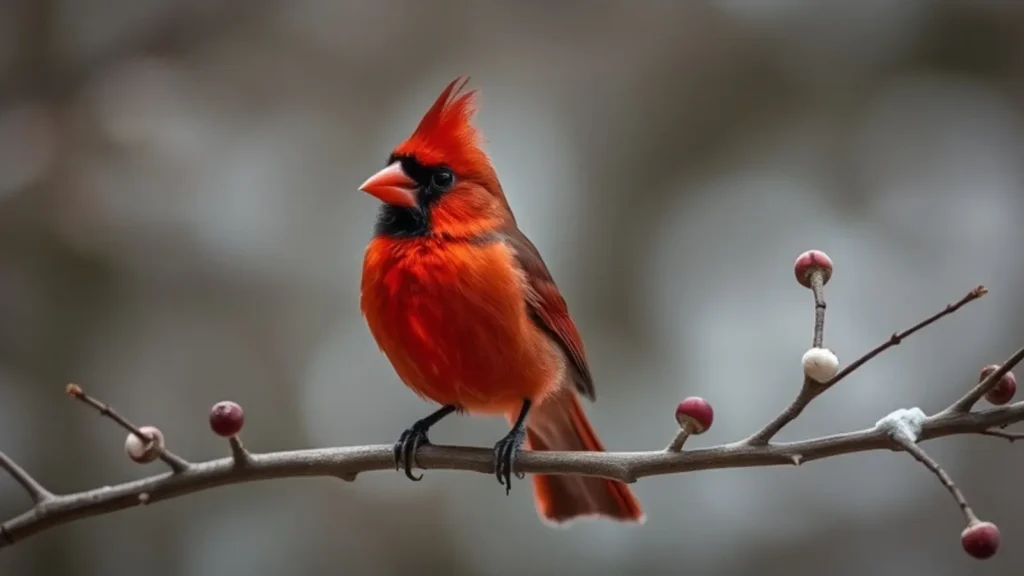
Red cardinal imagery can be particularly effective when communicating emotional concepts.
Memorial Design
Cardinals are frequently used in memorial artwork because their cultural associations with remembrance and enduring connection resonate with people experiencing loss.
Tattoos
A cardinal tattoo may represent love, resilience, a cherished memory, family, or personal transformation. The intended meaning depends on the wearer.
Home Décor
Cardinal imagery is popular in seasonal decoration because the bright red bird creates strong visual contrast and can evoke warmth during winter.
Education
Teachers can use the cardinal as an example when explaining symbolism, semiotics, color psychology, folklore, or the relationship between natural history and cultural meaning.
Writing and Storytelling
Authors can use a cardinal as a recurring motif for memory, hope, emotional transition, or a character’s connection with home.
Branding
Designers can use cardinal imagery when a brand needs to communicate visibility, energy, confidence, or community identity.
Why the Red Cardinal Remains Symbolically Powerful
The enduring appeal of the cardinal comes from the convergence of nature and narrative.
It is visually distinctive enough to attract attention, familiar enough to appear in ordinary surroundings, colorful enough to generate strong emotional associations, and culturally flexible enough to support multiple interpretations.
Most importantly, the cardinal frequently appears in meaningful human contexts: gardens, homes, winter landscapes, memorial spaces, and places associated with family memories.
That makes it an ideal symbolic object.
A cardinal does not have to be supernatural to be meaningful.
Sometimes symbolism emerges because an ordinary encounter becomes connected to an extraordinary memory.
Key Insights About Red Cardinal Symbolism
The most important ideas can be summarized in a few principles:
- Red cardinal symbolism is not universal. Meanings vary by culture, religion, folklore, and personal experience.
- Love and remembrance are among the most common modern interpretations.
- The bird’s red color contributes strongly to its symbolic identity.
- Its name is historically connected to the red clothing of Catholic cardinals.
- The belief that cardinals represent deceased loved ones is folklore, not scientific evidence.
- The bird’s year-round visibility contributes to associations with resilience and continuity.
- Cardinal symbolism works especially well in art, memorials, literature, design, and storytelling.
- Understanding the actual bird makes symbolic interpretations more accurate and nuanced.
Frequently Asked Questions About Red Cardinal Symbolism
What does seeing a red cardinal symbolize?
Seeing a red cardinal is commonly interpreted as a symbol of love, hope, vitality, remembrance, or spiritual connection. Some people believe a cardinal represents a deceased loved one, but this is a cultural and spiritual belief rather than a scientifically proven phenomenon.
What does a red cardinal symbolize after someone dies?
In modern folklore, a red cardinal appearing after someone’s death is often interpreted as a comforting sign associated with the deceased person. It can represent continuing love, remembrance, or emotional connection. There is no scientific evidence proving that cardinals literally carry messages from deceased people.
What is the biblical meaning of a red cardinal?
The Northern Cardinal does not have a specific biblical meaning because the bird is not explicitly identified in the Bible. Christian interpretations may connect its red color with broader religious themes, but claims about a specific prophetic meaning should be distinguished from biblical teaching.
What does a red cardinal symbolize in love?
A red cardinal can symbolize passion, affection, loyalty, companionship, and enduring emotional connection. These associations are largely created through the symbolism of the color red and modern cultural interpretations of the bird rather than through one universal tradition.
Are red cardinals a sign of good luck?
Some folklore and personal spiritual traditions regard cardinal sightings as positive signs associated with hope, encouragement, or good fortune. However, there is no scientific evidence that seeing a cardinal predicts luck or future events.
Why are cardinals associated with spiritual messages?
Birds have historically been used in human symbolism as images of freedom, movement between earth and sky, and communication with the transcendent. Modern cardinal folklore builds on those broader associations while also drawing on the bird’s striking appearance and cultural history.
Final Takeaways
Red cardinal symbolism is best understood as a cultural and personal language rather than a fixed supernatural code.
The bird’s brilliant red plumage naturally attracts human attention. Its name reflects a historical association with Catholic cardinals, while modern folklore has expanded its symbolism to include love, remembrance, hope, resilience, spirituality, and emotional connection.
For some people, a cardinal is simply a beautiful songbird. For others, it may become a deeply personal reminder of someone they love. Both responses can coexist.
The most responsible interpretation recognizes three different layers:
Biology: the cardinal is a real North American songbird with distinctive behavior and coloration.
Culture: societies and communities attach meanings to its color, appearance, and presence.
Personal experience: individuals can transform a bird encounter into a meaningful memory or symbol.
That combination explains why the cardinal continues to appear in religion, folklore, memorials, art, literature, education, branding, décor, tattoos, storytelling, and everyday life.

Lucas Whitmore reveals the hidden messages behind symbols, signs, and traditions through detailed symbolism guides.
