Buddhism symbolism is a visual language built around ideas such as enlightenment, compassion, wisdom, ethical living, impermanence, liberation, and the path beyond suffering.
From the Dharma wheel and lotus flower to the Bodhi tree, stupa, Buddha footprints, mudras, and the Eight Auspicious Symbols, Buddhist traditions use recognizable images to communicate teachings that can otherwise be difficult to express in words.
These symbols are not simply decorative motifs. They developed through centuries of religious practice, storytelling, architecture, ritual, painting, sculpture, literature, and cross-cultural exchange.
Understanding their symbolism therefore means looking beyond a single definition and considering where, when, and within which Buddhist tradition a symbol appears.
Buddhism Symbolism: A Featured-Snippet Definition
Buddhism symbolism refers to the visual signs, objects, gestures, architectural forms, and natural images used to represent Buddhist teachings, the Buddha’s life, spiritual qualities, and the path toward awakening. Common examples include the Dharma wheel, lotus, Bodhi tree, stupa, Buddha footprints, mudras, and Eight Auspicious Symbols.
What Does Buddhism Symbolism Mean?
At its broadest level, Buddhism symbolism translates abstract Buddhist teachings into forms that people can see, remember, contemplate, and incorporate into religious practice.
A wheel can communicate the Buddha’s teaching and the “turning” of Dharma. A lotus can evoke enlightenment emerging from difficult worldly conditions. A Bodhi tree recalls the Buddha’s awakening. A stupa can connect physical space with the Buddha’s relics, memory, and sacred presence.
However, symbolism in Buddhism should not be treated like a universal dictionary in which every image has exactly one meaning.
The same symbol may carry different associations depending on its historical period, Buddhist school, geographical location, ritual context, and artistic tradition. A lotus in an Indian Buddhist relief, a Tibetan thangka, a Chinese painting, and a modern logo may share visual ancestry while communicating somewhat different ideas.
That flexibility is one reason Buddhist symbolism has remained influential for more than two millennia.
The Historical Development of Buddhist Symbolism
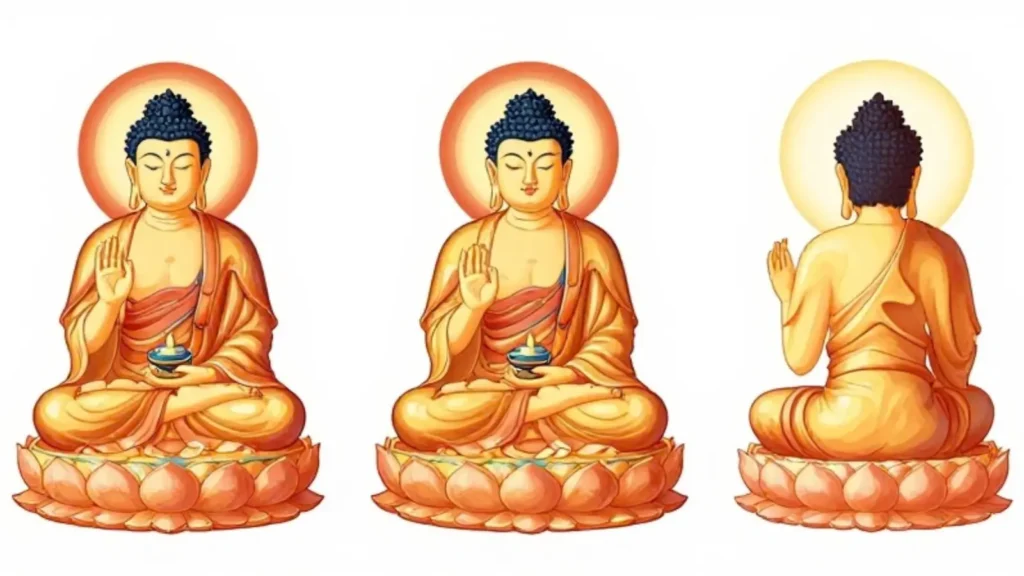
Buddhist symbolism developed alongside the spread of Buddhism from ancient India throughout Asia.
Early Buddhist art provides particularly important evidence for understanding how symbols functioned before images of the Buddha became widespread. At sites such as Bharhut and Sanchi, artists represented the Buddha through signs including the Bodhi tree, empty throne, wheel, footprints, and other visual references rather than consistently showing him in human form. Scholars commonly describe this early approach as “aniconic” representation.
The Metropolitan Museum of Art’s research on early Buddhist art likewise documents symbols such as footprints, the stupa, wheel, empty throne, Bodhi tree, riderless horse, and parasol as ways of evoking the Buddha and episodes from his life.
Over time, Buddhist artists increasingly created anthropomorphic images of the Buddha. Gandharan and other artistic traditions produced recognizable Buddha figures, while symbolic language continued rather than disappearing. Instead, images, gestures, objects, architectural forms, and narrative motifs became part of a much larger visual vocabulary.
This evolution demonstrates an important principle: Buddhist symbolism did not replace Buddhist teaching; it became one of the ways Buddhist teaching was communicated.
The Dharma Wheel: Symbol of Buddhist Teaching
The Dharma wheel, or dharmachakra, is one of the best-known symbols associated with Buddhism.
Its central meaning is connected with the Buddha’s Dharma—the teaching or path he presented for understanding suffering and cultivating liberation. The expression “turning the wheel of Dharma” is associated with the Buddha teaching and, particularly, with his first sermon at Sarnath.
What do the spokes of the Buddhist wheel mean?
The number of spokes can have different interpretations, but an eight-spoked wheel is frequently associated with the Noble Eightfold Path:
- Right View
- Right Intention
- Right Speech
- Right Action
- Right Livelihood
- Right Effort
- Right Mindfulness
- Right Concentration
The wheel’s circular form can also suggest continuity, movement, completeness, and the ongoing transmission of Dharma.
A particularly important distinction is that the wheel is not merely a symbol of “peace.” Its deeper Buddhist context concerns teaching, ethical practice, wisdom, and the path toward liberation.
The Met records a Japanese Buddhist ritual wheel in which eight spokes are explicitly associated with aspects of the Noble Eightfold Path.
The Lotus Flower in Buddhism
The lotus is among the most recognizable images in Buddhist art.
Its symbolism is especially powerful because the flower grows from muddy or murky water while emerging above the surface in a visually striking form. In Buddhist interpretation, this makes the lotus a compelling metaphor for spiritual development: awakening can emerge within the difficulties and imperfections of ordinary existence.
The lotus is associated with purity, awakening, spiritual growth, and enlightenment, although its exact interpretation can vary by tradition.
The lotus was already an important motif in early Buddhist art. Lotus imagery appears in Bharhut sculpture from around the first century BCE, and the Metropolitan Museum describes these lotuses as auspicious symbols associated with the Buddha’s enlightenment.
Lotus symbolism in everyday language
The lotus can therefore represent an important Buddhist idea:
Difficult circumstances do not automatically prevent spiritual transformation.
This makes the flower particularly powerful in art, meditation spaces, architecture, jewelry, educational imagery, and contemporary visual design.
The Bodhi Tree: Symbol of Enlightenment
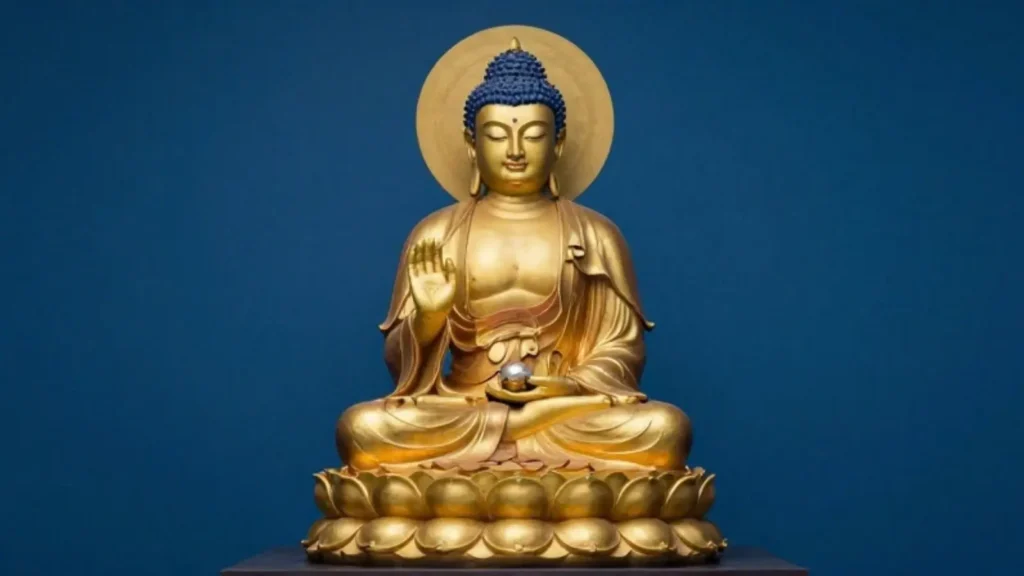
The Bodhi tree refers to the sacred fig tree associated with Siddhartha Gautama’s awakening.
According to Buddhist tradition, Siddhartha attained enlightenment while meditating beneath the tree at Bodh Gaya. The site subsequently became one of Buddhism’s most important pilgrimage locations.
The tree consequently symbolizes:
- Awakening
- Enlightenment
- Meditation
- Wisdom
- Spiritual transformation
- The Buddha’s pivotal moment of realization
Early Buddhist artists frequently used the Bodhi tree to represent the Buddha’s presence without depicting his physical body.
An empty throne beneath the tree could simultaneously refer to the sacred location, the Buddha’s absence, and the moment of awakening.
This makes the Bodhi tree especially significant in discussions of absence and presence in religious art.
The Stupa: Architecture as Buddhist Symbolism
A stupa is both an architectural structure and a powerful symbolic form within Buddhism.
The word derives from Sanskrit and is commonly associated with a mound or heap. Stupas existed in South Asian religious contexts before Buddhism, but Buddhist stupas became closely connected with relics and the Buddha. Early Buddhist stupas could contain portions of the Buddha’s remains.
The stupa therefore represents more than a building.
It can function simultaneously as:
- A reliquary
- A sacred monument
- A memorial
- A representation of the Buddha
- A focus for pilgrimage
- A place for circumambulation
- A visual expression of Buddhist cosmology and practice
At Sanchi, for example, architectural elements create a sacred environment in which movement, direction, gates, sculpture, and ritual participation work together.
The stupa demonstrates how Buddhism symbolism can become spatial rather than merely visual. Instead of simply looking at a symbol, practitioners can move around it and experience sacred architecture through bodily action.
Buddha Footprints and the Symbolism of Presence
Buddha footprints, known as buddhapada, are another important early Buddhist symbol.
A footprint can seem deceptively simple. Symbolically, however, it suggests physical presence while simultaneously acknowledging absence: the Buddha was here, walked the path, taught, and has passed beyond ordinary existence.
The Metropolitan Museum notes that Buddha footprints were among the symbols used to represent the Buddha in early Buddhist art.
This creates a fascinating symbolic tension:
The footprint is evidence of someone who is no longer physically standing there.
In that sense, it can evoke memory, pilgrimage, impermanence, reverence, and spiritual continuity.
Buddhist Mudras and the Language of the Hands
A mudra is a symbolic hand gesture used extensively in Buddhist art and practice.
Mudras can communicate particular events, teachings, spiritual qualities, or states associated with Buddhas and other figures. Smarthistory’s overview notes that mudras became important devices for communicating Buddhist narratives and concepts visually.
Some frequently encountered gestures include:
Dharmachakra Mudra
The Dharmachakra mudra is associated with teaching and the turning of the Dharma wheel. It is particularly connected with the Buddha’s first sermon.
Bhumisparsha Mudra
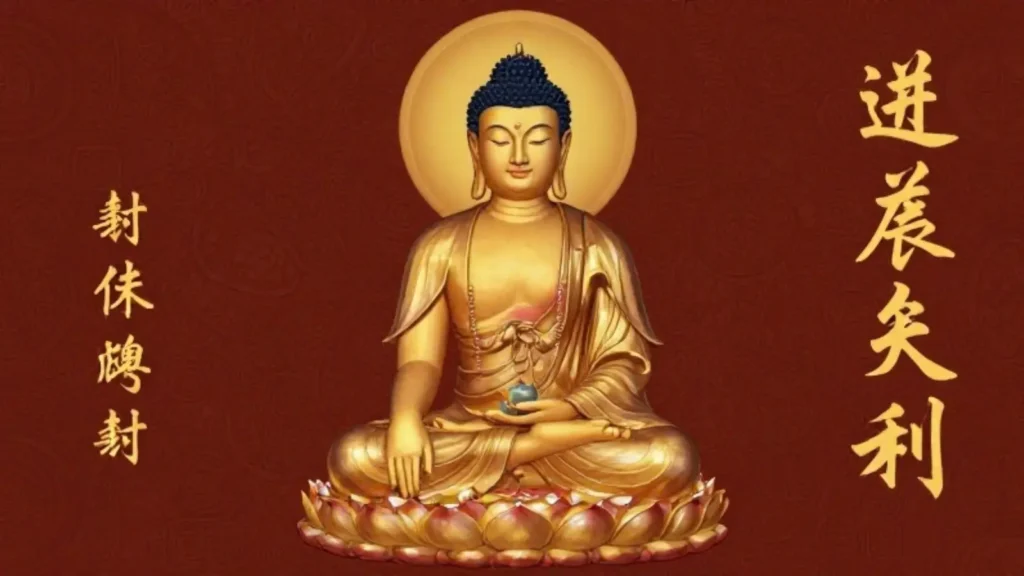
In the earth-touching gesture, the Buddha reaches toward the ground. It refers to the moment of enlightenment and the calling of the earth as witness to his awakening.
Dhyana Mudra
The meditation gesture is commonly associated with contemplative stillness and meditation.
The important lesson is that Buddhist sculpture is often meant to be “read.” Position of the hands, posture, facial expression, attributes, throne, surrounding figures, and architectural setting can all contribute to meaning.
The Eight Auspicious Symbols in Buddhism

The Eight Auspicious Symbols are especially prominent in Tibetan and Himalayan Buddhist traditions, although related auspicious imagery has broader South Asian roots.
Commonly identified as the Eight Auspicious Symbols are:
| Symbol | Common symbolic associations |
| Lotus | Purity and spiritual awakening |
| Dharma wheel | Buddhist teaching and the path |
| Conch shell | Proclamation of Dharma |
| Endless knot | Interdependence and interconnectedness |
| Treasure vase | Abundance and spiritual wealth |
| Victory banner | Triumph over obstacles or harmful forces |
| Parasol | Protection and spiritual authority |
| Pair of golden fish | Freedom, auspiciousness, and movement |
These meanings should be understood as traditional interpretive associations rather than rigid universal definitions.
In Tibetan Buddhist art, the symbols may appear on temple decorations, ritual objects, textiles, paintings, manuscripts, architecture, and ceremonial items.
Their visual repetition also demonstrates how symbolism can function as a memory system. Familiar forms allow practitioners to encounter Buddhist ideas through repeated visual cues.
The Endless Knot and Interdependence
The endless knot is one of the most visually distinctive Buddhist motifs.
Because its lines loop continuously without an obvious beginning or ending, it is often associated with ideas such as:
- Interdependence
- Continuity
- Interconnection
- The relationship between wisdom and compassion
- The complexity of cause and effect
Its visual structure makes it particularly suitable for expressing relationships rather than isolated objects.
From a semiotic perspective, this is significant. A symbol does not always need to resemble what it means. Instead, its structure can encourage the viewer to think about a concept.
The endless knot does precisely that: its interconnected lines encourage contemplation of relationships.
The Conch Shell, Parasol, Victory Banner, and Golden Fish
Other Buddhist symbols become more understandable when viewed through their traditional functions.
Conch Shell
The conch can symbolize the spreading or proclamation of Dharma. Its sound provides a natural metaphor for teachings traveling outward.
Parasol
The parasol historically carried associations with royalty, status, and protection. In Buddhist imagery it can therefore suggest protection from harmful influences and the dignity of Dharma. Early Buddhist art also used the parasol in association with royal imagery.
Victory Banner
The victory banner commonly represents triumph. In Buddhist contexts, that victory is better understood spiritually than militarily: overcoming ignorance, destructive tendencies, or obstacles on the path.
Golden Fish
The pair of golden fish is traditionally associated with auspiciousness and freedom. Because fish move freely through water, the image can also evoke liberation from restrictive conditions.
Buddhism Symbolism Across Different Buddhist Traditions
There is no single worldwide Buddhist symbolic system.
Theravāda Buddhism
In Theravāda regions such as Sri Lanka, Thailand, Myanmar, Laos, and Cambodia, Buddhist symbolism is strongly expressed through stupas, Buddha images, Bodhi trees, relics, temple architecture, narrative scenes, and ritual objects.
Mahāyāna Buddhism
In East Asian Buddhist traditions, including Chinese, Korean, Japanese, and Vietnamese contexts, symbolism developed through an enormous range of Buddhas, bodhisattvas, sacred landscapes, mandalas, calligraphy, ritual objects, and literary traditions.
Vajrayāna Buddhism
Tibetan and Himalayan Buddhism developed especially elaborate symbolic systems involving mandalas, mudras, ritual implements, deities, colors, geometric forms, and the Eight Auspicious Symbols.
Southeast Asian Buddhism
In Southeast Asia, Buddhist visual culture often combines local artistic traditions with inherited Indian Buddhist imagery. Architectural styles, sculpture, textiles, festivals, and temple environments show how symbols adapt to local cultural contexts.
This diversity is essential to understanding Buddhist symbolism accurately.
One symbol can have a shared foundation while acquiring new layers of meaning in different societies.
Buddhism Symbolism and Psychology
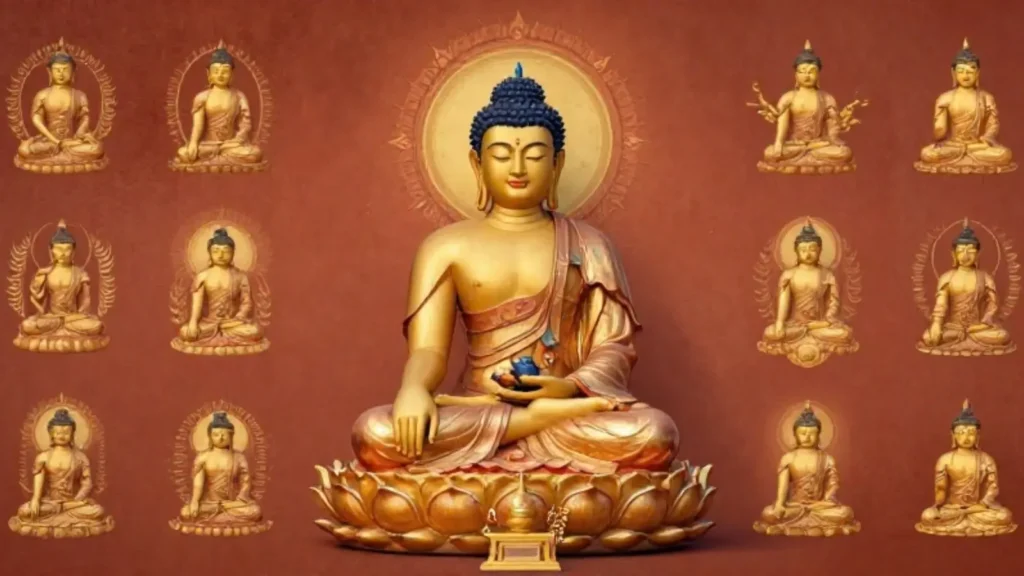
Buddhist symbols can also be considered through the lens of psychology and visual perception.
Humans often remember concrete images more easily than abstract explanations. A wheel, tree, flower, footprint, or hand gesture can therefore act as a cognitive anchor for a much larger idea.
For example:
Lotus → flower → growth → difficult environment → awakening
This sequence is not a scientific psychological formula. Rather, it illustrates how visual metaphor can help people organize abstract concepts.
The psychological power of symbolism can come from several characteristics:
- Simplicity: recognizable shapes are easy to remember.
- Repetition: repeated exposure strengthens familiarity.
- Narrative connection: symbols become attached to stories.
- Emotional association: sacred settings can influence how images are experienced.
- Cultural learning: communities teach members what particular images mean.
This helps explain why Buddhist symbols remain effective in education and visual storytelling.
Buddhism Symbolism in Art and Iconography
Buddhist art is a particularly rich field for studying symbolism.
A Buddha sculpture can communicate meaning through much more than facial expression. Viewers may need to consider:
- Posture
- Mudra
- Clothing
- Throne
- Halo
- Lotus pedestal
- Crown or ornaments
- Attendant figures
- Direction
- Architectural setting
- Objects held in the hands
- Color
- Scale
Gandharan Buddhist sculpture, for instance, developed powerful figurative representations of the Buddha, while earlier Indian traditions frequently communicated Buddhist narratives through symbolic motifs.
The result is a visual language in which an artwork can operate simultaneously as religious object, narrative, teaching tool, historical document, and work of art.
Buddhism Symbolism in Architecture
Architecture can turn Buddhist philosophy into an experience.
The stupa is an obvious example, but Buddhist architecture also includes monasteries, cave temples, shrines, gates, mandalas, pilgrimage routes, and sacred landscapes.
Borobudur in Java demonstrates how Buddhist ideas can be integrated into an enormous architectural composition. The monument was built around the eighth century and combines stupa architecture with mandala-like organization and Buddhist imagery.
This illustrates a broader principle of symbolic design:
A sacred space can teach through movement, orientation, repetition, scale, and visual sequence.
Buddhism Symbolism in Literature and Storytelling

Symbols also work as literary devices.
Buddhist literature contains recurring images of journeys, trees, wheels, flowers, rivers, mountains, light, darkness, animals, kingship, renunciation, and transformation.
These images can help turn philosophical concepts into stories.
For example, a journey may represent spiritual development, while awakening beneath a tree can become a narrative representation of profound transformation.
The Jataka tradition, which tells stories associated with the Buddha’s previous lives, also contributed to Buddhist visual storytelling. Early stupa reliefs depict Jataka narratives alongside scenes and symbols connected with the Buddha’s life.
Color Symbolism in Buddhism
Color symbolism varies considerably among Buddhist traditions, so universal claims should be avoided.
In many Buddhist contexts, colors can carry associations involving qualities such as wisdom, compassion, purity, transformation, or spiritual activity. Tibetan Buddhist traditions are particularly well known for systematic use of color in mandalas, paintings, ritual objects, and sacred imagery.
Color can also work at a practical level.
A designer may use saffron, gold, red, blue, white, or other colors to evoke Buddhist visual traditions, but the cultural meaning depends heavily on context.
Expert Tip
When using Buddhist colors in branding or design, research the specific Buddhist tradition being referenced rather than assuming that a color has one universal Buddhist meaning.
Buddhism Symbolism in Modern Design and Branding
Buddhist symbols now appear far beyond traditional temples.
They can be found in:
- Meditation apps
- Wellness websites
- Yoga studios
- Jewelry
- Interior design
- Educational materials
- Tattoos
- Clothing
- Digital illustrations
- Travel branding
- Contemporary art
- Books and publishing
However, modern use creates an important ethical question: Is the symbol being understood, or simply being used because it looks attractive?
A lotus used in a meditation app may reasonably communicate calmness or transformation. A sacred Buddhist image placed randomly on merchandise, clothing, or commercial packaging can be more complicated, especially when the original religious context is ignored.
Good visual communication requires cultural awareness.
Myth vs. Fact: Buddhist Symbolism
| Myth | Fact |
| Every Buddhist symbol has one universal meaning. | Meanings can vary by school, region, period, and context. |
| The lotus simply means peace. | It has richer associations with purity, awakening, and enlightenment. |
| The Buddha wheel is only decorative. | It is strongly connected with Dharma and Buddhist teaching. |
| All Buddhist art originally showed the Buddha as a human figure. | Early Buddhist art often used symbolic or aniconic representations. |
| Buddhist symbols are interchangeable across traditions. | Some symbols are especially prominent in particular Buddhist cultures. |
| Modern Buddhist imagery always preserves its traditional meaning. | Contemporary uses can reinterpret, simplify, commercialize, or sometimes misunderstand symbols. |
Common Mistakes When Interpreting Buddhism Symbolism
1. Treating all Buddhist traditions as identical
Buddhism developed across numerous societies, and its visual language is correspondingly diverse.
2. Reducing every symbol to a single English word
“Peace,” “calm,” and “spirituality” may describe modern associations, but they often fail to capture the historical depth of Buddhist symbols.
3. Ignoring historical context
A symbol in second-century BCE India cannot automatically be interpreted exactly like the same motif in a modern Tibetan temple.
4. Confusing Buddhist and general Asian imagery
Many visual motifs traveled between religious and cultural traditions. Similarity does not automatically mean identical meaning.
5. Assuming symbolism is purely decorative
In Buddhist art, visual elements can communicate doctrine, biography, ritual significance, and spiritual ideals.
Did You Know?
Early Buddhist artists sometimes represented the Buddha through an empty throne, Bodhi tree, wheel, footprints, or other symbols rather than depicting his human body. This early visual strategy is particularly important because it shows that Buddhist symbolism was not an afterthought—it was one of the foundational ways Buddhist ideas were communicated visually.
Practical Applications of Understanding Buddhist Symbolism
Understanding Buddhist symbolism has value well beyond religious studies.
Education
Teachers can use Buddhist symbols to introduce students to religion, art history, anthropology, mythology, architecture, and intercultural communication.
Art Analysis
Recognizing the Dharma wheel, Bodhi tree, mudras, lotus, or Buddha footprints can make Buddhist artworks much easier to interpret.
Travel and Cultural Heritage
Visitors to Buddhist temples and monuments can better understand what they are seeing instead of treating sacred imagery as generic decoration.
Design
Designers can create culturally informed visual communication by researching the history and context behind Buddhist motifs.
Literature
Writers can use symbolic structures such as journeys, trees, wheels, and flowers to explore transformation and spiritual development.
Branding
Organizations working with meditation or contemplative education may draw on Buddhist visual traditions, but responsible branding should distinguish genuine cultural references from superficial aesthetic borrowing.
Key Insights About Buddhism Symbolism
The most important lesson is that Buddhist symbolism is contextual.
A lotus is not simply a flower. A wheel is not simply a circular shape. A stupa is not simply an ancient building. A mudra is not merely a hand pose.
Each can function as part of a larger network of religious ideas, historical narratives, artistic conventions, ritual practices, and cultural memories.
Buddhist symbolism also demonstrates how humans communicate abstract concepts through concrete forms. Enlightenment is difficult to photograph. Wisdom cannot be physically displayed in a simple object. Liberation is an abstract spiritual goal.
Yet a flower, tree, wheel, gesture, footprint, or architectural monument can provide a visual doorway into those concepts.

Isabella Carter explores symbolism in nature, literature, art, and spirituality with engaging and informative research.
