Art rarely communicates through appearance alone. A painted flower can represent mortality, a doorway can suggest transition, a bird can evoke freedom, and a particular color can transform the emotional meaning of an entire composition. This deeper layer of visual communication is the foundation of symbolism in art.
Symbolism allows artists to communicate ideas that may be difficult to express literally: love, death, spirituality, identity, fear, power, memory, desire, transformation, isolation, hope, and countless other human experiences. Sometimes a symbol is deliberately chosen by an artist; in other cases, its meaning develops through religion, mythology, cultural tradition, historical events, or repeated use.
Understanding symbolism in art therefore requires more than memorizing a dictionary of symbols. Meaning depends on context. A snake might represent evil in one visual tradition, healing or renewal in another, and personal transformation in a contemporary artwork. The same object can carry completely different meanings for different audiences.
What Does Symbolism in Art Mean?
Symbolism in art is the use of images, objects, colors, gestures, forms, settings, or visual motifs to communicate ideas and emotions beyond their literal appearance. Artists use symbolic elements to suggest concepts such as love, mortality, spirituality, identity, power, nature, transformation, or psychological states, allowing viewers to interpret deeper meanings within an artwork.
Symbolism can be intentional, culturally inherited, personally meaningful, or open-ended. It is closely connected with iconography, semiotics, mythology, visual culture, psychology, religious imagery, and storytelling.
The important distinction is that a symbol does not necessarily have one permanent meaning. Its interpretation is shaped by the artwork’s composition, historical period, cultural environment, artist’s intentions, and viewer’s experiences.
Why Is Symbolism in Art Important?
Symbolism matters because visual images can communicate complex ideas without explaining them in words.
An artist may show an hourglass instead of writing “life is temporary.” A wilted flower may communicate mortality without a written explanation. A crown may suggest authority, while chains can imply oppression or imprisonment.
This makes symbolism especially powerful because viewers participate in constructing meaning.
Symbolism performs several functions:
- Communicates abstract ideas: Concepts such as justice, mortality, freedom, or spirituality can become visually understandable.
- Creates emotional depth: Symbolic imagery can make an artwork feel mysterious, intimate, disturbing, hopeful, or sacred.
- Preserves cultural knowledge: Religious symbols, myths, traditional patterns, and ceremonial objects can carry collective memory.
- Supports storytelling: Artists can introduce characters, conflicts, beliefs, and themes through visual clues.
- Encourages interpretation: Ambiguous symbols invite viewers to think rather than simply receive information.
- Builds identity: Symbols can communicate belonging to a community, nation, religion, movement, or cultural tradition.
In this sense, symbolism is not merely decoration. It is a form of visual language.
The Historical Evolution of Symbolism in Art
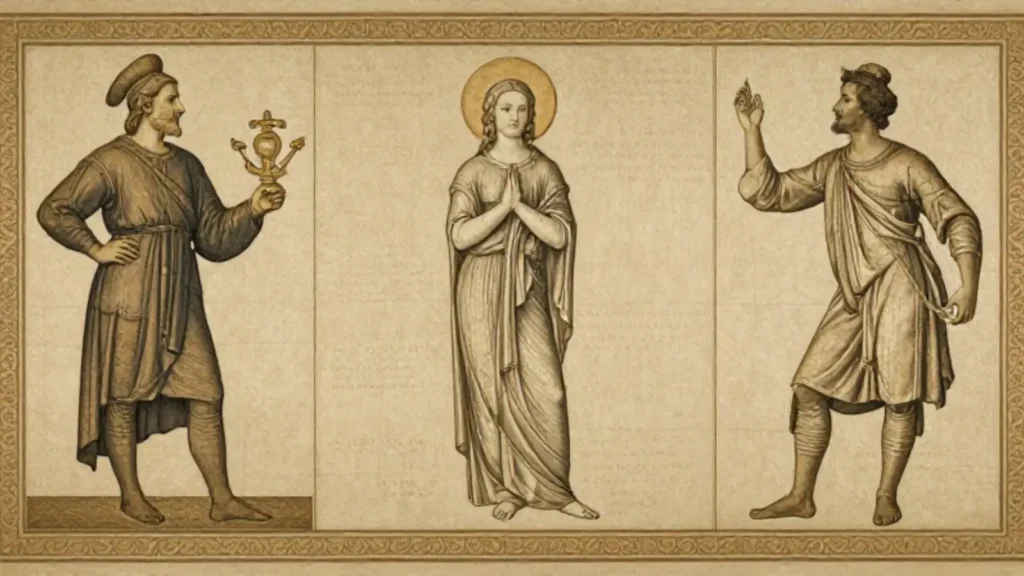
Humans have used visual symbols for thousands of years. Prehistoric cave paintings, ritual objects, burial artifacts, architectural decorations, and early religious images demonstrate that visual representation has long served purposes beyond simple description.
Ancient civilizations developed sophisticated symbolic systems. Egyptian art, for example, frequently connected images, objects, gestures, animals, colors, and hieroglyphic writing with religious and political ideas. Greek and Roman artists drew upon mythology, allegory, attributes of deities, and personifications.
During the medieval period in Europe, Christian art relied heavily on recognizable visual symbols. Saints could be identified through attributes associated with their stories, while objects such as the cross, lamb, dove, or halo carried religious significance.
Renaissance artists inherited many of these conventions while developing increasingly complex systems of allegory and iconography.
The rise of Symbolism as an artistic movement
There is also an important distinction between symbolism as a general artistic practice and Symbolism as a specific late-19th-century art movement.
The Symbolist movement emerged first in French literature during the 1880s and subsequently influenced visual artists across Europe. Symbolist artists reacted against approaches that emphasized objective naturalism and instead sought to express ideas, emotions, dreams, spirituality, and subjective experience. The Metropolitan Museum of Art describes Symbolism as a movement in which art emphasized emotion and ideas rather than objective representation of the natural world.
Artists associated with Symbolist tendencies included Gustave Moreau, Odilon Redon, Pierre Puvis de Chavannes, Arnold Böcklin, Edward Burne-Jones, Paul Gauguin, and later Gustav Klimt, among others. The movement was diverse rather than a single uniform style.
The Museum of Modern Art similarly characterizes Symbolism as an international avant-garde movement that began in France and spread across Europe and North America during the final decades of the nineteenth century.
Symbolism, Iconography, and Semiotics: What’s the Difference?
These concepts overlap, but they are not identical.
| Concept | Main concern | Simple explanation |
| Symbolism | Deeper meaning | An image represents an idea beyond itself |
| Iconography | Recognizable subject matter | Identifying and interpreting conventional visual motifs |
| Semiotics | Signification | Studying how signs create and communicate meaning |
| Allegory | Extended conceptual meaning | A larger narrative in which people, objects, or events represent ideas |
| Metaphor | Comparison | One thing is used to illuminate another |
| Motif | Repeated element | An image or visual idea appearing repeatedly in a work or body of work |
Semiotics is particularly useful for understanding modern visual culture. In semiotic analysis, a visual sign can be considered in relation to both its visible form and what it represents. MoMA’s discussion of Hal Fischer’s Gay Semiotics, for example, explicitly describes semiotics as the study of how meaning is created and communicated through signs.
This also demonstrates why symbols are rarely completely universal. A sign can acquire specialized meanings within particular communities.
Common Symbols in Art and Their Possible Meanings
No symbol has a single meaning in every culture, but certain motifs recur frequently.
| Symbol | Common associations | Why context matters |
| Rose | Love, beauty, desire, mortality | Color and cultural setting can change interpretation |
| Dove | Peace, spirituality, innocence | Religious imagery may add specific meanings |
| Snake | Transformation, danger, healing, temptation | Different traditions interpret snakes very differently |
| Mirror | Identity, vanity, self-knowledge, illusion | Narrative context determines emphasis |
| Tree | Life, growth, ancestry, connection | May have religious or mythological significance |
| Water | Renewal, emotion, purification, change | Calm and turbulent water can communicate different ideas |
| Skull | Death, mortality, vanity, remembrance | Historical genre affects interpretation |
| Bird | Freedom, soul, transcendence | Species and cultural tradition matter |
| Crown | Authority, status, sovereignty | Can also symbolize pride or oppression |
| Doorway | Transition, opportunity, mystery | Its surrounding imagery changes its meaning |
Expert Tip
Never interpret a symbol in isolation. Ask three questions:
- What is shown?
- What is happening around it?
- What did this image mean in its historical and cultural context?
That approach is usually more reliable than relying on a generic “symbol meanings” list.
Color Symbolism in Art
Color is one of the most influential symbolic tools available to artists.
Red may suggest passion, danger, violence, love, sacrifice, or vitality. Blue can communicate calmness, spirituality, distance, melancholy, or authority. White may suggest purity or peace in some contexts while representing mourning in others.
Black can evoke death, mystery, elegance, grief, power, or the unknown. Green can suggest nature, fertility, renewal, jealousy, or political identity depending on context.
However, color psychology should not be reduced to universal formulas.
A color’s meaning depends on culture, historical period, material, surrounding colors, subject matter, and personal experience. A painter can deliberately reverse an established association. Contemporary artists frequently exploit these expectations by making familiar colors feel unfamiliar.
Why color works symbolically
Color affects perception before viewers consciously analyze an image. Artists can therefore use color to establish atmosphere and guide attention.
For example, imagine the same portrait:
- surrounded by warm reds and oranges, it may feel passionate or threatening;
- surrounded by pale blues, it may appear distant or contemplative;
- surrounded by deep black, it may become mysterious or mournful.
The symbolic meaning emerges from the relationship between color and context.
Symbolism in Religious and Spiritual Art
Religion has played a major role in the development of visual symbolism.
Religious art often needs to communicate concepts that cannot be directly photographed: divinity, salvation, resurrection, transcendence, sacred authority, sin, enlightenment, or the afterlife.
Christian art developed extensive symbolic traditions involving the cross, halo, lamb, dove, fish, vine, and various attributes associated with biblical narratives and saints.
Buddhist and Hindu visual traditions likewise contain extensive symbolic systems involving gestures, lotus imagery, sacred geometry, deities, animals, colors, objects, and spatial arrangements.
Islamic artistic traditions have developed rich uses of geometry, arabesque, ornament, architecture, and calligraphy, although representational practices vary substantially across contexts.
The lesson is important: religious symbolism cannot be interpreted responsibly by applying one universal symbolic dictionary to every tradition.
Historical context and theological tradition matter.
Symbolism Across Different Cultures
Symbolic meaning changes when images travel across cultures.
Consider the owl. In some traditions, owls have associations with wisdom, while in others they can be connected with darkness, death, or supernatural beliefs.
The lotus has major symbolic significance in several Asian religious and cultural traditions, where it can be associated with purity, spiritual development, or emergence from difficult conditions.
The lion can represent courage, sovereignty, strength, guardianship, or political authority.
The same visual object can therefore function as a cultural sign rather than a universal psychological code.
Did You Know?
Even apparently “natural” symbols are culturally interpreted. A sunrise is physically the same phenomenon everywhere, but an artist can use it to represent birth, resurrection, hope, nationalism, a new era, or simply the passage of time.
Psychological Meaning of Symbolism in Art
Symbolic art often operates on both conscious and unconscious levels.
A viewer might immediately recognize a skull as a reference to death, while a particular composition may produce a less easily articulated feeling of anxiety or isolation.
Psychological interpretation can help explain why certain visual elements feel emotionally powerful. Repetition, contrast, scale, color, spatial distance, facial expression, gesture, and visual ambiguity can all influence how viewers respond.
However, psychological interpretation should not be confused with scientific certainty.
It is tempting to claim that every symbol represents a universal unconscious archetype. Some interpretations may be useful frameworks, but they should not automatically be treated as proven facts about every viewer.
Common Mistake
Mistake: Assuming that everyone interprets a symbol identically.
Better approach: Separate three layers:
- the artist’s likely intention,
- the cultural or historical convention,
- the individual viewer’s interpretation.
These layers can agree—or conflict.
Mythology and Symbolism in Art
Mythology provides artists with a ready-made vocabulary of characters, stories, conflicts, and metaphors.
Greek mythology has influenced countless works involving figures such as Aphrodite, Apollo, Athena, Medusa, Narcissus, Orpheus, Icarus, and Oedipus.
Symbolist artists in particular frequently drew upon mythology, biblical narratives, dreams, and fantastic imagery. The Met notes that early Symbolist artists created dreamlike worlds populated by biblical figures, Greek mythological subjects, and fantastical creatures.
Gustave Moreau’s Oedipus and the Sphinx illustrates how myth could become a vehicle for psychological and philosophical questions rather than simply a depiction of an ancient story.
Myth therefore functions as a symbolic framework: the familiar story gives viewers an entry point while the artist changes emphasis to explore contemporary concerns.
Symbolism in Literary and Visual Storytelling
Artists and writers use symbolism in remarkably similar ways.
A novelist may use a storm to reflect emotional conflict. A painter may create the same association through turbulent skies.
A writer may introduce a locked door as a metaphor for secrecy. A filmmaker can communicate the same idea through composition and lighting.
This relationship between literature and visual art was particularly important during the Symbolist period, when artists and writers shared an interest in suggestion, ambiguity, dreams, spirituality, and subjective experience. The Met identifies the movement’s literary beginnings in France during the 1880s before its ideas became closely associated with visual artists.
Symbolism therefore acts as a bridge between visual storytelling and language-based storytelling.
Symbolism in Famous Symbolist Art
Several artists demonstrate how symbolism can operate differently from straightforward representation.
Gustave Moreau
Moreau used biblical and mythological subjects to explore psychological tension, desire, mystery, violence, and spirituality.
Odilon Redon
Redon’s strange creatures, floating heads, dreamlike environments, and unusual color relationships demonstrate how an image can suggest a psychological state without providing a literal narrative.
Paul Gauguin
Gauguin used simplified forms, intense color, and symbolic compositions to move away from conventional naturalistic representation.
Gustav Klimt
Klimt combined ornamental pattern with symbolic imagery, exploring themes involving sexuality, life, death, desire, and human relationships. His work also demonstrates the connection between Symbolism and the decorative arts associated with Art Nouveau.
Edward Burne-Jones
Burne-Jones created highly imaginative works that often resist simple interpretation. Even The Golden Stairs has generated debate over its meaning, illustrating an important truth about symbolism: an artwork can support interpretation without having one universally agreed explanation.
How Artists Create Symbolic Meaning
Symbolism does not come only from individual objects. Artists can create meaning through the entire visual structure.
Composition
Where an object appears can change its symbolic importance.
A tiny figure surrounded by enormous empty space may communicate vulnerability or isolation.
Scale
Making an object unusually large can transform it from an ordinary detail into a dominant conceptual element.
Repetition
Repeated motifs can establish visual themes and create associations.
Contrast
Light versus darkness, confinement versus openness, and natural versus artificial forms can symbolize conceptual oppositions.
Gesture and body language
Hands, posture, facial expressions, and movement can communicate power, submission, grief, affection, resistance, or uncertainty.
Space
Distance between figures can suggest intimacy or alienation.
This is why symbolism in art should be analyzed as a system, not as a collection of isolated objects.
How to Analyze Symbolism in Art: A Practical Method
When looking at an unfamiliar artwork, use this five-step process.
1. Describe before interpreting
Write down what you literally see without assigning meaning.
2. Identify unusual details
Look for objects, colors, gestures, animals, patterns, settings, or repeated forms that seem deliberate.
3. Investigate context
Ask:
- Who created the work?
- When was it created?
- Where?
- For whom?
- What cultural or religious traditions influenced it?
4. Compare possible meanings
Consider at least two interpretations rather than immediately choosing one.
5. Connect the symbols to the whole artwork
A symbol becomes meaningful through its relationship with composition, subject matter, title, medium, historical context, and other visual elements.
This method reduces the risk of projecting modern assumptions onto historical artworks.
Myth vs. Fact: Symbolism in Art
| Myth | Fact |
| Every symbol has one universal meaning | Meanings vary by culture and context |
| Artists always explain their symbols | Many artists intentionally leave meanings open |
| Symbolism is only about objects | Color, composition, gesture, space, and form can also symbolize |
| Symbolic art is always religious | Symbolism appears in secular, political, personal, commercial, and contemporary art |
| Symbolism ended with 19th-century Symbolism | Symbolic visual communication continues throughout contemporary culture |
Symbolism in Modern Art and Digital Culture
Symbolism did not disappear when traditional painting changed.
Contemporary artists use photographs, installations, sculpture, video, performance, digital imagery, found objects, text, and conceptual strategies to create symbolic relationships.
Modern visual communication also demonstrates how quickly symbols can evolve.
Logos, emojis, icons, interface elements, memes, fashion, advertising images, political posters, album covers, tattoos, and social-media graphics all rely on learned visual associations.
MoMA’s documentation of Hal Fischer’s Gay Semiotics offers a useful modern example of how clothing and visual details can become coded signs within a particular social community—and how the meaning of a visual sign can remain ambiguous outside that context.
This illustrates a broader principle: symbols work because communities learn relationships between forms and meanings.
Symbolism in Branding and Design
Brands rely heavily on symbolic communication.
A logo may use:
- geometric forms to suggest precision,
- organic shapes to suggest naturalness,
- particular colors to establish identity,
- animals to communicate strength or speed,
- minimalist design to suggest modernity,
- heritage imagery to communicate tradition.
But successful branding requires cultural sensitivity.
A symbol that feels positive in one market may have an unintended association elsewhere. Designers therefore need to understand cultural symbolism, color traditions, historical references, typography, and local visual conventions.
Practical Application
When designing a brand identity, ask:
What does this image literally show? What does it imply culturally? What emotion does it create? And could a different audience interpret it differently?
That four-part test can prevent many symbolic design mistakes.
Symbolism in Education and Art Appreciation
Teaching symbolism can make art history more engaging because students learn to investigate rather than simply memorize.
Instead of saying:
“The object means X.”
A teacher can ask:
- What do you notice?
- Why might the artist have included it?
- What did this object mean historically?
- What could it mean today?
- Are there competing interpretations?
This approach encourages visual literacy, critical thinking, cultural awareness, and evidence-based interpretation.
It also teaches students an important research skill: distinguishing documented meaning from speculation.
Common Mistakes When Interpreting Symbolism
1. Treating online symbol lists as universal truth
Symbol dictionaries can be useful starting points, but they are not substitutes for historical research.
2. Ignoring the artist
An artist’s writings, titles, sketches, commissions, letters, or other works may provide valuable evidence.
3. Ignoring the audience
A symbol created for a particular religious or political community may have been immediately recognizable to its original viewers.
4. Applying modern meanings to historical art
Contemporary interpretations can be interesting, but they should not automatically replace historical context.
5. Confusing possibility with certainty
If evidence is incomplete, say that an interpretation is possible, plausible, debated, or contested rather than presenting it as established fact.
Key Insights About Symbolism in Art
The most important ideas can be summarized simply:
- Symbols communicate beyond literal appearance.
- Context determines meaning.
- The same symbol can mean different things in different cultures.
- Symbolism is broader than the 19th-century Symbolist movement.
- Color, composition, space, gesture, and form can all become symbolic.
- Religious and mythological traditions have strongly influenced visual symbolism.
- Semiotics helps explain how visual signs create meaning.
- Personal interpretation can coexist with historical evidence.
- Ambiguity is often a deliberate artistic strategy.
- Modern branding, media, and digital communication continue to depend on symbolic thinking.
FAQ: Symbolism in Art
What is symbolism in art?
Symbolism in art is the use of visual elements such as objects, colors, animals, gestures, settings, or compositions to communicate ideas beyond their literal appearance. Symbolic imagery can express emotions, beliefs, cultural values, philosophical concepts, personal experiences, or social commentary.
Why do artists use symbolism?
Artists use symbolism because some ideas are difficult to communicate directly. Symbolic imagery allows an artwork to suggest complex concepts such as love, mortality, spirituality, identity, conflict, freedom, memory, or transformation while leaving room for interpretation.
Is symbolism in art universal?
No. Some symbolic associations are widespread, but meanings are strongly influenced by culture, religion, historical period, artistic tradition, and personal experience. A symbol that represents one concept in one society can communicate something very different elsewhere.
What is the difference between Symbolism and symbolism?
Symbolism with a capital S generally refers to the late-19th-century artistic and literary movement associated with subjective, emotional, spiritual, mythological, and dreamlike expression. Symbolism with a lowercase s refers more broadly to the use of symbols to communicate meaning in art and visual culture.
How can you identify symbolism in an artwork?
Start by describing the artwork literally, then identify unusual or repeated objects, colors, gestures, patterns, and compositional choices. Next, research the artist, period, cultural context, and relevant traditions. Finally, compare possible interpretations and connect individual symbols to the artwork as a whole.
Why is symbolism still important today?
Symbolism remains important because humans continue to communicate visually through art, design, advertising, logos, photography, film, architecture, fashion, emojis, digital interfaces, and social media. Modern visual culture constantly creates and reinterprets symbols.
Final Takeaways
Symbolism in art is essentially a language of suggested meaning. It transforms ordinary visual elements into carriers of emotion, memory, cultural identity, spirituality, political ideas, psychological states, and philosophical questions.
Its history reaches from ancient visual traditions to medieval religious art, Renaissance allegory, nineteenth-century Symbolism, modernist experimentation, contemporary art, branding, digital communication, and online visual culture.
The most reliable way to interpret symbolic art is not to memorize what every object supposedly “means.” Instead, examine the artist, artwork, historical context, cultural tradition, visual relationships, and viewer perspective together.
That approach respects both artistic ambiguity and historical evidence and explains why symbolism continues to make art more layered, memorable, and intellectually engaging.

Amelia Rosewood writes about symbolic meanings, ancient traditions, and the emotional connections between humans and symbols.
