Christian symbolism has shaped art, architecture, literature, worship, education, and cultural identity for nearly two thousand years.
From the cross displayed in churches to the fish symbol seen on vehicles, Christian symbols communicate profound theological ideas through simple visual forms.
These symbols help believers remember biblical teachings, express faith, and connect with centuries of Christian tradition.
Understanding Christian symbolism goes beyond recognizing familiar images. It reveals how visual communication has preserved religious beliefs, inspired artists, influenced architecture, and strengthened communities throughout history.
Whether viewed from a theological, historical, cultural, or artistic perspective, Christian symbols remain among the world’s most recognizable and meaningful forms of symbolic expression.
Featured Snippet: What Is Christian Symbolism?

Christian symbolism refers to the use of visual signs, objects, colors, animals, numbers, and images that represent biblical teachings, Christian beliefs, spiritual truths, and the life of Jesus Christ. These symbols communicate complex theological concepts, preserve religious traditions, inspire worship, and express faith across cultures and generations.
What Does Christian Symbolism Mean?
Quick Answer
Christian symbolism is the practice of expressing Christian beliefs through meaningful visual representations that point beyond themselves to deeper spiritual realities.
Unlike simple decoration, Christian symbols carry layers of meaning rooted in Scripture, church history, theology, and cultural tradition. They serve as teaching tools, reminders of faith, and expressions of spiritual identity.
Christian symbolism often represents:
- God’s love
- Salvation
- Hope
- Eternal life
- Resurrection
- Forgiveness
- Sacrifice
- Faithfulness
- Divine protection
- The Kingdom of God
Each symbol invites reflection rather than functioning as an object of worship.
The Historical Origins of Christian Symbolism

Early Christianity
The earliest Christians often practiced their faith secretly because of persecution within the Roman Empire.
Instead of displaying obvious religious imagery, believers used discreet symbols to identify one another.
Some of the earliest symbols included:
- The Fish (Ichthys)
- Anchor
- Shepherd
- Dove
- Vine
- Bread
- Wine
These symbols appeared in underground meeting places, tombs, pottery, and personal belongings.
Development Through Church History
As Christianity spread across Europe, Asia, Africa, and later the Americas, symbolism expanded dramatically.
Major influences included:
- Biblical narratives
- Jewish traditions
- Roman artistic styles
- Byzantine iconography
- Medieval theology
- Renaissance art
- Gothic architecture
Over time, Christian symbolism became integrated into:
- Church buildings
- Paintings
- Sculpture
- Manuscripts
- Music
- Stained glass
- Liturgical clothing
Why Christian Symbolism Remains Important Today
Christian symbols continue to serve multiple purposes.
They help people:
- Remember biblical teachings
- Express religious identity
- Teach children about faith
- Preserve historical traditions
- Inspire prayer and worship
- Strengthen community belonging
- Communicate beliefs across language barriers
Modern churches also use symbolism in digital media, educational materials, logos, and branding.
Major Christian Symbols and Their Meanings

| Symbol | Primary Meaning | Biblical Connection | Common Use |
| Cross | Salvation and sacrifice | Crucifixion of Jesus | Churches, jewelry |
| Fish (Ichthys) | Christian identity | Calling of disciples | Cars, logos |
| Dove | Holy Spirit and peace | Jesus’ baptism | Baptism imagery |
| Lamb | Jesus as the Lamb of God | Gospel of John | Easter celebrations |
| Anchor | Hope and stability | Hebrews 6 | Christian art |
| Vine | Spiritual life | John 15 | Church decoration |
| Bread | Christ as the Bread of Life | Last Supper | Communion |
| Light | God’s presence | Gospel of John | Candles, worship |
| Alpha and Omega | God’s eternity | Revelation | Religious artwork |
| Crown | Victory and eternal life | New Testament | Christian illustration |
The Cross: The Central Symbol of Christianity
Featured Answer
The cross is the most recognized Christian symbol because it represents Jesus Christ’s crucifixion, sacrificial love, forgiveness, redemption, and resurrection hope.
Although the cross originally symbolized execution in the Roman world, Christians came to understand it as a symbol of victory over sin and death through the resurrection of Christ.
Today, the cross represents:
- Faith
- Redemption
- Hope
- Mercy
- Eternal life
- God’s love
Different Christian traditions display crosses in various artistic forms while sharing these core meanings.
The Fish (Ichthys): A Secret Sign of Faith
The Greek word Ichthys became an acronym for a confession of faith in Jesus Christ.
Historically, the fish symbol allowed Christians to identify one another discreetly during periods of persecution.
Today it symbolizes:
- Christian identity
- Evangelism
- Discipleship
- Faith in Christ
It remains popular on vehicles, businesses, churches, and educational institutions.
Colors in Christian Symbolism

Color has long been used to communicate theological ideas.
| Color | Symbolic Meaning |
| White | Purity, resurrection, holiness |
| Purple | Royalty, repentance |
| Red | Sacrifice, love, the Holy Spirit |
| Green | Growth, hope, eternal life |
| Gold | Glory, heaven, divinity |
| Blue | Heaven, faithfulness |
| Black | Mourning, reflection |
Different Christian traditions may assign slightly different meanings depending on liturgical practices.
Animals in Christian Symbolism
Animals frequently appear in Scripture and Christian art.
Dove
Represents:
- Peace
- Holy Spirit
- New beginnings
Lamb
Represents:
- Innocence
- Sacrifice
- Jesus Christ
Lion
Represents:
- Strength
- Kingship
- Courage
Eagle
Represents:
- Spiritual vision
- Resurrection
- Divine inspiration
Pelican
In medieval Christian tradition, the pelican symbolized self-sacrificial love because of a long-standing legend that it fed its young with its own blood. This symbolism is devotional rather than based on animal behavior.
Numbers in Christian Symbolism
Biblical numbers often carry symbolic meaning.
| Number | Common Symbolism |
| 3 | Trinity |
| 7 | Completion |
| 12 | God’s people |
| 40 | Testing and preparation |
| 1 | Unity |
| 10 | Divine order |
Scholars note that symbolic interpretation of numbers depends on literary and historical context rather than serving as hidden codes.
Christian Symbolism in Art
Christian art communicates theology visually.
Artists use symbolism to represent:
- Heaven
- Resurrection
- Saints
- Angels
- Biblical stories
- Spiritual virtues
Examples include:
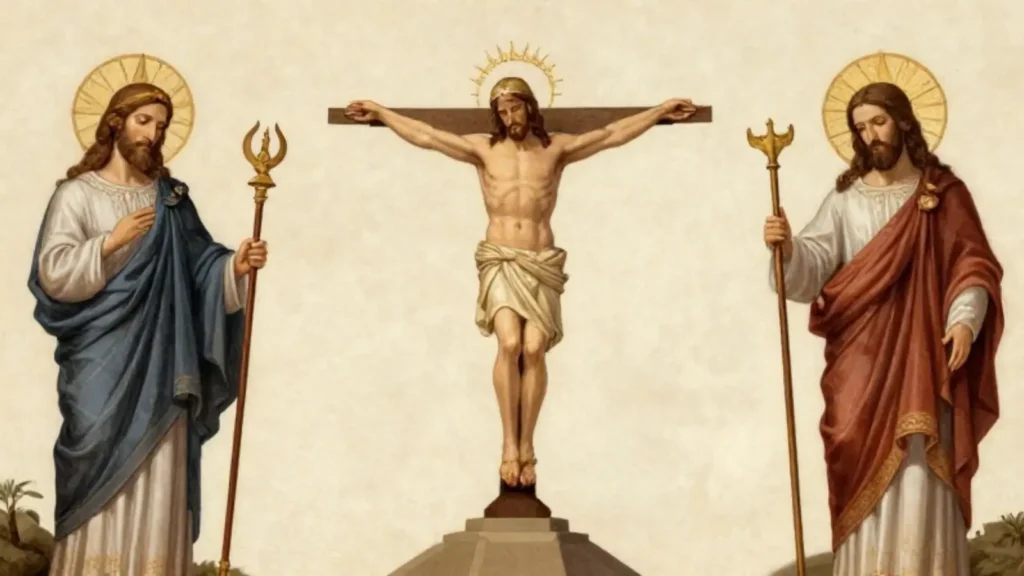
- Halos representing holiness
- Light symbolizing God’s presence
- Vine motifs illustrating spiritual connection
- Water representing baptism
From Byzantine mosaics to Renaissance masterpieces, symbolism has helped viewers engage with biblical narratives.
Christian Symbolism in Architecture
Church architecture itself contains symbolic meaning.
Common examples include:
- Steeples pointing toward heaven
- East-facing sanctuaries symbolizing resurrection hope
- Stained glass teaching biblical stories
- Baptismal fonts representing spiritual rebirth
- Circular windows symbolizing eternity
Architecture combines function, beauty, and theology into one unified symbolic language.
Christian Symbolism Across Cultures

Christian symbols are understood worldwide, but local traditions often shape artistic expression.
| Region | Common Symbolic Emphasis |
| Europe | Medieval iconography |
| Middle East | Early biblical heritage |
| Africa | Community and celebration |
| Latin America | Festivals and devotional art |
| Asia | Local artistic traditions integrated with Christian themes |
| North America | Contemporary visual communication |
While the core theological meanings remain similar, artistic styles often reflect regional culture.
Psychological Meaning of Christian Symbolism
Symbols help people process complex ideas more effectively than abstract language alone.
From a psychological perspective, symbols can:
- Strengthen memory
- Encourage reflection
- Foster community identity
- Support ritual practices
- Create emotional connection
- Reinforce shared values
Their influence arises through learning, culture, and personal experience rather than through inherent supernatural properties.
Christian Symbolism in Literature
Christian symbolism appears throughout world literature.
Authors use symbols to explore themes such as:
- Redemption
- Hope
- Sacrifice
- Forgiveness
- Moral struggle
- Resurrection
- Faith
Even works that are not explicitly religious may draw upon Christian imagery because of its long-standing influence on Western literature.
Christian Symbolism in Modern Design and Branding
Many organizations incorporate Christian symbolism into:
- Church logos
- Educational institutions
- Charitable organizations
- Non-profit identities
- Digital media
- Social media graphics
- Worship presentations
Effective religious branding uses symbols respectfully while ensuring they remain clear, meaningful, and culturally appropriate.
Christian Symbolism and Semiotics
Semiotics is the study of signs and symbols.
In Christian symbolism:
- The signifier is the visible image, such as a cross.
- The signified is the spiritual meaning associated with that image, such as Christ’s sacrificial love and redemption.
This relationship explains why symbols communicate ideas so powerfully across languages and cultures.
Did You Know?
- The fish symbol predates the widespread public use of the cross in Christian communities.
- Many medieval churches were designed to teach biblical stories visually because literacy rates were lower than today.
- Christian symbolism includes not only images but also gestures, music, architecture, colors, and liturgical seasons.
- Some symbols have evolved over centuries while retaining their core theological significance.
Expert Tip
When studying Christian symbolism, distinguish between:
- Biblical symbolism explicitly found in Scripture.
- Historical traditions developed by Christian communities.
- Artistic conventions created by painters, architects, and iconographers.
- Local cultural expressions that reflect regional customs.
Recognizing these differences provides a more accurate understanding of how symbols function in Christian life.
Common Mistakes
Assuming every Christian tradition interprets symbols identically
Different denominations may emphasize symbols differently while sharing core beliefs.
Treating symbols as objects of worship
In mainstream Christian teaching, symbols point toward spiritual truths rather than replacing them.
Ignoring historical context
Many symbols gained additional meanings as Christianity spread into new cultures.
Assuming every artistic symbol comes directly from the Bible
Some symbols originated through centuries of Christian art and tradition rather than explicit biblical passages.
Myth vs. Fact
| Myth | Fact |
| Every Christian symbol appears directly in the Bible. | Some symbols developed later through church history and artistic tradition. |
| Symbols have identical meanings everywhere. | Interpretation may vary across cultures and denominations. |
| Christian symbolism is only about art. | It also influences worship, education, architecture, literature, music, and design. |
| Symbols replace faith. | Symbols are intended to communicate and reinforce faith, not substitute for it. |
Practical Applications of Christian Symbolism
Christian symbolism is used in many areas of everyday life.
Examples include:
- Religious education
- Church architecture
- Graphic design
- Cultural heritage preservation
- Museum interpretation
- Biblical storytelling
- Faith-based branding
- Visual communication
- Academic theology
- Community celebrations
These applications demonstrate how symbols continue to bridge history, belief, and modern communication.
Key Insights
- Christian symbolism combines theology, history, art, and culture.
- Symbols communicate complex spiritual ideas through visual language.
- Historical context is essential for accurate interpretation.
- Cultural traditions enrich symbolic expression without necessarily changing core beliefs.
- Christian symbols continue to influence architecture, literature, education, design, and digital communication worldwide.
Conclusion
Christian symbolism represents one of the richest visual traditions in human history. Through symbols such as the cross, fish, dove, lamb, light, and vine, Christians have expressed beliefs about God’s love, redemption, hope, and eternal life across centuries and cultures.
While interpretations may vary among traditions and historical contexts, these symbols consistently serve as powerful tools for teaching, remembrance, artistic expression, and communal identity.
Understanding Christian symbolism also deepens appreciation for the broader roles that symbols play in communication, education, architecture, literature, branding, and cultural heritage.
Whether viewed through the lens of theology, history, anthropology, psychology, or design, Christian symbols continue to shape how people interpret meaning and connect with enduring spiritual narratives.

Nathaniel Brooks analyzes symbols, their origins, cultural importance, and psychological impact across history and modern society.
