A feather can look almost weightless, yet feather symbolism carries remarkably rich meanings across human history. Because feathers belong to birds creatures associated with flight, height, movement, and the sky they have often become visual metaphors for freedom, transcendence, spirituality, communication, protection, beauty, status, and transformation.
But there is no single universal meaning: a feather’s significance depends heavily on the bird, culture, historical period, color, setting, and person interpreting it.
From ancient Egyptian representations of Ma’at to Māori feather cloaks, Indigenous ceremonial traditions, medieval religious art, royal heraldry, literary quills, fashion, tattoos, jewelry, and contemporary branding, feathers repeatedly appear wherever humans want to express something that feels lighter, higher, or more meaningful than ordinary physical existence.
Understanding feather symbolism therefore means looking beyond the familiar idea of “freedom.” A feather can represent truth, authority, remembrance, creativity, identity, spiritual connection, or even mortality. Its power comes partly from its physical characteristics
and partly from the meanings societies have built around those characteristics.
Featured-Snippet Answer: What Does a Feather Symbolize?
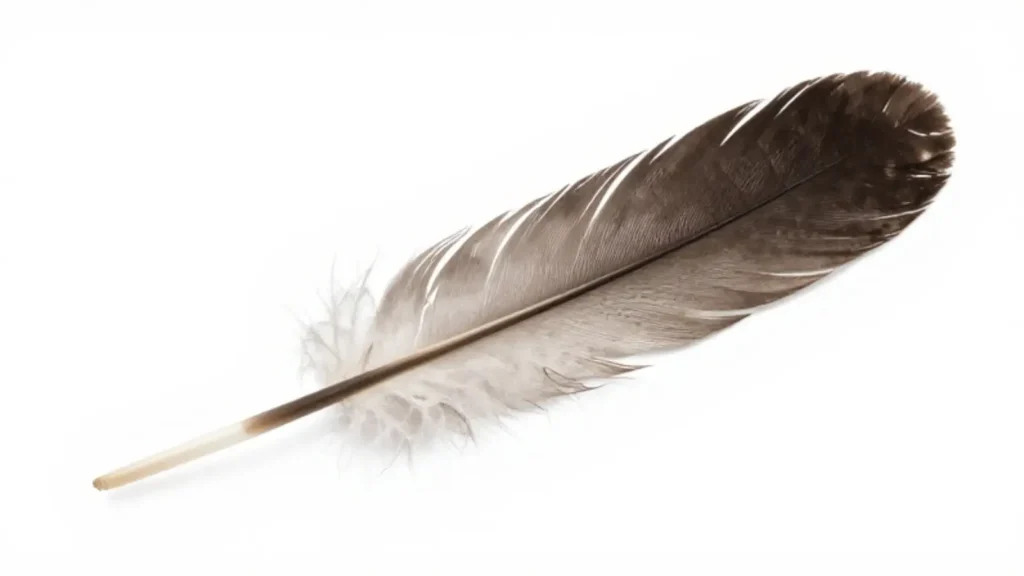
Feather symbolism commonly represents freedom, spiritual connection, transcendence, protection, communication, truth, wisdom, creativity, and transformation. However, its meaning is not universal. Different cultures and traditions associate particular feathers with status, sacredness, justice, remembrance, identity, or divine connection, making context essential when interpreting a feather as a symbol.
What Is the Symbolism of a Feather?
At its broadest level, a feather symbolizes the possibility of rising above ordinary limitations.
A feather is simultaneously light and functional. It helps a bird fly, protects its body, regulates temperature, attracts mates, and can provide camouflage. Humans observing these qualities naturally incorporated feathers into visual language.
Common symbolic associations include:
- 🪶 Freedom — because birds fly through open skies.
- 🌬️ Lightness — because feathers are delicate and easily carried by air.
- 🪽 Spirituality — because flight creates an intuitive association with heaven or the unseen.
- ⚖️ Truth and justice — particularly through the ancient Egyptian feather of Ma’at.
- 🦅 Honor and authority — especially when associated with culturally significant birds.
- ✍️ Communication and creativity — through the historical use of quills.
- 🌱 Transformation — because feathers can suggest growth, movement, and a new direction.
- 🕊️ Peace and remembrance — depending on the bird and cultural context.
The crucial point is that these meanings are associations rather than biological laws. A feather itself does not inherently “mean” freedom. Rather, human beings interpret its physical qualities through cultural systems of symbolism, mythology, religion, art, and language.
The Historical Evolution of Feather Symbolism
Feathers have been meaningful to humans for thousands of years, partly because birds occupy a fascinating position between earth and sky.
Humans walk on the ground; birds can suddenly leave it.
That visual difference made birds powerful subjects for mythology and religious imagination.
Ancient Egypt: The Feather of Ma’at
One of the clearest historical examples appears in ancient Egyptian religion.
Ma’at represented truth, justice, balance, harmony, and cosmic order. She was commonly depicted with an ostrich feather, and Egyptian beliefs surrounding the afterlife included the weighing of the deceased person’s heart against Ma’at’s feather. A balanced heart indicated moral fitness to continue into the afterlife.
This gives the feather a particularly sophisticated symbolic role.
It was not simply “lightness.” It became an instrument of moral measurement.
The feather therefore represented an ideal against which human behavior could be judged: truth, balance, righteousness, and proper order.
Feathered Objects and Royal Display
Feathers also became associated with wealth, ceremony, and prestige.
Ancient Egyptian royal objects included ostrich-feather fans, while feathers appeared in elite visual culture and ceremonial contexts.
This demonstrates an important principle in symbolism:
A natural object can acquire social meaning when societies repeatedly place it in powerful ceremonial contexts.
The feather moves from nature into ritual, art, clothing, and political identity.
Feather Symbolism Across Cultures
There is no single “global feather meaning.” Comparing cultures reveals something more interesting: different communities can use similar physical qualities to create very different symbolic systems.
| Cultural context | Feather-related symbolism | Important context |
| Ancient Egypt | Truth, justice, balance, cosmic order | Ma’at and the feather of judgment |
| Māori traditions | Prestige, spiritual connection, identity | Bird feathers and feather cloaks |
| Some Indigenous North American traditions | Sacredness, honor, prayer, ceremony | Meanings vary significantly by nation |
| European heraldry | Rank, distinction, ceremonial identity | Specific heraldic meanings are context-dependent |
| Christian art | Heavenly beings, transcendence, protection | Wings are more central than isolated feathers |
| Writing traditions | Knowledge, authorship, communication | Quill pens |
| Modern design | Freedom, elegance, creativity | Highly dependent on visual context |
| Contemporary memorial imagery | Remembrance and spiritual comfort | Modern symbolic convention rather than universal doctrine |
Māori Feather Traditions
Māori featherwork provides an especially important example of feathers functioning as cultural objects rather than generic decorations.
Te Papa explains that feather cloaks, known as kahu huruhuru, derive prestige or mana partly from Māori beliefs about birds as children of Tāne, the god of the forest, and as messengers between spiritual and physical realms. Different birds can possess particular qualities, and those qualities can be associated with objects made from their feathers.
Certain feathers have also carried strong associations with leadership, peace, remembrance, and resistance.
The Raukura feather tradition, for example, became associated with peaceful resistance and Māori identity through the teachings and actions of Te Whiti-o-Rongomai and Tohu Kākahi.
This is why casually describing every Indigenous feather as a generic “symbol of freedom” can be misleading.
The history is often much more specific.
Indigenous Feather Symbolism: Why Context Matters
Feathers, particularly eagle feathers, hold profound significance in many Indigenous communities in North America, but it is important not to treat hundreds of distinct nations and traditions as one cultural system.
The Smithsonian has documented the significance of eagle feathers to Native American communities and the role of the National Eagle Repository in providing eagle parts for cultural, religious, ceremonial, and artistic uses.
For some communities, eagle feathers may be connected with:
- honor
- prayer
- ceremony
- blessing
- leadership
- respect
- spiritual relationships
- important life events
But the precise meaning and protocols differ among nations, families, and communities.
Expert Tip
When discussing Indigenous feather symbolism, avoid saying “Native Americans believe feathers mean X.”
A more accurate formulation is:
“Some Indigenous nations and communities have traditions in which particular feathers, especially eagle feathers, carry sacred, ceremonial, or honor-related significance.”
That small linguistic change makes the explanation more historically responsible.
Feather Symbolism in Religion and Spirituality
Feathers frequently appear in religious imagery because they visually connect earthly existence with the sky.
Christianity and Angelic Imagery
In Christian visual culture, feathers are strongly associated with wings and therefore with angels and heavenly beings.
However, an important distinction should be made: the familiar image of a humanlike angel with feathered wings is primarily a product of artistic and iconographic traditions rather than a simple description found throughout biblical texts.
Over centuries, Christian artists developed visual conventions for depicting heavenly beings. Feathers consequently became part of a broader visual vocabulary involving heaven, divine messengers, protection, holiness, and transcendence.
The feather’s symbolism here comes from the wing, rather than necessarily from an isolated feather.
The Feather as a Spiritual Metaphor
In contemporary spiritual culture, people may interpret finding a feather as:
- a sign of guidance
- a reminder of someone who has died
- protection
- reassurance
- spiritual presence
- a message from the unseen
- encouragement during transition
These are belief-based interpretations, not scientifically established facts.
That distinction matters.
There is no scientific evidence establishing that finding a particular feather objectively communicates a supernatural message. The experience can nevertheless be personally meaningful because symbols acquire significance through memory, emotion, culture, and personal narrative.
Feather Symbolism in Psychology
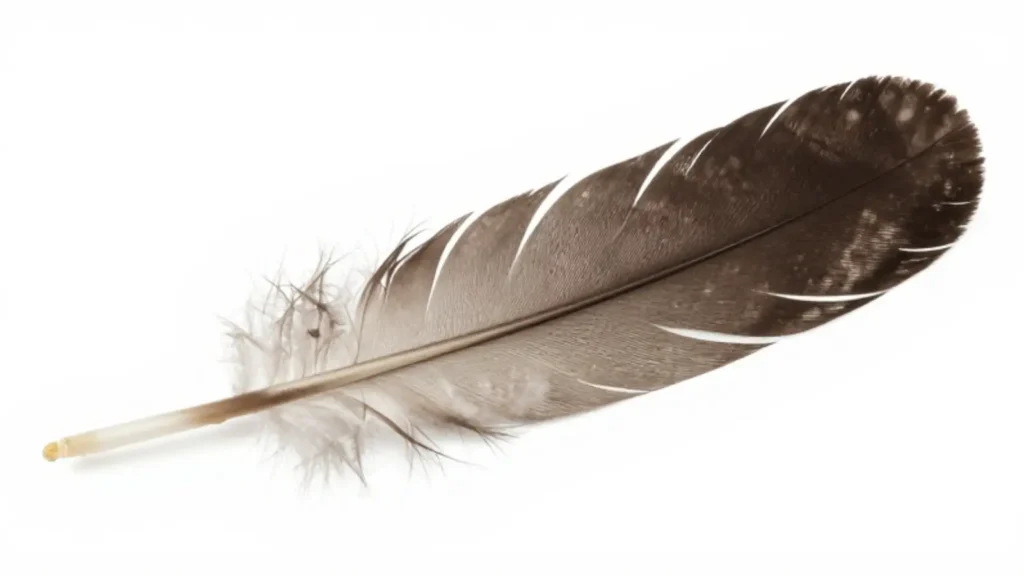
Psychology does not provide one universal dictionary in which “feather = freedom.”
Instead, the psychological meaning of a feather can be understood through association, perception, memory, emotion, and personal symbolism.
A person who associates feathers with a deceased loved one may experience a feather differently from someone who associates feathers with fashion or birds.
This is where personal symbolism becomes powerful.
Why Feathers Feel “Light”
Human perception responds strongly to visual characteristics.
A feather’s:
- delicate structure
- curved silhouette
- soft texture
- aerodynamic form
- association with birds
- ability to move in air
can create visual impressions of softness and movement.
Designers can exploit these associations to make a composition feel graceful rather than heavy.
Feather Symbolism and Personal Meaning
A feather tattoo might symbolize freedom for one person, remembrance for another, spirituality for a third, and creativity for someone else.
The object remains the same.
The semiotic relationship changes.
This is an important principle in cultural symbolism: meaning is created through the relationship between object, context, audience, and cultural knowledge.
Feather Symbolism in Mythology and Folklore
Birds appear extensively in mythology because flight provides an obvious metaphor for crossing boundaries.
Birds can move between:
- earth and sky
- wilderness and civilization
- life and death
- physical and spiritual realms
- human and divine worlds
Feathers consequently become portable traces of that boundary-crossing ability.
The Feathered Serpent and Mesoamerican Traditions
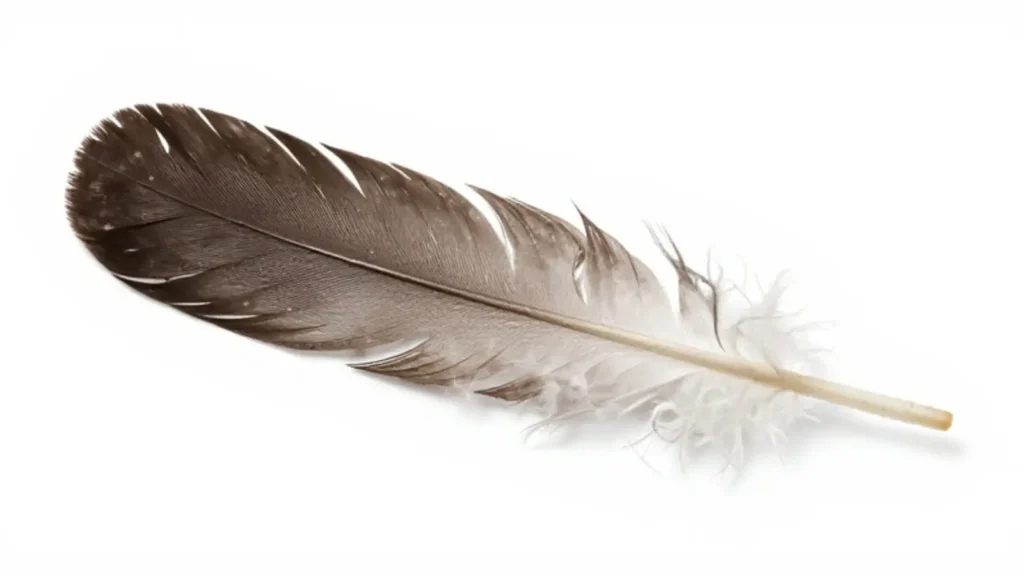
Mesoamerican traditions provide another reminder that “feather symbolism” can be embedded within larger religious systems.
The feathered serpent is an important motif in Mesoamerican history, including traditions associated with Quetzalcoatl and related feathered-serpent imagery.
Here, feathers do not simply mean “freedom.” Their meaning emerges from the combination of bird + serpent + divinity + cosmology.
That is a useful lesson for symbolic interpretation:
Never interpret a symbol in isolation when its original culture treated it as part of a larger symbolic system.
Feather Symbolism in Art and Iconography
Artists have used feathers to communicate both literal and metaphorical ideas.
A feather can suggest:
- movement
- fragility
- elegance
- mortality
- flight
- spiritual elevation
- identity
- ornamentation
- transformation
Because feathers have intricate structures, they are also visually attractive subjects for painting, sculpture, photography, textiles, and jewelry.
In iconography, the species of bird matters.
An eagle feather does not necessarily communicate the same message as a peacock feather, owl feather, dove feather, or ostrich feather.
The Importance of the Bird
| Feather type | Common associations in modern symbolism | Caution |
| Eagle | Strength, vision, honor, authority | Cultural meanings vary |
| Dove | Peace, innocence, reconciliation | Often connected with Christian imagery |
| Owl | Wisdom, mystery, knowledge | Associations derive from broader owl symbolism |
| Peacock | Beauty, display, pride, luxury | Can carry positive or negative meanings |
| Ostrich | Ma’at, ceremony, luxury, ornament | Strong historical Egyptian associations |
| Raven/crow | Mystery, intelligence, death, transformation | Folklore varies widely |
| Swan | Grace, beauty, transformation | Often literary and artistic |
| Goose | Writing and communication | Strong connection to quill pens |
These should be understood as contextual associations, not fixed definitions.
Feather Symbolism in Literature and Writing
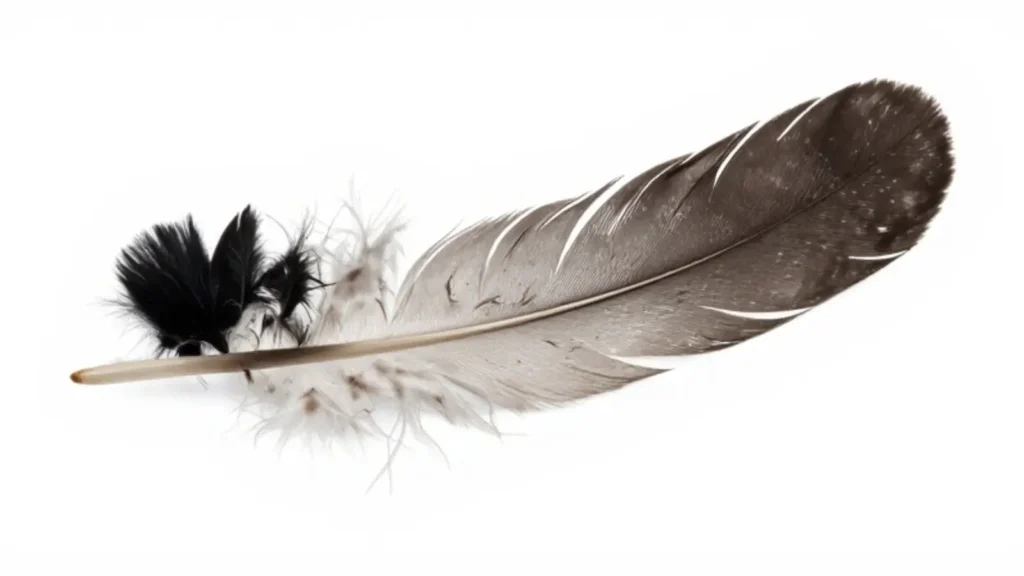
Few objects demonstrate the relationship between physical material and intellectual symbolism better than the feather quill.
Before modern pens became widespread, quills made from bird feathers were important writing instruments. Smithsonian collections document quill pens made from the outer feathers of geese or swans, with the hollow shaft functioning as an ink reservoir.
That practical history transformed the feather into a visual metaphor for:
- writing
- authorship
- knowledge
- storytelling
- scholarship
- poetry
- intellectual expression
- recorded history
This is why a feather beside an ink bottle immediately communicates writing to many modern viewers, even though most people no longer write with quills.
The object survived as a symbol after the technology disappeared.
Feather Symbolism in Heraldry and Status
Feathers have also been used in ceremonial dress, military ornamentation, heraldry, and elite fashion.
Plumes were incorporated into helmets, ceremonial clothing, and heraldic designs. Their upward direction and association with elaborate dress made them visually useful for communicating distinction.
But there is a common misconception worth correcting:
Myth vs. Fact
Myth: Every feather in heraldry has one universally recognized meaning.
Fact: Heraldic imagery is highly contextual. Specific designs, families, traditions, and historical circumstances matter, and a feather does not automatically possess one universal symbolic definition.
This distinction prevents modern symbolic “dictionaries” from being projected backward onto historical objects.
Feather Symbolism in Fashion and Luxury
Feathers have long occupied a complicated position in fashion.
Their visual qualities make them attractive for:
- hats
- costumes
- theatrical clothing
- jewelry
- accessories
- ceremonial garments
- haute couture
But fashion history also demonstrates that symbolism is connected to economics.
Rare or difficult-to-obtain feathers can become markers of wealth and exclusivity.
The history of feather fashion includes both aesthetic innovation and serious conservation concerns. Feather use in fashion contributed to pressure on bird populations, while later conservation movements and legal restrictions changed the industry.
This creates a modern ethical question:
Can something be aesthetically beautiful while its sourcing causes ecological harm?
That question has made provenance, sustainability, antique materials, and responsible sourcing increasingly relevant to contemporary feather-related design.
Color Symbolism and Feather Meaning
Color can substantially alter how a feather is interpreted.
White Feather
Often associated with:
- peace
- innocence
- purity
- remembrance
- spirituality
- angels
But white does not universally mean purity in every culture.
Black Feather
Can suggest:
- mystery
- mourning
- protection
- transformation
- shadow
- the unknown
Blue Feather
Often evokes:
- calm
- sky
- communication
- spirituality
- freedom
Red Feather
May communicate:
- vitality
- courage
- passion
- strength
- sacrifice
Gold Feather
Can suggest:
- prestige
- divinity
- wealth
- illumination
- achievement
The surrounding design determines which interpretation becomes dominant.
A black feather beside a skull communicates something very different from a black feather incorporated into a luxury logo.
Feather Symbolism in Branding and Visual Communication
Feathers are particularly useful in branding because their silhouette is recognizable even when highly simplified.
A feather logo can communicate:
Freedom + elegance + creativity
or
Writing + knowledge + communication
or
Luxury + softness + sophistication
depending on typography, color, composition, and industry.
Practical Applications
A feather motif may work especially well for:
- publishing companies
- writing services
- stationery brands
- wellness businesses
- creative studios
- luxury products
- spiritual-themed businesses
- travel brands
- education platforms
- memorial products
However, designers should avoid choosing a feather simply because it “looks spiritual.”
The strongest branding begins with the intended brand association, then selects the appropriate feather style.
A sharp eagle feather creates a different visual identity from a soft white plume.
Feather Symbolism in Tattoos and Jewelry
Feather tattoos remain popular because the symbol is visually flexible.
A feather can represent:
- independence
- personal growth
- overcoming hardship
- remembrance
- spirituality
- connection with nature
- creativity
- a new chapter
- freedom
Common Mistake
One of the biggest mistakes is assuming a tattoo has a fixed meaning simply because a website says so.
A tattoo is personal communication.
If someone chooses a feather to honor a parent, for example, its meaning is rooted in that person’s biography—not in a universal symbolic rule.
The same principle applies to necklaces, bracelets, artwork, home décor, and gifts.
Feather Symbolism in Dreams
Dream interpretation requires particular caution.
Popular dream dictionaries often assign fixed meanings to feathers, such as “freedom” or “spiritual messages.” These claims should not be treated as scientific conclusions.
A dream containing a feather may be meaningful to the dreamer because of personal memories, current concerns, cultural associations, or emotional context.
A Better Way to Interpret a Feather Dream
Instead of asking only:
“What does a feather mean?”
ask:
- What kind of feather appeared?
- What was happening around it?
- How did you feel?
- Did the feather remind you of someone?
- What does that bird mean to you personally?
- Was the feather damaged, falling, flying, or being held?
- What associations does your culture give it?
This approach respects personal meaning without presenting symbolic interpretation as scientific diagnosis.
Did You Know? Feathers Have a Practical History Too
Feathers were not merely decorative or symbolic.
They served practical functions in human technology.
Quill pens were historically important writing instruments, while feathers were also used in arrow fletching and numerous forms of clothing, craft, and ornamentation. Smithsonian collections document the long practical history of quill writing.
This practical history helps explain why feathers accumulated so many symbolic meanings.
People did not merely look at feathers.
They used them.
When an object participates in everyday life, ritual, art, technology, and status systems, its cultural associations can become unusually rich.
Common Mistakes When Interpreting Feather Symbolism
1. Assuming There Is One Universal Meaning
There isn’t.
“Freedom” is common in modern interpretations, but historical meanings include justice, status, ceremony, writing, identity, spirituality, and authority.
2. Treating All Indigenous Cultures as One
Indigenous nations have distinct histories, languages, beliefs, and ceremonial practices.
3. Confusing Modern Spiritual Belief With Historical Evidence
A contemporary person may believe a feather is a message from a deceased loved one. That can be emotionally meaningful without being a historically established religious doctrine or scientific fact.
4. Ignoring the Bird
A feather without identifying its bird can lose important context.
5. Ignoring the Setting
A feather on a gravestone, a fashion runway, a national emblem, and a wedding invitation can communicate very different things.
Myth vs. Fact: Feather Symbolism
| Myth | Fact |
| Every feather means freedom | Meaning varies by culture and context |
| All Indigenous feather traditions are identical | Different nations have distinct traditions |
| A feather found outdoors is objectively a supernatural sign | That is a spiritual interpretation, not an established scientific fact |
| White feathers universally mean purity | Color meanings vary culturally |
| Feathers are mainly decorative | They have major practical, religious, artistic, and technological histories |
| A feather tattoo has one standard meaning | Tattoo symbolism is highly personal |
| Ancient Egyptians simply saw feathers as symbols of freedom | Ma’at’s feather was strongly associated with truth, justice, balance, and cosmic order |
Why Feather Symbolism Remains Powerful Today
Feather symbolism survives because it operates at several levels simultaneously.
Biological Level
Feathers are associated with birds, flight, protection, and movement.
Psychological Level
Their delicate appearance can evoke feelings of lightness, beauty, freedom, or fragility.
Cultural Level
Religions, communities, artists, governments, and traditions assign specific meanings to particular feathers.
Semiotic Level
A feather becomes a sign whose meaning changes according to surrounding signs.
Commercial Level
Brands use feathers to create associations with elegance, creativity, freedom, or communication.
Personal Level
Individuals attach memories and emotions to feathers through experiences, relationships, and life events.
This layered structure explains why a tiny object can communicate an unusually large idea.
Practical Framework: How to Interpret a Feather Symbol
When analyzing feather symbolism in art, literature, branding, jewelry, tattoos, or cultural artifacts, use this six-step framework:
1. Identify the Bird
What bird does the feather belong to?
2. Identify the Context
Where is the feather being used?
3. Identify the Culture
Which community or historical tradition created the symbol?
4. Examine Color and Form
Is the feather white, black, iridescent, natural, stylized, broken, burning, or floating?
5. Examine Surrounding Symbols
Is it paired with wings, birds, writing tools, religious imagery, weapons, flowers, skulls, or crowns?
6. Separate Tradition From Personal Interpretation
Ask whether the meaning is historically documented, culturally transmitted, modern, or personally assigned.
This method produces far better interpretations than relying on generic symbolism lists.
Key Insights About Feather Symbolism
The most important lesson is that feathers are polysemous—they can carry multiple meanings at the same time.
A feather can be:
- physically functional
- aesthetically beautiful
- culturally important
- religiously meaningful
- politically significant
- personally emotional
- commercially useful
- linguistically metaphorical
Ancient Egyptian Ma’at demonstrates how a feather can become a symbol of moral truth. Māori featherwork demonstrates how feathers can carry prestige, identity, spirituality, and cultural heritage. Indigenous eagle-feather traditions demonstrate why cultural specificity and respectful context matter. Quill pens demonstrate how a physical object can become a metaphor for knowledge and authorship.
Together, these examples show that symbolism is not a static dictionary.
It is a relationship between object, culture, history, audience, and meaning.
Conclusion
Feather symbolism remains powerful because feathers sit at the intersection of nature and human imagination.
Their connection with birds makes them natural symbols of flight and freedom. Their delicate physical structure encourages associations with lightness and beauty.
Their historical use in ceremony, clothing, writing, art, and technology gives them additional layers of cultural meaning.
In ancient Egypt, the feather of Ma’at represented truth, justice, balance, and cosmic order. In Māori traditions, feathers can participate in systems of prestige, spirituality, identity, and cultural memory. Among some Indigenous nations, particular feathers carry sacred and ceremonial significance.
In literature and writing, the feather became inseparable from the quill and therefore from authorship and communication. In contemporary culture, feathers continue to appear in tattoos, jewelry, fashion, branding, memorial art, and spiritual imagery.
The most responsible interpretation is therefore not simply “a feather means freedom.”
A better conclusion is:
A feather symbolizes whatever its physical qualities, cultural history, visual context, and human relationships have taught a particular community or individual to see in it.
That flexibility is precisely what makes the feather such a durable symbol.

Nathaniel Brooks analyzes symbols, their origins, cultural importance, and psychological impact across history and modern society.
