Few gemstones have carried as much cultural meaning across thousands of years as jade. Jade symbolism is closely associated with qualities such as purity, integrity, protection, prosperity, longevity, harmony, status, life, and spiritual significance but its meaning is not universal.
Different societies have interpreted jade through their own histories, environments, religious ideas, artistic traditions, and social systems.
That distinction matters. Jade is not simply a “lucky stone” or a decorative green gemstone. In ancient China, jade became deeply connected with moral character, ritual, social status, and ideals of refinement.
In ancient Mesoamerica, green jadeite was associated with water, agricultural fertility, new growth, royal power, and life. Among Māori communities in Aotearoa New Zealand, pounamu often called New Zealand jade or greenstone has connections with status, authority, ancestry, sacredness, craftsmanship, and peacemaking.
Understanding jade symbolism therefore means looking beyond color. The stone’s hardness, durability, translucency, coolness, polish, rarity, and difficulty of working all contributed to the meanings people attached to it.
Featured-Snippet Answer: What Does Jade Symbolize?
Jade commonly symbolizes purity, integrity, protection, prosperity, longevity, harmony, wisdom, and renewal. Its meaning varies by culture: Chinese traditions strongly associate jade with virtue and moral refinement, while ancient Mesoamerican cultures connected green jadeite with water, fertility, life, and rulership. Māori pounamu carries meanings involving authority, ancestry, sacredness, and peace.
What Does Jade Symbolism Mean?

At its broadest level, jade symbolism represents the human tendency to transform physical qualities into cultural ideas.
Jade is exceptionally durable. It can survive for centuries with relatively little visible deterioration. That physical endurance naturally lends itself to concepts such as longevity, permanence, resilience, and continuity.
Its polished surface has a distinctive luster. Its green varieties resemble vegetation, water, leaves, and new growth. Its tactile qualities make it pleasant to hold, while its toughness made it suitable for tools, weapons, ornaments, ritual objects, and sculptures.
These characteristics created a powerful symbolic vocabulary.
| Physical quality of jade | Common symbolic association |
| Hardness | Strength, resilience, integrity |
| Durability | Longevity, permanence, continuity |
| Green color | Life, renewal, nature, fertility |
| Luster | Purity, refinement, beauty |
| Rarity | Prestige, wealth, status |
| Difficulty of carving | Patience, mastery, craftsmanship |
| Cool-to-warm tactile quality | Vitality and living presence |
| Ability to be polished | Transformation and refinement |
However, these are broad interpretive patterns rather than universal rules. Jade symbolism must always be interpreted in cultural context.
The Historical Origins of Jade Symbolism
Jade in Ancient China
China has perhaps the most famous and enduring jade tradition in the world.
Jade was being worked in Neolithic China thousands of years ago. During cultures such as Liangzhu, jade objects were produced with extraordinary technical precision despite the difficulty of working such a hard material. Archaeological evidence shows jade objects appearing as ornaments, ritual objects, burial goods, and symbols of social importance.
The importance of jade extended beyond aesthetics.
Chinese thinkers and artisans increasingly connected the stone’s physical characteristics with human virtues. The Metropolitan Museum of Art notes associations between jade’s gentle color and benevolence, its soft luster and humility, and its hardness and integrity.
This created one of the most influential forms of moral symbolism associated with a gemstone.
Jade could therefore represent the ideal person: outwardly refined but internally strong, valuable without being ostentatious, and capable of maintaining integrity under pressure.
Jade and Ritual Objects
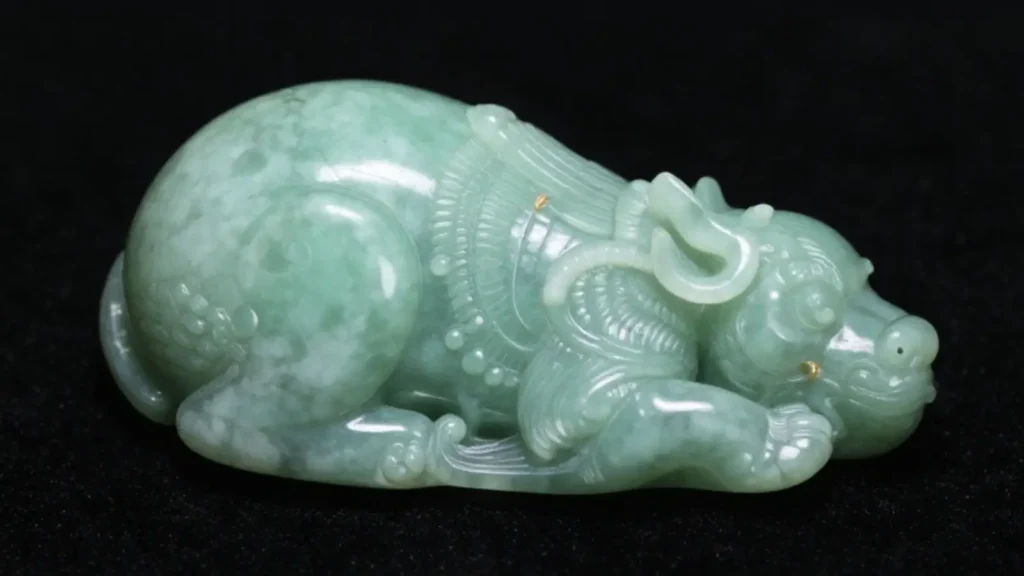
One important ancient form was the bi, a circular jade disk with a central opening.
Liangzhu and other Neolithic jade objects appear in burial contexts, and scholars have interpreted some of these objects as having ritual, social, and possibly cosmological functions. The Met records examples in which jade bi disks were buried with people of high status.
This demonstrates that jade symbolism was never limited to jewelry. It could participate in ideas about death, ritual authority, social rank, and the relationship between humans and the cosmos.
Jade Symbolism in Chinese Philosophy and Moral Thought
One of the most distinctive aspects of Chinese jade symbolism is its connection with virtue.
Rather than simply representing material wealth, jade could serve as a metaphor for character.
The comparison works because jade combines apparently opposing qualities:
- It is hard but visually gentle.
- It is valuable but naturally understated.
- It can be polished into extraordinary beauty without losing its strength.
- It requires patience and discipline to shape.
- Its durability suggests constancy.
This made jade an especially effective metaphor for ethical refinement.
A person could metaphorically be “like jade” because they possessed qualities such as integrity, restraint, dignity, benevolence, or cultivated character.
Expert Tip
When explaining Chinese jade symbolism, avoid reducing it to “jade means good luck.” That is too simplistic.
A more accurate interpretation is that jade became part of a much broader cultural vocabulary involving virtue, ritual, status, beauty, refinement, moral character, and continuity.
Jade Symbolism in Mesoamerica
Jade developed a very different but equally sophisticated symbolic language in ancient Mesoamerica.
The word “jade” in Mesoamerican contexts commonly refers specifically to jadeite, although ancient cultures also worked with other greenstones. A major source of jadeite was the Motagua River Valley in present-day Guatemala. Its restricted availability contributed to its exceptional value.
Among the Olmec and later Maya, greenstone and jadeite were closely connected with water, vegetation, agricultural fertility, new growth, royal authority, and life.
The color itself mattered.
Green could evoke:
- Rain
- Water
- Maize
- Young plants
- Fertility
- Renewal
- Agricultural abundance
- Living breath
The Metropolitan Museum of Art describes ancient Maya jade symbolism as involving new growth, water, primordial places, living breath, longevity, and elite status.
Jade and the Maya Concept of Life
The Maya relationship with jade was particularly complex.
Because polished jade could resemble water and because the stone retained its physical integrity over immense periods, it could become associated with permanence and life.
Some high-ranking Maya burials included jade beads placed in the mouth of the deceased. Museum scholarship interprets this practice in relation to ideas of animate breath and eternal life.
This gives jade symbolism a fascinating dual dimension:
Jade could represent both life and the continuation of existence beyond death.
It was therefore not merely an ornament. It could become part of a broader visual language concerning transformation, ancestry, kingship, fertility, and the afterlife.
Jade, Kingship, and Political Power
Jade’s rarity also transformed it into a language of authority.
Ancient Maya rulers wore elaborate jade regalia, and jade objects could incorporate images of deities, mythological beings, rulers, and hieroglyphic elements. These objects communicated status while simultaneously connecting political authority with sacred narratives.
This is an important lesson in visual communication:
A precious material can communicate power before its imagery is even understood.
The viewer sees rarity, craftsmanship, color, and scale. Those physical qualities establish prestige. Symbolic imagery then adds another layer of meaning.
Jade therefore functioned simultaneously as:
- Jewelry
- Political communication
- Religious imagery
- Elite identity
- Ritual material
- Economic wealth
- Ancestral inheritance
Māori Pounamu and Jade Symbolism in New Zealand
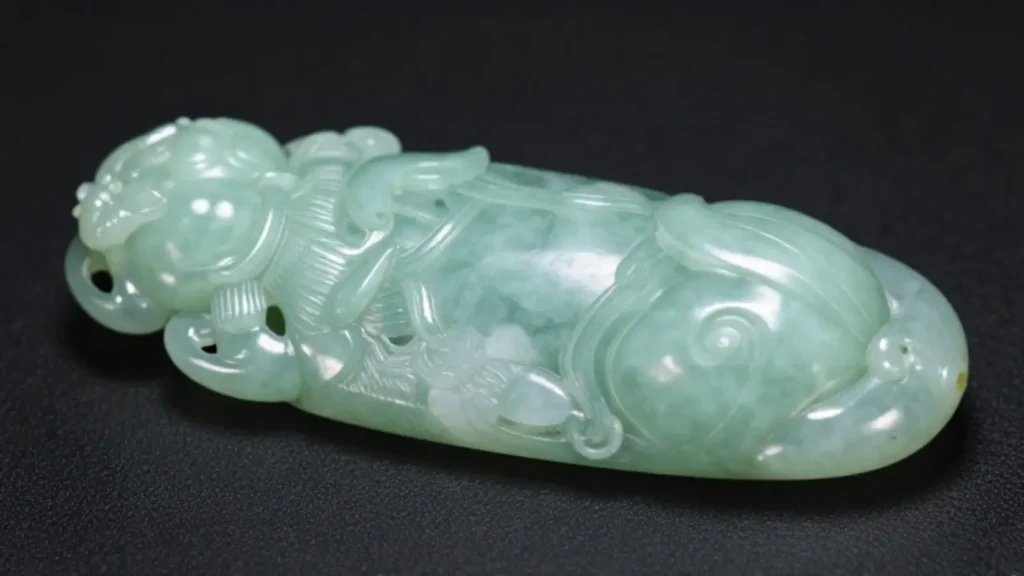
Another major jade tradition is found in Aotearoa New Zealand.
Pounamu, traditionally associated with Māori culture, is commonly called greenstone or New Zealand jade. Most pounamu is nephrite, although bowenite is also included within the broader category of pounamu. It occurs naturally in the South Island and has a particularly important relationship with Ngāi Tahu.
Pounamu carries meanings that include:
- Mana
- Status
- Authority
- Ancestral connection
- Sacredness
- Strength
- Peace
- Identity
- Continuity
Te Ara, the Encyclopedia of New Zealand, explains that pounamu was valued for its strength, beauty, status, authority, and spiritual significance.
Pounamu as a Symbol of Authority
Certain pounamu weapons and heirlooms were associated with chiefs and chiefly families.
The mere pounamu, for example, became a major symbol of chieftainship. These objects were not simply functional weapons; they could carry histories, names, ancestral associations, and social authority.
That makes pounamu an excellent example of how an object can become a cultural memory device.
The stone physically survives, while stories and genealogical relationships become attached to it.
Jade as a Symbol of Peace
Jade symbolism also has an important connection with peacemaking in Māori tradition.
Pounamu objects could be exchanged as symbols of peace agreements. Te Ara describes the concept of a tatau pounamu, or “greenstone door,” in which pounamu’s durability represented the enduring nature of peace.
This is particularly revealing from a semiotic perspective.
The meaning comes from the physical quality of the material:
Durable stone → enduring agreement → lasting peace.
The physical object becomes a metaphor for a social relationship.
Psychological Meaning of Jade
From a modern psychological perspective, jade should not be presented as having scientifically proven supernatural effects.
There is, however, a meaningful distinction between psychological association and scientific causation.
People can associate jade with calmness, nature, balance, protection, prosperity, or emotional stability because of cultural learning, personal experience, color perception, symbolism, and repeated exposure.
Green and Human Perception
Green commonly evokes natural environments because vegetation is such a familiar part of human visual experience.
That can make green jade feel:
- Natural
- Fresh
- Calm
- Organic
- Balanced
- Renewing
But the psychological interpretation of green is influenced by context and culture. It should not be presented as a universal emotional response.
Important Distinction
There is a major difference between saying:
“Jade symbolizes protection in certain traditions.”
and:
“Jade scientifically protects the person wearing it.”
The first is a cultural-symbolic claim.
The second is a scientific claim requiring evidence.
Keeping those categories separate is essential for responsible EEAT content.
Spiritual Meaning of Jade
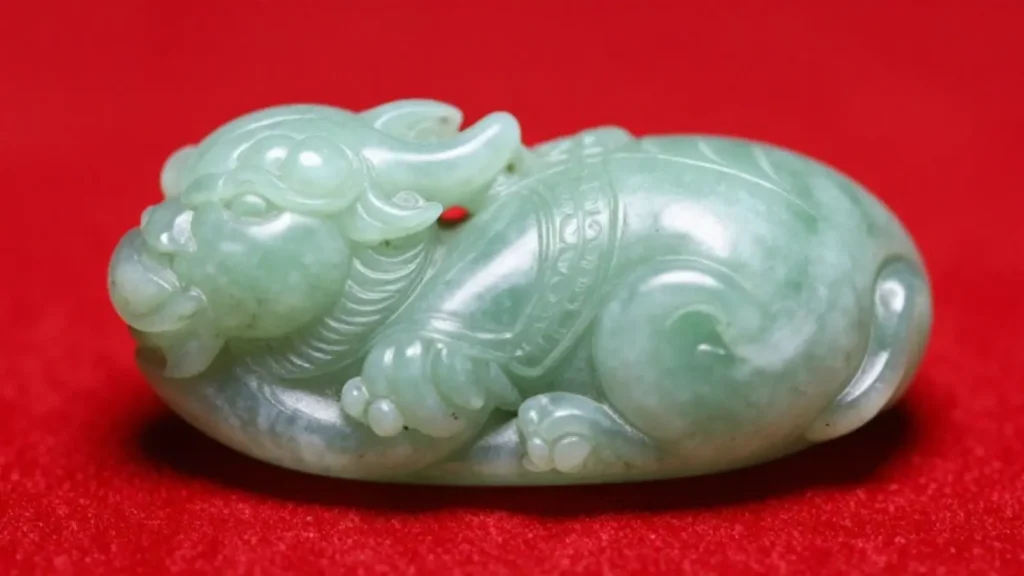
In spiritual and metaphysical traditions, jade is often associated with:
- Protection
- Harmony
- Abundance
- Emotional balance
- Spiritual growth
- Renewal
- Inner wisdom
- Longevity
- Positive energy
These interpretations are widely encountered in contemporary crystal and gemstone culture.
However, such beliefs should be described as spiritual or traditional interpretations, not established scientific facts.
Jade’s long historical association with ritual objects, burial practices, sacred adornment, and religious art gives these modern interpretations a deep cultural background, but that does not scientifically establish supernatural properties.
Jade and Religious Symbolism
Jade has appeared in religious and ritual contexts rather than belonging exclusively to one universal religion.
In ancient China, jade objects could function within ritual systems and burial practices. In Mesoamerica, jadeite and greenstone were incorporated into offerings, royal regalia, funerary contexts, and imagery associated with deities and cosmology.
Jade was also incorporated into later Chinese religious and courtly contexts.
For example, an eighteenth-century Qing jade book in the Metropolitan Museum’s collection is associated with an imperial text commemorating the completion of a pagoda and reflects the Qing court’s relationship with Tibetan Buddhism.
The key point is that jade symbolism changes when the religious and historical environment changes.
Jade in Art, Sculpture, and Iconography
Jade is exceptionally important in the history of decorative art because it rewards slow craftsmanship.
Its hardness makes carving difficult. Ancient artisans often had to use grinding, sawing, drilling, abrasion, and polishing rather than simply cutting the material like softer stone.
This technical difficulty adds another symbolic layer:
Rare material + difficult craftsmanship + skilled maker = extraordinary cultural value.
Jade objects can therefore symbolize both the natural world and human mastery over materials.
Artistic Symbolism
Artists have used jade to represent:
- Animals
- Deities
- Human figures
- Mythological beings
- Royal identities
- Plants
- Ritual objects
- Cosmological forms
- Abstract geometric designs
The meaning comes not only from the material but also from shape, color, imagery, placement, wearer, and context.
Jade Symbolism in Literature and Storytelling
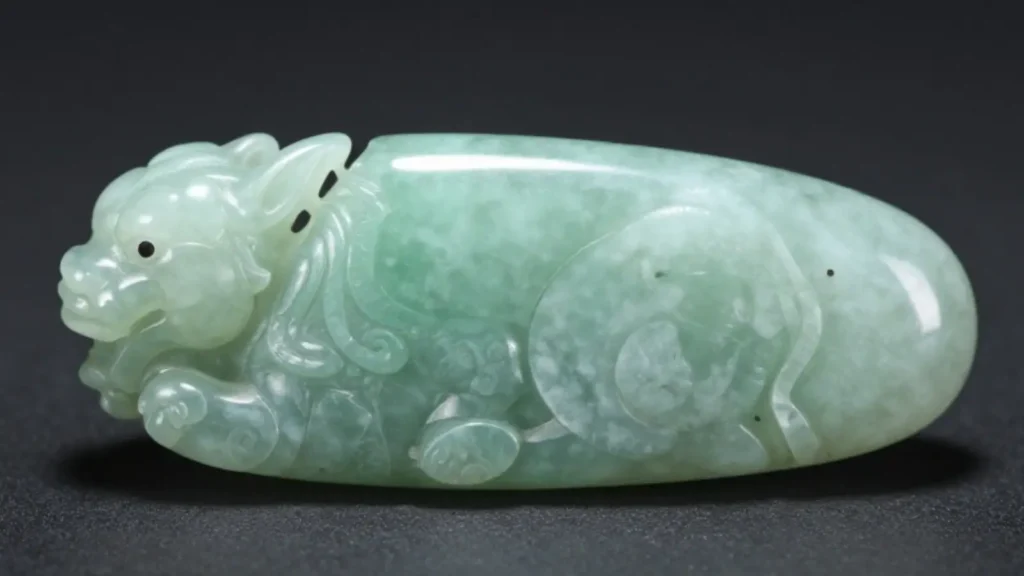
In literature, jade frequently functions as a metaphor for beauty, virtue, refinement, rarity, or preciousness.
This is particularly strong in Chinese cultural traditions, where jade’s association with moral qualities allowed writers to compare human character with the physical properties of the stone.
Literary symbolism often works through metaphor:
jade = refined character
jade = precious beauty
jade = purity
jade = endurance
jade = something worthy of preservation
In contemporary storytelling, jade can also communicate ancestry, inherited identity, wealth, spirituality, cultural heritage, or a connection with the past.
Jade Symbolism in Branding and Design
Modern brands frequently use gemstones and natural materials to communicate intangible qualities.
Jade-inspired design can suggest:
- Luxury
- Heritage
- Natural elegance
- Wellness
- Exclusivity
- Calmness
- Sophistication
- Cultural authenticity
- Sustainability
- Timelessness
The color jade green can be especially effective when paired with restrained typography and natural textures.
Practical Applications
Jade symbolism can be used thoughtfully in:
- Jewelry branding
- Interior design
- Packaging
- Wellness branding
- Cultural exhibitions
- Museum interpretation
- Fashion
- Editorial design
- Luxury products
- Digital interfaces
- Educational materials
But cultural context matters.
A brand using Māori pounamu imagery, for example, should not automatically treat it as generic “green gemstone symbolism.” Pounamu has specific cultural relationships, including connections to Ngāi Tahu ownership and cultural heritage.
Jade Symbolism in Consumer Behavior
Consumers do not interpret products purely through function.
Material, color, history, craftsmanship, and cultural associations can all influence perceived meaning.
A jade object may communicate “precious” before someone knows its price.
It may communicate “traditional” because of its historical associations.
It may communicate “natural” because of its green color.
It may communicate “lasting” because of its physical durability.
This is a classic example of semiotic value: an object carries meaning beyond its practical function.
Common Jade Symbolism Across Cultures
| Symbolic theme | China | Mesoamerica | Māori pounamu |
| Strength | Strong association | Material and elite value | Strong association |
| Longevity | Important | Strongly associated with enduring jade | Connected with enduring heirlooms |
| Life | Present through moral/cultural symbolism | Strong association with growth and breath | Connected with vitality and cultural continuity |
| Status | Major historical role | Strong royal association | Strong chiefly association |
| Spirituality | Ritual and philosophical contexts | Ritual and cosmological contexts | Sacred/tapu relationships |
| Peace | Not its defining global association | Not its primary association | Explicit peacemaking symbolism |
| Ancestry | Strong through heirlooms and history | Important in elite/funerary contexts | Particularly important through whakapapa |
| Nature | Green jade and material qualities | Water, maize, vegetation | Relationship with land and pounamu resources |
The table illustrates why a single dictionary-style definition of “jade symbolism” is inadequate.
Myth vs. Fact: Jade Symbolism
Myth: Jade has one universal meaning.
Fact: Jade symbolism varies significantly across cultures and historical periods.
Myth: All jade is green.
Fact: Jade can occur in multiple colors. Chinese traditions, for example, have historically placed very high value on white jade, while Mesoamerican cultures often prized bright green and blue-green jadeite.
Myth: Jade always means luck.
Fact: Luck and prosperity are common modern associations, but historical meanings include virtue, ritual authority, fertility, life, status, ancestry, peace, and longevity.
Myth: Jade is one single mineral.
Fact: Gemological “jade” refers principally to two distinct materials: nephrite and jadeite. Pounamu traditions also include bowenite, which is not technically jade.
Myth: Spiritual claims about jade are scientific facts.
Fact: Spiritual meanings belong to systems of belief and cultural interpretation. They should not automatically be presented as scientifically established effects.
Common Mistakes When Interpreting Jade Symbolism
1. Treating every culture as identical
Chinese jade symbolism should not simply be transferred to Maya or Māori traditions.
2. Confusing jade with green gemstones generally
Color alone does not determine mineral identity or cultural meaning.
3. Ignoring material properties
Jade’s hardness, durability, luster, and workability helped shape its symbolic importance.
4. Reducing jade to “good luck”
This overlooks thousands of years of complex cultural meanings.
5. Making supernatural claims as scientific claims
Spiritual symbolism and scientific evidence belong to different categories.
6. Ignoring cultural ownership
Contemporary pounamu has specific Māori cultural and legal contexts that should be respected rather than flattened into generic gemstone marketing.
Did You Know?
Jade can be harder to work than its polished appearance suggests. Ancient artisans often relied on abrasion, grinding, sawing, and drilling to create jade objects. In Neolithic China, the technical effort required to produce highly polished jade forms was considerable.
Chinese jade is not synonymous with green jade. White jade has historically held exceptional prestige in China, demonstrating that jade symbolism cannot be explained through green color alone.
Maya jade was extraordinarily difficult to obtain and work. Much of the jadeite used in ancient Mesoamerica came from the Motagua River Valley, making the material an important component of long-distance exchange networks.
Pounamu is deeply connected with New Zealand’s South Island. Its restricted natural distribution contributed to its distinctive cultural importance, particularly for Ngāi Tahu.
Expert Insight: Why Jade Became Such a Powerful Symbol
The deepest explanation for jade symbolism is not simply “green means life.”
It is the interaction of material, environment, craftsmanship, scarcity, social power, and storytelling.
Jade is physically impressive.
Humans noticed that.
It was difficult to obtain.
That created rarity.
It was difficult to shape.
That elevated craftsmanship.
It survived for generations.
That encouraged associations with continuity.
It could be polished beautifully.
That made it ideal for prestige objects.
Its colors could resemble water, vegetation, or natural landscapes.
That encouraged associations with life and renewal.
Then societies embedded those physical characteristics into myths, rituals, political systems, family histories, and artistic traditions.
That is how a stone becomes a symbol.
The Philosophical Meaning of Jade
Jade symbolism ultimately raises a philosophical question:
Why do humans turn physical objects into representations of moral and spiritual ideals?
The answer lies partly in metaphor.
We understand abstract ideas through tangible experiences.
Strength is difficult to see, but stone is visibly hard.
Permanence is abstract, but an ancient object that survives centuries feels permanent.
Purity is conceptual, but polished translucent material provides a visual metaphor.
Character is invisible, but jade’s combination of softness in appearance and hardness in substance can represent an ideal personality.
This is why jade remains so powerful in visual storytelling.
It transforms invisible concepts into visible objects.
Modern Meaning of Jade Symbolism
Today, jade may represent very different things depending on who is using it.
For one person, it may symbolize:
- Family heritage
- Cultural identity
- Prosperity
- Protection
- Spiritual practice
- Personal resilience
- Beauty
- Nature
- A meaningful gift
- An inherited tradition
For another person, it may simply be a beautiful gemstone.
Neither interpretation has to be identical.
Symbolism is relational. Meaning emerges from the interaction between object, culture, context, memory, and observer.
This is why the same jade pendant can function as jewelry, a cultural artifact, a family heirloom, a spiritual object, or a fashion accessory.
Key Insights About Jade Symbolism
- Jade symbolizes different things in different cultures.
- Chinese traditions strongly connect jade with virtue, refinement, ritual, and integrity.
- Ancient Mesoamerican cultures associated jadeite and greenstone with life, water, fertility, new growth, royalty, and permanence.
- Māori pounamu carries meanings involving status, authority, sacredness, ancestry, and peacemaking.
- Jade’s physical durability helped create symbolic associations with longevity and permanence.
- Color is important, but jade symbolism cannot be reduced to the color green.
- Jade has served practical, artistic, political, ritual, and funerary purposes.
- Modern spiritual meanings should be distinguished from scientifically established effects.
- Jade remains powerful in branding because it can communicate heritage, luxury, nature, and permanence.
- The cultural context surrounding jade is as important as the gemstone itself.
Conclusion: The Enduring Power of Jade Symbolism
Jade symbolism is powerful because it developed through the meeting of nature and human imagination.
Across different societies, people recognized jade’s unusual hardness, beauty, rarity, and endurance. They transformed those physical characteristics into ideas about virtue, life, fertility, protection, authority, ancestry, peace, longevity, and spiritual meaning.
In China, jade became deeply associated with moral refinement and integrity. In ancient Mesoamerica, green jadeite became intertwined with water, agricultural fertility, living breath, royal identity, and the continuation of life. In Māori culture, pounamu carries relationships with mana, sacredness, ancestry, authority, identity, and peace.
The enduring lesson is that jade does not have one symbolic meaning.
Its symbolism is a cultural language.
Understanding that language helps explain not only gemstone traditions but also broader human practices involving art, religion, ritual, branding, architecture, literature, identity, and visual communication.
Jade remains meaningful today precisely because it can connect something physical and enduring—a stone—with things humans have always considered difficult to hold: memory, character, belonging, beauty, continuity, and hope

Lucas Whitmore reveals the hidden messages behind symbols, signs, and traditions through detailed symbolism guides.
